Published May 12, 2023 07:34AM
Bridgerton's Queen Charlotte Is Venus—And We Can't Stop Thinking About It
We see goddess behavior everywhere.
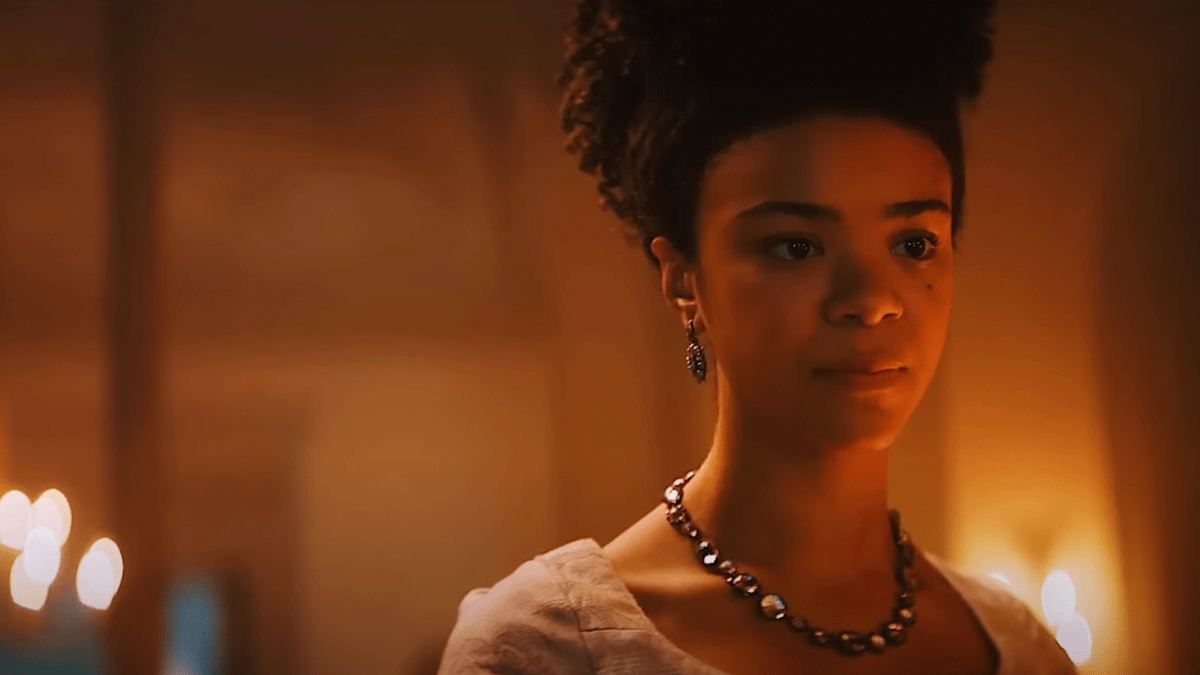
(Photo: Netflix)
Dearest Gentle Reader: The following article divulges moments, scenarios, and happenings from Queen Charlotte: A Bridgerton Story. Consider yourself forewarned.
It’s obvious from the introductory comments of the long-awaited Queen Charlotte: A Bridgerton Story, prequel to the immensely popular Netflix series, that it intends to challenge the societal norms of 18th-century London. Racial discrimination, silenced same-sex romance, and the absurd notion of femininity equating to frailty are each addressed in laudable Bridgerton fashion. Yet with the latest release, it seems the writers also set out to instruct readers on aspects of the feminine archetype of Venus.
The planet has been correlated with goddess behavior by ancient cultures the world over. The Phoenicians knew her as Astrate. The Egyptians referred to her as Isis as well as Aset. Hindu astrology knew her as Sukra. Greek mythology deemed her Aphrodite. And in Roman times, she was known as Venus.
ADVERTISEMENT
Although the titles and attributes might vary, the goddesses were similarly revered for strength, intelligence, grace, passion, creativity, sexuality, art, healing, magic, and, at times, tempestuousness. More than anything, though, each culture’s goddess related to this planet was regarded as “the summit of beauty and love.” A cultural icon, albeit a slightly misunderstood one. And Venus was her name.
Or is it Charlotte?
How Queen Charlotte Exemplifies Venus
The mention of Venus isn’t introduced until late in the first episode, yet the goddess-like attributes of Charlotte are evident from the outset. After British royalty arrange for Charlotte to be a bride for their king sight unseen, her brother attempts to calm her fury by comparing her to art. Draped in stylish lyonnaise silk, 200-year lace, and sapphires, Charlotte remains motionless as she launches into a scathing rebuttal to his pandering comment. Goddess behavior.
After Charlotte attempts to elude the arranged marriage by climbing a brick wall in wedding finery and later acquiesces to the wedding, she casts aside the boring, girlish gown insisted on by the king’s mother for a design she commissioned from a modiste in Paris. Also goddess behavior.
ADVERTISEMENT
Yet the truly queenly attributes of Venus not only relate to how Charlotte carries herself outwardly, but with what she concerns herself inwardly. She is enamored by theater, reading, art, music, and fashion. She is empathetic toward the poor and orphaned. She is true to herself. She is considerate. She is compassionate. She is kind. Goddess. Goddess. Goddess.
Curiously, these self-aware and thoughtful traits are attributed to Taurus, the astrological sign ruled by the planet Venus. As it happens, Queen Charlotte, who was born on May 19, 1744, was a Taurus. And it is perhaps not coincidence that the series focusing on the queen’s lessons from her past was released during Taurus season. Coincidence or fated?
How Venus Plays Out in Charlotte’s Love Story
Those obsessed with Bridgerton are no strangers to showrunner Shonda Rhimes’ penchant for complicated love stories. The romance between Charlotte and King George III, as conveyed through the lens of Netflix, is challenged by an arranged marriage, cross-cultural misunderstandings, a devious mother-in-law, the weightiness of royalty, the impetuousness of youth, and the king’s mercurial temperament and fluctuating grasp on reality which were not fully understood at the time.
Beneath the weight of these impediments, the metaphor of Charlotte and Venus becomes exquisitely apparent. Love is not being silently tolerant nor ascribing to the feminine stereotype of submission and subservience. Venus teaches us that love is intense, compassionate, and unyielding. It requires fierce strength in some moments and receptivity in others.
ADVERTISEMENT
Think back to when the king remains distant from Charlotte following their wedding. Charlotte is only somewhat mollified to eventually learn that he has been hiding in his observatory and charting the planet’s trajectory. “You prefer stars to my company,” she asserts. In a way, yes. He was actually fixated on the transit of Venus in 1796, a rare crossing of the planet across the surface of the Sun that was essential for astronomical calculations of the Earth to Sun.
As the Bridgerton king explains the exquisite aspects of the transit to his queen, she deigns to look at Venus through the telescope, murmuring, “It is beautiful.”
“It is,” replies George, staring at her.
ADVERTISEMENT
It is, quite simply, a story of two different souls struggling to meet one another, one that’s almost as old as the stars and planets themselves. Love is not perfect. But it is patient and it is kind. It is also sometimes insecure, confused, and furious. That is the fullest expression of the goddess Venus. And that is the significance of Charlotte’s queenly embodiment of Venus, demonstrated again and again as the king’s mental health sways. It is seen in her ability to take in the fact that he is most himself when he is engaging with the things he most loves. It is found in her continually caring not for his sanity but for his happiness. And it is her lovingly reminding him when he is lost between the heavens and the earth, in so many words, that he is just George and that she is Venus.
In her later years, Queen Charlotte explains, “You love and you love hard, because if you do not, you are lost.” That is the essential message of Venus. It’s unknown whether that was intended as subtext for her majesty as an astrological archetype. Although this reader can’t help but think that it was, indeed.
