Published April 25, 2025 06:06AM
TikTok is Turning to This Ancient Flower to Ease Anxiety and Heighten Consciousness
Thousands of years later, Egyptian blue lotus is trending again.
(Photo: Freepik)
In recent years, the Egyptian blue lotus flower has been showing up in conscious communities as well as TikTok, farmers’ markets, even skincare products. Users are claiming all sorts of benefits, including enhanced mood, even skin tone, sounder sleep, increased amorousness, lucid dreaming, even straight-up psychoactive effects.
There’s nothing new about these purported benefits of the mystical plant, which has been revered by cultures dating back millennia for its medicinal, spiritual, and psychoactive properties. They’re simply newly appreciated.
The mystical plant hails from Northern Africa as well as India, Sri Lanka, and Thailand. It has been depicted as a symbol of divinity and spiritual awakening in artwork and hieroglyphics dating back to the 14th century B.C. In these artifacts, ancient Egyptians are seen harnessing its powers during skincare rituals as well as spiritual ceremonies. Its petals open at first light, with the bloom turning to follow the arc of the sun throughout the day before closing at sundown, making it easy to understand why the flower was associated with the sun god Ra.
ADVERTISEMENT
Also known as Nymphaea Caerulea, Egyptian blue lotus is technically classified as a daylily rather than a lotus, although both categories of plants thrive in similarly sodden conditions. The petals’ fragrance has been described as an enchanting blend of floral, fruity, and earthy—imagine the sweetness of honey and cherries with the lilt of lilac and green florals.
Egyptian Blue Lotus Flower Effects
Ancient Egyptians believed the blue lotus could induce states of heightened consciousness and spiritual awareness. It was also regarded as a potent aphrodisiac and harnessed to promote mental clarity and a sense of calm. They communed with it by brewing the flowers into tea and fermenting them into wine to sip before religious ceremonies. It was also valued for its medicinal properties to support a variety of ailments—among them anxiety, insomnia, and gastrointestinal issues—and was also infused into tinctures and salves.
The dried flower was similarly relied on in Ayurvedic medicine, a science that dates back 5,000 years in India, to calm the mind and promote a restful night’s sleep. It was believed to balance the vata and pitta doshas, which are two of the three fundamental energies that govern the human body. The vata dosha is associated with movement, creativity, and a tendency toward anxiety and restlessness. The pitta dosha, on the other hand, is associated with digestion and a tendency toward anger and irritability. By balancing these energies, blue lotus is believed to induce a state of harmony and calm.
In addition to its calmative properties, blue lotus is harnessed in Ayurveda for its anti-inflammatory properties, which are sometimes used with conditions such as arthritis and joint pain. It’s also used to support healthy digestion and to treat bloating, gas, and constipation via teas, tinctures, and capsules.
Contemporary research suggests that two of the flower’s numerous active compounds, apomorphine and nuciferine, promote relaxation. Although research suggests it might hold potential with some mental health disorders, including depression, schizophrenia, and insomnia. No clinical trials have been done to date.
Although not approved by the FDA for human consumption, Egyptian blue lotus is legal in all states except Louisiana. If you have an existing medical condition or are taking medication, consult with your physician before taking blue lotus.
ADVERTISEMENT
How to Commune With Egyptian Blue Lotus
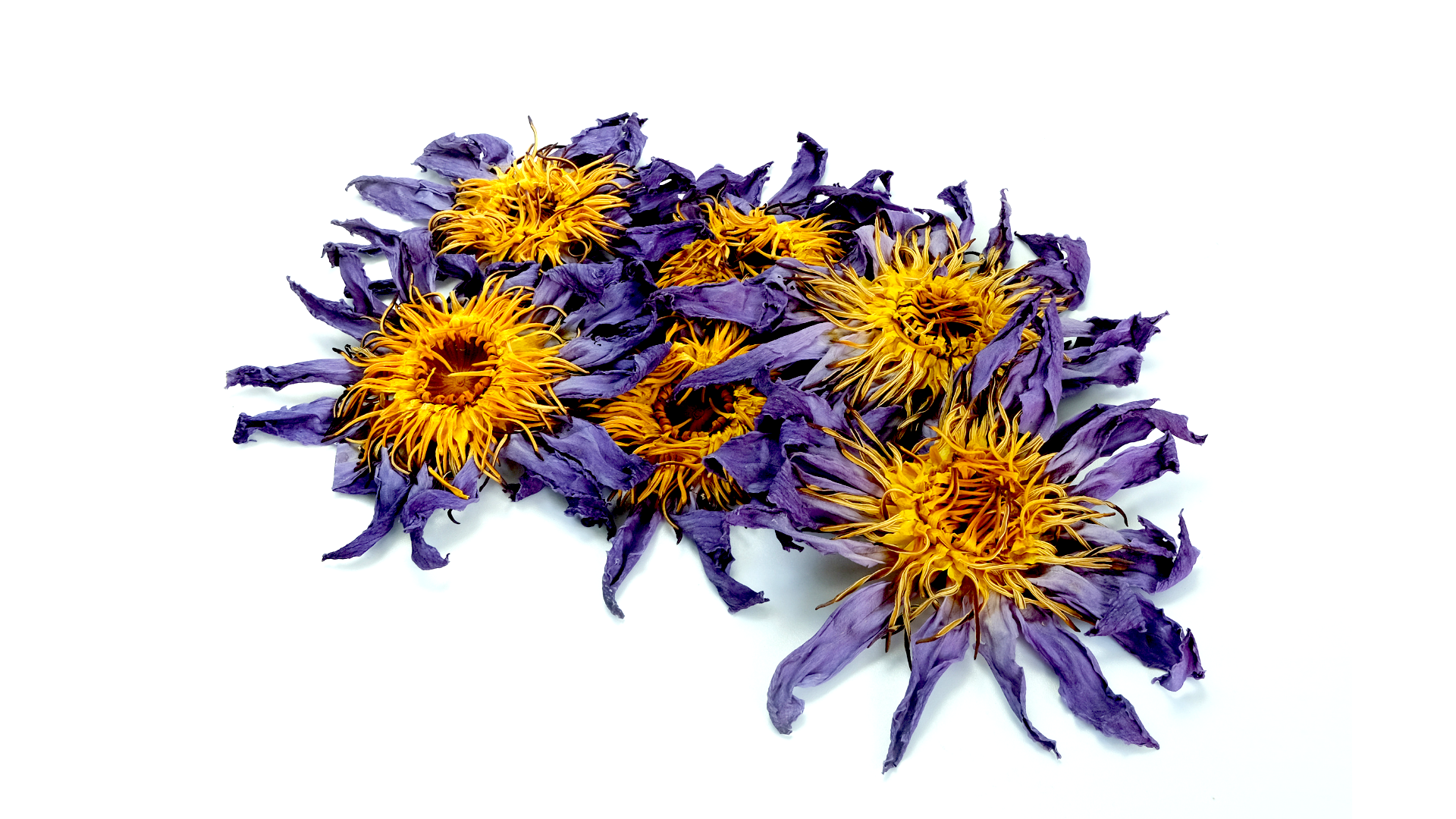
This is where ancient plant wisdom meets contemporary awareness. There are several ways to commune with Egyptian blue lotus in a therapeutic way. Although the dried flower is commonly used in teas, baths, ceremonial cacao, tinctures, perfumes, even being rolled with cannabis, it’s important to remember that plants are not simply ingredients—they’re living beings with their own intelligence. Traditional medicine systems and emerging science alike recognize plants as responsive, relational, and attuned to energy.
However you choose to work with blue lotus, approach it as you would a trusted elder or dear friend—with reverence, presence, and deep respect. Following are two ways the curious can work with the plant in integrity.
Egyptian Blue Lotus Bath
If you don’t have a bathtub or a place to soak, you can still practice this ritual by slowly pouring the plant infusion over your body in the shower, beginning at the crown of your head and letting it flow down your entire body.
ADVERTISEMENT
You’ll also want a large glass vessel, room-temperature spring or filtered water, and a quiet moment in the light.
Adjust to what’s accessible and resonant.
- Handful of Egyptian Blue Lotus petals or full flowers (vision, sensuality, soft awakening)
- Handful of Rose petals (tenderness, remembrance, the holy heart)
- Small handful of Chamomile (calm, innocence, restoration)
- Small handful of Butterfly Pea flowers (blue hue, dream realm, upper chakra opening)
- Optional: Linden (for grief-tending + quiet love)
- Optional: Calendula (for light, solar warmth, and protection)
- Optional: Holy Basil (Tulsi) (cleansing, attuning, devotion)
- Optional: 1 clear or rose quartz crystal (cleansed)
- Begin with Devotion:
Place your botanicals out as if setting an altar. Place your hands over them and offer this (or your own) prayer:
Thank you, plant ones, for your presence.
I place you in this water with care.
May your spirit move through me —
clearing, softening, remembering.
I enter this bath in gratitude.
- Steep in Sunlight
Place the herbs in a clear vessel and pour room-temperature water over them. Slowly stir the herbs clockwise with your hand, whispering your intention into the water. Cover the jar loosely and place it in the sunlight for 2-4 hours, ideally in the morning when the light is gentle. - Prepare Your Bath
As the tea steeps, create an atmosphere of quiet connection.Light a candle. Breathe, even sing to yourself and the plants. You’re preparing your space both inside and out. When ready, fill your tub with warm (but not hot) water. Pour the infusion into the bath or add it in a cloth sachet. Swirl the water clockwise as you whisper your intention once more. - Enter Intentionally
Step into your bath slowly, as if entering a temple. Let the petals float around you. Let your body settle into the warmth.
Close your eyes and listen — not for sound, but for soul. Stay as long as you need. Let yourself be unraveled and rewoven.If you’re using a crystal, hold it in your hands for a moment before releasing it into the water. Let it rest against your heart as you pause and ask, What do I most need to receive right now?
- Complete with Gratitude
When it feels time, gently rise. Do not rinse, do not use soap or lotion. Let the botanical water dry on your skin like an anointing. If any petals remain, return them to the earth as an offering. Give thanks. Whisper again to the water, “I remember now.”
Ceremonial Egyptian Blue Lotus Cacao
The pinch of salt opens the flavor and grounds the energy of the flower. Makes 1 serving.
- 1 teaspoon dried Egyptian blue lotus flower petals or 1 whole flower
- 1 cup water or plant milk, plus more for infusing
- 1 tablespoon ceremonial-grade cacao paste or powder
- Pinch sea salt
- 1–2 teaspoon maple syrup, honey, or coconut sugar (to taste)
- Optional: cinnamon, vanilla extract, or rose powder for depth
- Optional: ashwagandha, mucuna, or reishi for extra support
- Optional: plant milk to make more creamy if cacao is too strong
- Infuse the Lotus
Place your blue lotus in a mug or small bowl. Pour enough hot (but not boiling) water over it to cover the petals. Cover and let it steep for 10-15 minutes while you prepare the cacao. - Heat the Cacao
In a small pot, heat your water or plant milk until hot but not boiling. Add the cacao paste or powder and stir continuously until silken. Add salt, sweetener, and any extras you like. - Combine & Strain
Strain the blue lotus tea into your cacao. Stir gently. Take a moment to breathe as you stand above the steam and set your intention. - Sip Slowly
Drink intentionally and with presence. Let it be a conversation—not a rush, but a meeting—of body, spirit, and plant. Don’t forget to let yourself FULLY take pleasure.
