Published October 21, 2025 07:42AM
If you buy through our links, we may earn an affiliate commission. This supports our mission to get more people active and outside.Learn about Outside Online's affiliate link policy
Ram Dass—What’s He Up to Now?
The ever-popular Mr. Alpert talks about drugs, devotion, psychotherapy—and service.
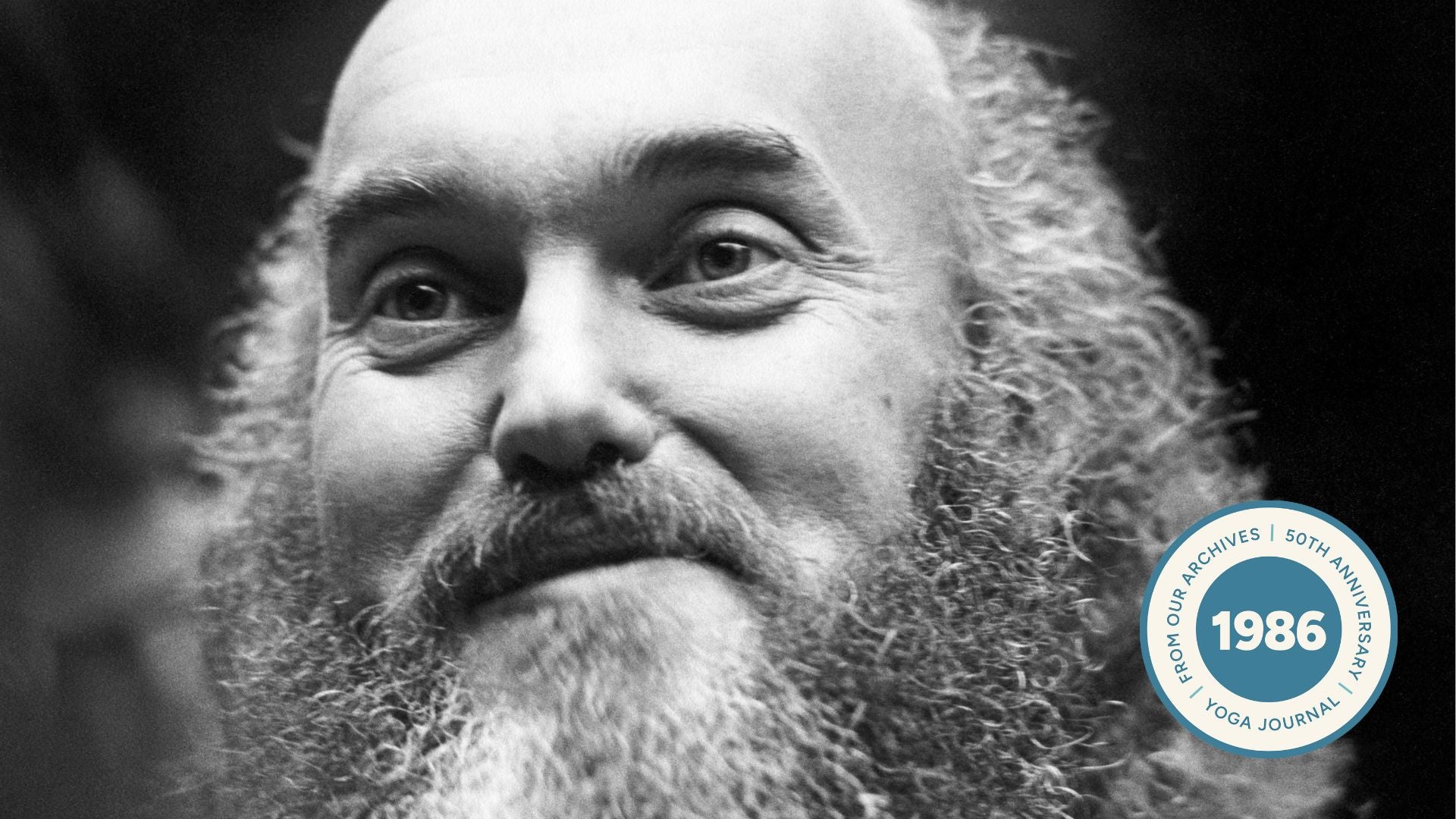
(Photo: Robert Altman | Getty)
In Yoga Journal’s Archives series, we share a curated collection of articles originally published in past issues beginning in 1975. These stories offer a glimpse into how yoga was interpreted, written about, and practiced throughout the years. This article first appeared in the September/October 1986 issue of Yoga Journal. Find more of our Archives here.
Ram Dass appears for our interview right on schedule—and without entourage. No fanfare. No pretense. No teacherly airs. The physical form has changed over the years, and the dark, tired eyes, incipient potbelly, and silvery hair (what’s left of it) indicate that at 55 Ram Dass is no stranger to the wear and tear that come with age. (“I don’t have that act together, really,” he replies later to a question about maintaining his own physical health.)
Casually but elegantly dressed, without beard now (only the moustache remains), Ram Dass seems relaxed as he makes himself at home in my rather spartan Berkeley, California, office. As we exchange pleasantries and then settle down to address deeper issues, I’m impressed by his sincerity, his no-nonsense willingness to air all, even the most embarrassing personal insights and anecdotes.
ADVERTISEMENT
This man, I marvel to myself, has been pioneer, spokesperson, fellow traveler, and teacher to a generation of spiritual seekers. His ground-breaking experiments with LSD set the stage for the psychedelic ’60s, and his immensely popular Be Here Now, the fruit of his discipleship with the Indian guru Neem Karoli Baba, has guided thousands in their search for spiritual awakening.
In the influential books that followed, Ram Dass chronicled with remarkable candor the triumphs and travails of his own journey of awakening. And throughout, far from becoming a guru himself, he has remained the perpetual student, the perpetual researcher of the realms of the spirit, still experimenting, still exploring a variety of methods—and still reporting his findings to a world-wide following.
A Conversation With Ram Dass
In recent years Ram Dass has been focusing more and more of his time and attention on the work of the Seva Foundation, which he co-founded (“seva” means “service” in Sanskrit). The organization, whose original purpose was to put an end to blindness in Nepal, has now undertaken the broader task of educating people to the inner rewards of compassionate action. One of Seva’s latest projects has been helping to establish a nationwide network of autonomous local groups whose members support one another in service as a path to spiritual transformation.
What is your day-to-day practice like? I know that Neem Karoli Baba (Maharaj-ji) was your original teacher and that under his guidance your practice was primarily devotional. But I also know that you’ve explored other paths.
My primary practice is guru kripa, the method of the guru, which involves maintaining a somewhat continuous dialogue with him. I carry his presence inside me all the time, and I relate to him about every situation. Eventually this method expands to the point where every experience you have is part of your dialogue with the guru, and life becomes a series of messages or situations being sent to you through which you can get closer. For example, I may see that you are Maharaj-ji in drag, or that he set this scene up to play with me in some way, or that he’s standing behind me giggling, reminding me not to take myself too seriously.
In addition, his instructions to me (which are now 13 or 14 years old) to feed and serve people, and the fact that his lineage in the Hindu tradition is Hanuman [the monkey god who lives only to serve Ram], leads me to constantly be exploring the ways in which service can be the form of Bhakti Yoga that brings me closer to freedom. I just spent two months in Burma sitting in Vipassana meditation—that’s part of my sadhana too. And in a way Vipassana brings me closer to Maharaj-ji, because the quieter I am, the more clearly I can hear his teachings. Maharaj-ji himself used to say to me, “Bring your mind to one point and you’ll know God.”
Part of your practice, then, is to see each situation as an opportunity to get closer to your guru, to see it as his lila, his play, his teaching.
He is no longer that guy in India. Now it’s at the point where, as Ramana Maharshi used to say, “God, guru, and One are the same.” Getting closer to the guru, at this point, means getting closer to my own true self, to the indescribable.
ADVERTISEMENT
In addition, I sense that in the Hanuman lineage it has never been clearly enunciated exactly what is meant by doing service as a vehicle for awakening. I’ve always done lots of service, like lecturing, teaching, working with people who are sick or dying, but then I would go meditate in order to cool myself out. I became interested in why I couldn’t do the service itself as the vehicle for getting cooled out. Why did I have to rely on Dhyana Yoga (meditation) rather than Karma Yoga? Why couldn’t Karma Yoga be complete unto itself? So when I came back from Burma, I decided to throw myself into service as hard as I could. I just kept saying yes: I’m taking care of my father. I’m working with AIDS people, I’m working with dying people, I’m teaching courses on aging. I’m doing individual therapy, I help run the Seva Foundation—just more and more stuff, just “yes, yes, yes.” And I’m learning where the toxicities are. My sadhana now is examining how I get caught in service, how the grabbing starts, where I lose the injunction of the Bhagavad Gita that says, “To do pure Dharma, don’t identify with the actor or the fruits of the action.”
You’re pushing yourself to an edge, then, in the context of service.
Yes, I always do that. I want to see if it works—and if it doesn’t, I want to find out why. I want to see where I have to clean up my act so it will work. I know it’s possible because Hanuman did nothing but serve Ram, and he had this incredible energy because of the purity of his service. So I’m just examining my impurities, if you will, discovering where I have to tune up my vehicle.
Where do you draw the line? For example, why sleep? Why eat? Why eat as much as you do? Where does one stop giving out completely and start taking care of oneself? Is there a limit?
Even that distinction—taking care of oneself versus giving to others—is a model that gets in the way. If it’s working right, when you’re giving out, you’re also taking care of yourself. My latest book, How Can I Help? focuses on how it works both ways. If it doesn’t, something is wrong. Through service you should be getting fed, getting energized, becoming lighter and more spacious.
Of course, all this is theoretical. Part of it works for me and part of it doesn’t. What I need to do is to keep zeroing in on the part that doesn’t and keep explaining it to myself and to everybody else until we can see why, because I’m sure service can be a pure upaya [method for achieving enlightenment]. I just don’t know yet how to articulate it, and I can’t find the books that do.
In other words, it’s not that there’s something wrong with serving so selflessly, but rather that there’s something wrong with the vehicle doing the serving that needs to be taken care of.
Exactly. And it’s a fascinating adventure for me, because I feel I’m getting closer to my lineage, which is Hanuman and Maharaj-ji. Maharaj-ji used to sleep two hours a night. The rest of the time he would be surrounded by people; he would be yelling and teaching and throwing people out and feeding people and doing whatever he did, and maybe he was doing that on other planes in the room as well—I don’t know. In Burma we didn’t eat after 11 in the morning and I found that I slept much less. The fact that we slept four hours a night didn’t bother me in the least. Of course, I had very little stimulation out there, and very little attachment. Attachment is what creates the fatigue. Now I sleep maybe 5-and-a-half to 6 hours, and then I can’t sleep anymore. I get tired sometimes, but I watch why I’m getting tired and what the tiredness brings up in me.
ADVERTISEMENT
You mentioned your relationship to Maharaj-ji. I think it was Da Free John who said, “Dead gurus don’t kick ass.” Do you feel that not having a living teacher has been a shortcoming in your Practice?
I would love a teacher who would kick ass…yes, if I found someone whose truth I trusted enough to give him that license. I miss that in Maharaj-ji. But I don’t think it’s true that he doesn’t kick ass continuously. If you’re trying to awaken, life situations kick ass very fast because you keep seeing where you’re falling flat on your face again and again. You say, “I have no attachment to power” and then you see yourself [constantly] going after it. You have no choice but to face it. That’s what kicking ass means—it just shows you where you’re stuck. Of course, I would like somebody who could cut through my trips quickly. But I also see that I don’t have a violence about my sadhana the way I used to. I used to have the attitude that it had to be done yesterday, and I was going to get enlightened tomorrow—the drugs were violent, the teachers who would do it to me were violent, the methods were violent. I don’t have that attitude anymore. I’ve developed patience, a sense of timing, and the sense that it’s all going fine. I don’t think I’m falling off the path. I feel a deepening harmony. The melodrama of sadhana just doesn’t interest me anymore.
What about drugs? I understand that even now you do drugs occasionally. How do you see the role of drugs on the path? Do you see your occasional drug use as a weakness, or is it just not a problem for you, particularly?
Of those two options, I would choose the latter. It’s not a weakness, by any means. I see chemicals as an upaya, a method, that we only know how to use in a certain limited way. When my guru took acid and nothing happened, he said, “Yogis used these kinds of things years ago, but they used them in conjunction with fasting and so on. Nowadays, people don’t know how to use them.” That’s what I experience—that people don’t know how to use them. They’re usable, but they are not a total upaya. He said, “It allows you to have darshan with the saints. But it would be better to be Christ than to visit him. This won’t do that for you.” I hear that very clear, subtle distinction. It’s as if the drug experience gives you an astral analogue rather than the thing itself.
At the same time, I incredibly honor what psychedelics have done for me. I would be a complete phony if I found it efficacious to reject them at this point. However, they have become less and less interesting to me as the years have gone on—irrelevant, if you will. I take them now and then because just the irrelevance makes my setting for using them better than when I believed that I needed them and felt they were going to take me somewhere.
ADVERTISEMENT
In a way I’m still a research scientist of psychedelic chemicals. I feel like I have a responsibility to that upaya, just as I have a responsibility to Hanuman and to meditation, to understand them clearly and be able to communicate to others the ways they work. When a chemical comes along, unless it’s very violent, I will try it and see what it has to say.
The other thing about drugs is that for a number of years I would invariably take a puff of a joint before I lectured. The reason I did this was that I always assumed the audience wanted me to be higher than they were. That’s what they came for—for me to get them high.
Your definition of high was…
Where my mind would be more liquid and playful and spacious than theirs. Since getting up in front of a large lecture can be constricting from an ego point of view, I would override it with a puff of a joint. I found over the years that I would never smoke alone—it just doesn’t interest me—but I would do it for the audience. I used to kid that one puff could get 3,000 people high.
ADVERTISEMENT
Then I began asking myself, “Why do I assume people want me to be different than I am? Why can’t I just be who I am? If they don’t like it, they won’t come to the lectures. And if they don’t come to the lectures, I’ll do something else.” It was scary, but I decided to do it, because I felt heavy, and thick, and caught in my ego. I was under the impression that my speaking was better when I was high, but I realized that it wasn’t the performance that changed, it was my evaluation of the performance. When I smoked, I was less judgmental and more appreciative of myself. All I had to do was deal with the judging factor rather than assuming that the performance had to change. So I did a tour absolutely straight, and I never had such a wonderful time in my life. The audience was so responsive. I stayed in people’s homes because I no longer had that kind of private world to protect. All the paranoia was gone.
When I was in Burma doing Vipassana meditation, I experienced that the way I used drugs and the way I used my guru were similar in certain ways. They were both—not totally, but in part—a reflection of my psychodynamic needs. I was using both the drugs and the guru, saying—”I can’t do it—you do it for me.” There was a certain feeling of inadequacy, of dependency. And I saw that my way of using the guru was keeping me from merging with the guru, because I was keeping that distance out of my own psychological need. As I explored what that was about, I experienced my fear of power—I’ve always said in the past that when I get it, I misuse it, so I’ve always mistrusted myself with power. Because [I believed] I would become arrogant, cold, manipulative…
I hear an ambivalence toward power.
Exactly. I loved it, I was afraid of it, and I hated my love of it, because my love of it was impure in my own eyes. And I suddenly realized that the Theravadin (Vipassana) tradition was the path of the warrior, and the warrior is someone who accepts his own power. That’s why I had such a hard time with the concept of right effort in Buddhism. I kept saying, “What effort?” I remember once going to see [the Tibetan Buddhist teacher] Chogyam Trungpa, Rinpoche when he was lecturing at Tail of the Tiger in Vermont. I was waiting out in a field in a VW, smoking grass with some friends, and someone came up and said, “Trungpa wants to see you.” I went up to his room, and Trungpa was sitting on a chair with a saké bottle in front of him. He said, “Ram Dass, we have to accept responsibility.” And I said, “What responsibility? God has all the responsibility, I don’t have any responsibility. ‘Not my will, but Thy Will, oh Lord.'” And he said, “Ram Dass, you’re copping out.” That stuck with me for a long time.
ADVERTISEMENT
You mentioned psychological need and psychodynamics. What about psychotherapy—your own psychotherapy in particular? I understand that you were recently a client in psychotherapy, and I’m wondering how you see psychotherapy as a skillful means in conjunction with spiritual practice.
Individual psychodynamics distort and color—and, if you will, define the boundaries of—the way a sadhana can work. People meditate for lots of different reasons psychologically, and those psychological reasons ultimately define the boundaries of their practice, unless the method takes them beyond their original motivation for using the method.
For example, people who have a difficult time in social relationships may find the monastic life appealing. Or people who have very strong sexual desires may be drawn to tantra. But the fact that their practice of tantra is based on their sexual desire starts to limit the way in which they can understand tantra, because at some point, tantra has to go beyond sexual desire.
The same with people who are prone to a monastic life—they may be caught in the monastic style and be unable to see that they also have to integrate their more social, extroverted side.
Exactly. Because as long as you push anything away, it has you. As long as you have a model of why you are doing something, the model defines the boundaries of what you do. The model is like a prison of the Light. Lots of people, for example, serve out of a sense of righteousness, which is based on guilt and inadequacy. That defines the limits of their service as a sadhana. True service and compassion have nothing to do with righteousness.
ADVERTISEMENT
When you see that psychology plays such a key role in spiritual practice, it behooves you to attend to your psychodynamics at some point. But I don’t think it’s reasonable to expect your therapist to be your spiritual teacher also; I think you have to learn to use therapists without buying their whole reality principle. I was a psychotherapist for many years, and I was [a client] in Freudian analysis many years ago. When I went into spiritual work, I said, in effect, “The spiritual practices are a meta game, and they will ultimately dissolve all the psychological stuff.” Then I got involved with this being Emmanuel, who speaks through Pat Rodegast. Emmanuel’s a wonderful friend, a lovely guy. I asked him, “Emmanuel, what should I be doing?” And he said, “Why don’t you try being human? You enrolled in a school, why don’t you try taking the curriculum?” It was funny, because I had never thought of my humanity as a practice. I was too busy trying to become divine.
Emmanuel focused me back on my humanity as a path. I realized then that I had work to do in relationships, and I soon found myself in a painful relationship. I was like a 13-year-old boy again; I had stopped my development at a certain stage and just gone ahead in my intellectual and spiritual work. So I decided to go back into therapy for a while—not because I expected the therapist to help me spiritually, but because the psychodynamic level was a veil, and I wanted a veil specialist. And I got one—I got a very good mirror who showed me stuff. And it worked for a while, until it became apparent that I was freer than he was and that there was a point where I really couldn’t go any further because I understood what he was mirroring. So I stopped, and we became good friends.
In other words, you were able to second-guess him.
Yes, I knew his trip.
ADVERTISEMENT
I’m wondering how being a public figure, a representative of a generation, of a movement, has hindered your spiritual practice?
It’s hard for me to know how power has been a hindrance, because I have it. I don’t know what I would be like without it. I can see that it has confronted me with my own attachments, so in that way it’s been incredibly graceful. At first I wanted it, then I saw how empty it was, then I got despairing, and it kept changing and changing until now I do what I do, just like someone who sits at his computer all day. The love just pervades all of it; the dynamics of fame are totally irrelevant. They just don’t do anything to me anymore.
You mentioned in an interview I read recently that you feel paranoid around people you can charm, because they don’t know the real you. You mentioned it in relation to the Vipassana teacher U Pandita, whom you were unable to charm.
If you have a very strong symbolic value in society—you’re very beautiful, or very rich, or very well known—people are so busy responding to the sym-bol that you could starve to death before they would give you what you needed. I was just talking to a man two days ago who had a great deal of political power in the world at one time. He said that before that, he’d go to a party and everyone would ignore him. After that, he’d go to a party and everyone would want to sleep with him. And he hadn’t changed. I get that same feeling. A lot of people in public life end up withdrawing and having a few friends they feel safe with, who know them. I don’t go in that direction at all. I’m learning how to let people run through their projections. For example, if somebody comes up and says, “Oh, Guru-ji,…” well, I’m not a guru, but if I don’t push them away, and I don’t grab onto them, they can go through their projection much faster than if I had any reaction at all.
ADVERTISEMENT
Of course, I’m very fortunate because the image that’s usually projected onto me is a positive one. After all, what does Ram Dass represent? Someone who’s trying to be honest, trying to be spiritual. I’m surrounded by a sea of love, if you will, because people know I don’t have any powers, I’m not going to heal them or cure them. I sit on airplanes and answer my mail—I write every answer myself—but over the years the payoff has been incredible; the web of intimate one-on-one contacts just keeps growing. There are people who, when they think of me, feel loving and feel that we are joined together in a journey of spirit. I’m getting a tremendous amount of support from that.
A couple of years ago you stopped making public appearances for a while. I’m wondering why you did that.
I got extremely good at what I was doing, but it wasn’t good enough. I had as full a lecture schedule as I could handle, with files full of invitations and people who were very appreciative of my lectures, and I was charging very little and everything was going fine, but I wasn’t free. Then I’m just transmitting more suffering, and that isn’t good enough. So I decided to stop and give myself however long it took until I could be in public from a different place. I stopped for two years. I had no plan about how long it would last; I sort of assumed it would go on for years. When I stopped, I didn’t even know what I would do. It wasn’t as if I stopped to do something—I stopped to not do something. I wasn’t desperately looking. I was just slowing down and tuning and opening. I started to read more and sit and look out at the marsh near the house I live in.
ADVERTISEMENT
My work with the Seva Foundation brought me back into lecturing. Also the appreciation I get, when I go into deep enough meditation practice, that service is my way. And also the realization I had last summer that people don’t need me to be a finished product, that as long as I am honest, they can take what they can get and use it, and we can share what we have together.
Something really profound happened to me in Burma. I don’t even know what it is yet. Before, when I kept talking all the time about this stuff, I’d end up only knowing what I had said, and all I would know about Maharaj-ji were the stories I told about him. I realized I was conceptualizing the universe, and I’d lost Maharaj-ji into the conceptual processes I’d imposed upon him. So I had to shut up for a while to reconnect to the non-conceptual universe.
Now I’m not attached to my words like I was before—it’s not the same. Something is different. I’m much more afloat. I’m walking into situations empty now, and the situations create a form. In the form I do what I do, I walk out of the situation, and it’s all as empty as it was before.
ADVERTISEMENT
What Suzuki Koshi calls burning yourself up in each activity and leaving no trace. Before, you were suffering under the burden of your own traces.
Exactly.
How do you think your work with U Pandita in Burma helped effect this change? Was it the moment-to-moment mindfulness, which allowed you to stay with thoughts as they arose?
I think that’s certainly a component, but more of it is the kind of peace that’s connected with spaciousness. I’m at peace now in some way that makes me not need to define myself in terms of the words I just said. Often, after a situation, I would rehearse what had happened, either to savor it or to be embarrassed anew by some stupid thing I had done. That doesn’t happen now at all. I think some of it has to do with being comfortable in that warrior role.
ADVERTISEMENT
One last question, Ram Dass. I’m wondering about the name change. For a while there it seemed that you had gone back to Richard Alpert, but lately, as I understand it, you have become Ram Dass again.
Originally when I got the name Ram Dass, it was a reminder of what my business was, because it means “servant of God.” It got people treating me somewhat as a spiritual person, which was a support to my practice.
Then, as the years went by, I began to feel stronger in my faith and connectedness with the spirit, and I saw that the name was an obstacle to my being heard by a large segment of the society that distrusted any Westerners with an Eastern name. So I attempted to go back to my Western name, feeling that I didn’t need “Ram Dass” anymore.
ADVERTISEMENT
However, it was deeper into my consciousness and the cultural consciousness than I had expected. People, I found, really resisted my changing. And I realized that, for my part, I didn’t care. Who I am is not a name. Or, as they say of the Tao, “The Great Way has no name.” So I decided to “let it be.”