Updated March 21, 2025 02:58PM
Malasana (Garland Pose or Squat)
An excellent facilitator of good pelvic floor health, Garland Pose, called Malasana in Sanskrit, stretches the ankles, groins, and back while stimulating proper digestion. No worries if your heels don't reach the floor—simply rest them on a folded blanket.
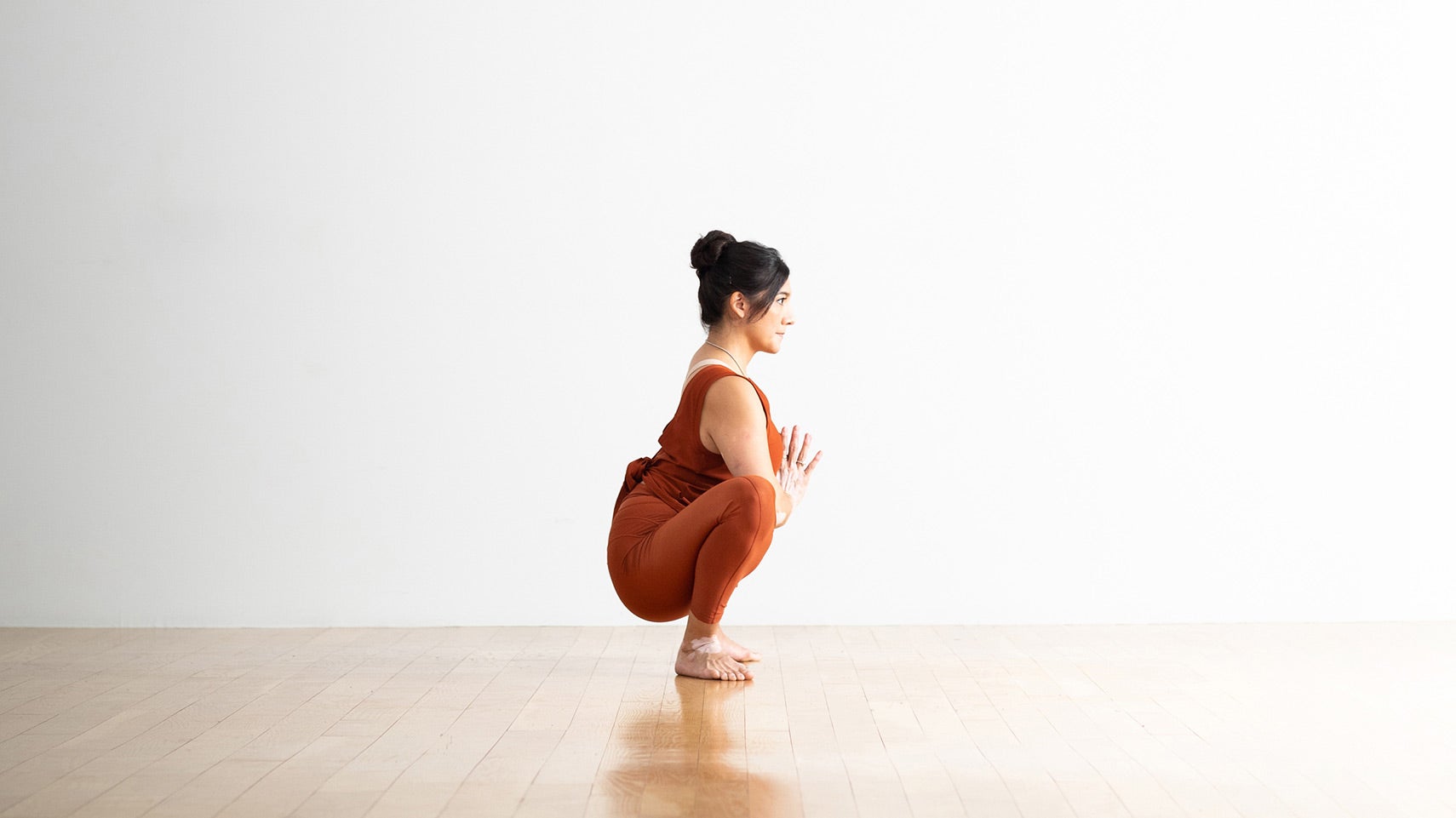
(Photo: Andrew Clark)
When you were a kid, did you sit in a squat pose easily? Most children do—sometimes for hours at a time as they play on the floor. Adults can lose this ability because we sit in chairs all day long, rarely hanging out that close to the ground for any length of time. If you can’t do this pose now, it’s almost always because you haven’t done it in a long time. If it’s available to you, do it often. If it’s not, doing this pose is a worthwhile goal.
For thousands of years, humans have been sitting in this deep squat pose. In Asian cultures, they still gather and even eat in this pose. They also regularly use squatty potties! While these aren’t common in Western cultures—we prefer toilets—the idea of squatty potties are great. You keep your body supple and fit while you go! One expert, Philip Beach, calls Garland Pose our birthright. He thinks we all deserve to do this pose that develops ankle flexibility and strength and requires deep flexion in the hip joints. Put simply: It keeps us on the move for life.
The benefits don’t end there. Scientists studied hunter-gatherer cultures to find out why the people have fewer health issues. Hunter-gatherers sit in a chair position far less often, and they squat constantly as a resting position. Researchers found that the tribespeople’s leg muscles stayed stronger than Westerners’ muscles who often sat for most of the day. Their muscles contracted 40 percent more often in the Garland position. Studies in animals show that when tissues are inactive, they produce fewer enzymes that breakdown fats, leasing to bigger buildups of cholesterol that leads to heart problems. Our resting in chairs may lead to more heart problems than the hunger-gatherers have! Obviously, there are other factors such as diet and lifestyle, but the squatting versus chair position is also a link worth paying attention to! Our bodies are made to take certain poses, and experts agree that this is one of them. If you can’t do it, try often. Sit on a block, lift your heels or take your feet wider. Over time, this healthy pose may get easier.
ADVERTISEMENT
Another benefit is how grounding and calming Garland Pose can be. It focuses on the Muladhara or Root Chakra. Doing this pose may make you feel more connected to your practice and less distracted. And feeling better is always a great goal in your asana practice.
The Sanskrit name of this pose is Malasana and, as you may know, a mala is a garland of beads. Some people use the beads as decorations around their necks. Others use the beads for prayer. The prayer is usually a Japa meditation in which you repeat a mantra 108 times, once for each bead, making your way around the necklace. This pose is named after the beads because in the full expression, your wrap your arms forward and around your shins to the lower back. The arms are the mala. They are your decoration, your necklace and your prayer beads. In the more upright position, with the hands in prayer, elbows between wide knees, Garland Pose is hard for some people and easy for others. Either way, it’s an important pose to practice because some experts believe this pose leads to more mobility in the body to keep you moving for your entire life.
Sanskrit
Malasana
Muh-LUH-suh-nuh
mala = garland
asana = pose
ADVERTISEMENT
Garland or Squat Pose: Step-by-Step Instructions
- Squat with your feet as close together as possible. (Keep your heels on the floor if you can; otherwise, support them on a folded mat.)
- Separate your thighs slightly wider than your torso. Exhaling, lean your torso forward and fit it snugly between your thighs.
- Press your elbows against your inner knees, bringing your palms to together in Anjali Mudra (Salutation Seal), and resist the knees into the elbows. This will help lengthen your front torso.
- To go further, press your inner thighs against the sides of your torso. Reach your arms forward, then swing them out to the sides and notch your shins into your armpits. Press your finger tips to the floor, or reach around the outside of your ankles and clasp your back heels.
- Hold the position for 30 seconds to 1 minute, then inhale, straighten the knees, and stand into Uttanasana.
Variations
Garland Pose with a blanket under your heels
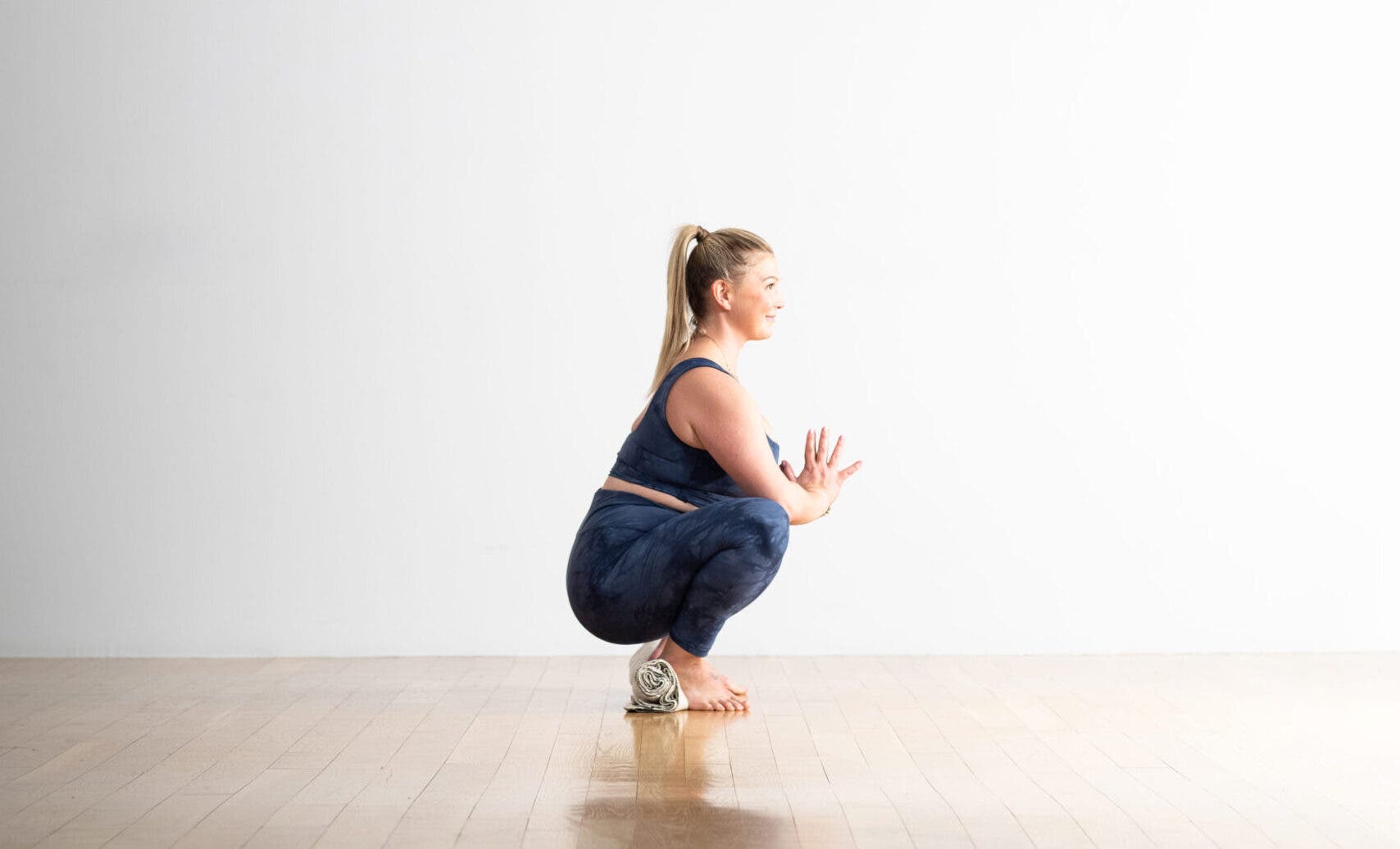
If it’s difficult for you to bring your heels to the floor in this pose, stand with your heels elevated on the edge of folded blankets or on a rolled blanket. Keeping your feet as close together as possible, squat low into the pose.
Garland Pose sitting on a block
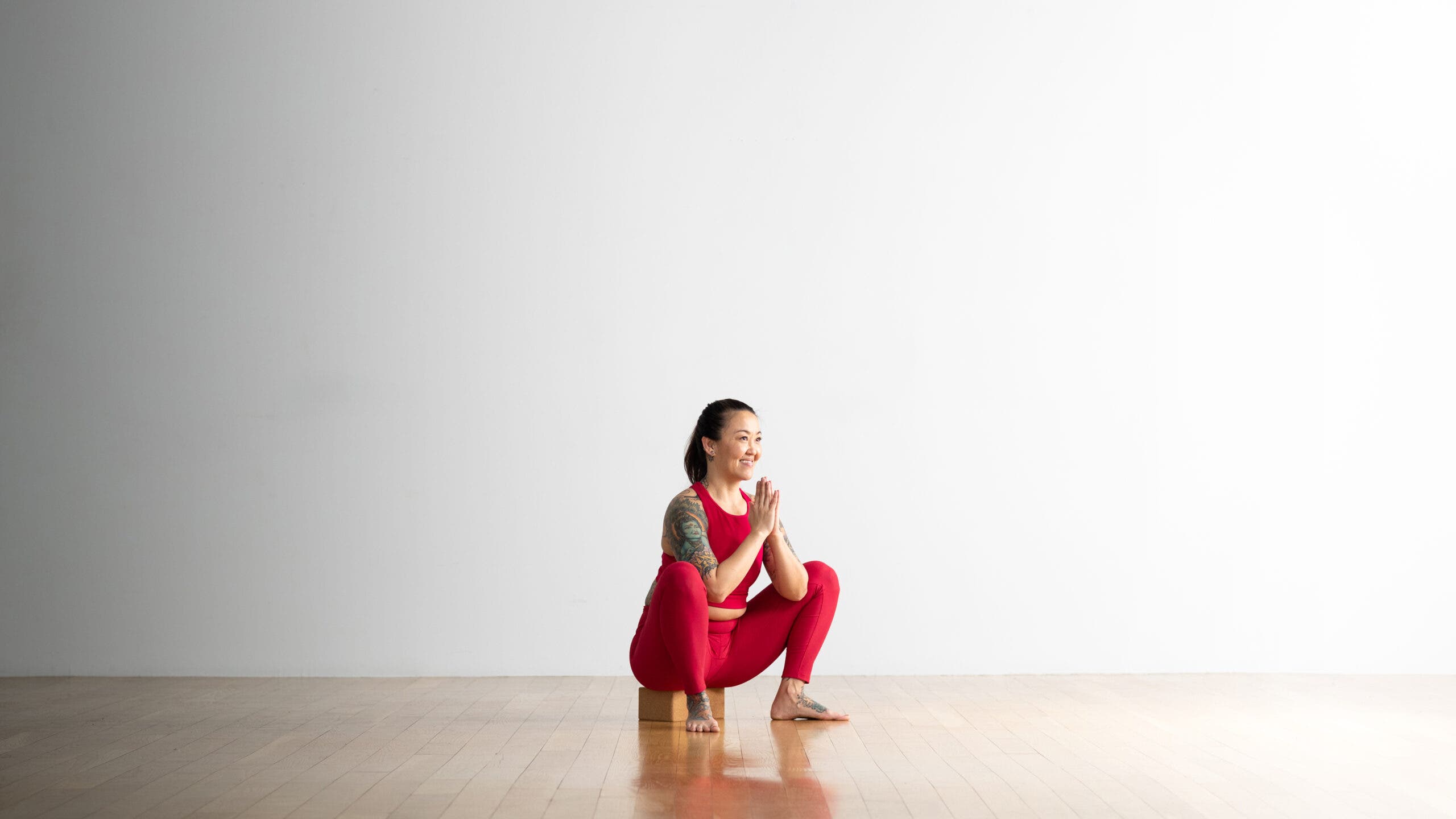
For more support, you can practice this pose by sitting on a block or a combination of blocks and folded blankets. Separate your feet as much as you need to; turn your feet and knees out and bring your hands to prayer position in front of you.
ADVERTISEMENT
Garland Pose against a wall
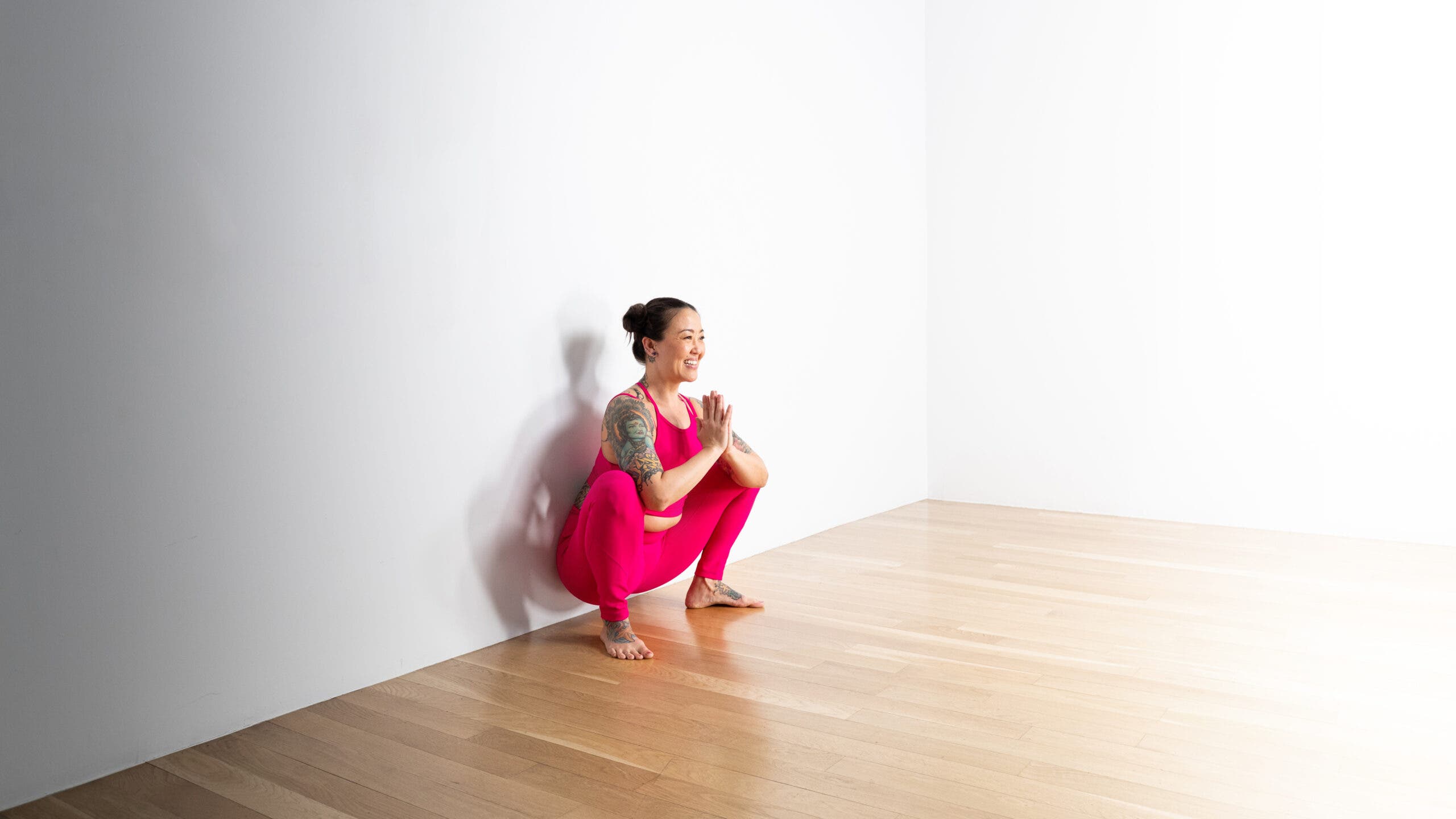
Practicing Malasana against a wall can help support your balance as you squat, and it can assist your alignment in the pose. Begin standing with your heels a few inches from a wall, and support yourself by sliding your glutes along the wall as you squat into the pose.
Garland Pose basics
Benefits
- Stretches the ankles, groins and back torso
- Tones the belly
Beginner’s Tip
- If squatting is difficult, sit on the front edge of a chair seat, thighs forming a right angle to your torso, heels on the floor slightly ahead of your knees. Lean your torso forward between the thighs.
- Hold a chair to lower down if the pose is still difficult. Or you could turn around and use a wall for support while you squat. With this pose, the goal is not necessarily stronger quads and glutes. You want to find balance of effort and ease, focusing on greater hip and ankle flexibility.
- If you can’t get your seat down to the ground, sit on a block, lift the heels or take your feet wider. Don’t be discouraged. Just go as low as your hips and knees allow and hold for five breaths. Do it once a day!
Why we love this pose
Garland or Squat Pose is a powerful hip opener. It is a favorite practice for people who are preparing for birth and for people who are looking for a pose that will assist their digestion.
Teacher tips
- Cue students to bring their feet mat-width apart, place their hands in prayer and bend their knees till their seats rest on or near the floor. A block is a great prop under the bum. Heels may be lifted. Elbows will be between the knees. Elbows can nudge the knees open while the knees hug into the elbows for the benefits of strengthening the inner thighs.
- One variation of the pose involves the arms extend around the body. Prep them first. Have students take the right arm in front of the right shin and the left hand high to the sky or wrapped around the back. Repeat on the other side. Then cue them to try it again seeing if the right hand can wrap around to the back while the left hand may meet it. Once they have the bind, they may fold forward bring the head closer to the ground.
- Until a student can bind, cue them to point the toes forward so the feet are parallel. This is a fun, accessible challenge.
