Published July 16, 2025 09:23AM
This Is the Key to Nailing That Balancing Pose
Find your focus to better your balance.
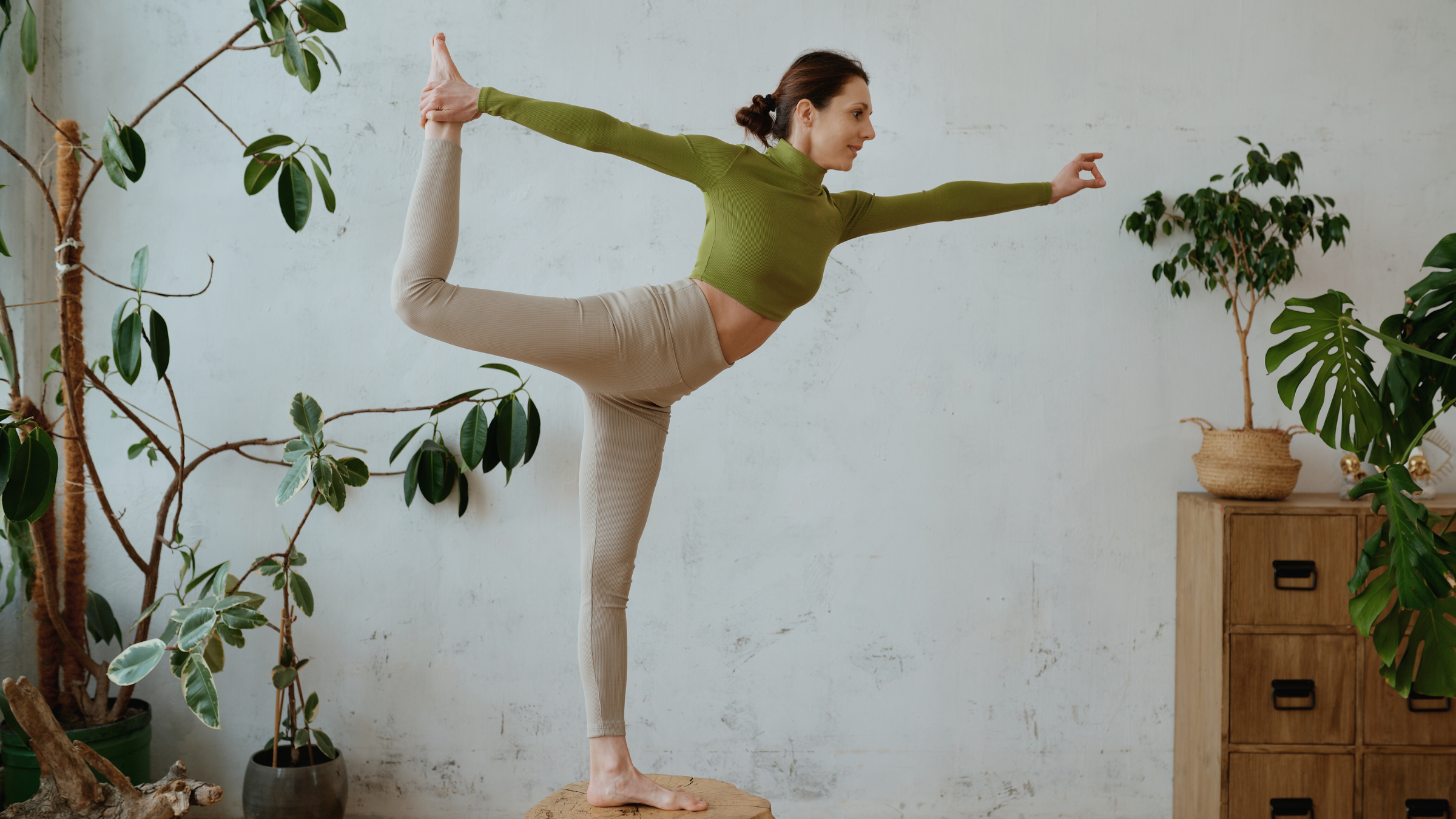
(Photo: Canva)
If you’ve ever found yourself wobbling in and out of Dancer Pose, puffing as you exhale, and wondering how to improve your balance in yoga, you’re not alone. But if have a dance background, have practiced with a yoga teacher adept at explaining cues, or are just naturally perceptive, you may have also noticed that fixing your focus on a single still point can have a fairly immediate grounding—aka wobble-eliminating—effect.
In yoga, this single-pointed gaze is known as drishti, and it serves as a method of blocking out distractions, turning the gaze inward, and, as it turns out, bolstering balance.
But how exactly does this work—and how can you leverage your gaze to find more strength and stillness in balancing postures?
How Does Your Gaze Affect Your Balance?
According to physical therapist Mackenzie Grillo, DPT, your vision helps you perceive where you are in space, also known as proprioception. This perception is essential, but it also makes focus all the more important.
“If you are constantly shifting your gaze, your brain is constantly recalibrating your proprioception, so it makes it more difficult to maintain balance,” she explains.
Fortunately, she explains that this is compensated for, at least in part, by an automatic response called the vestibulo-ocular reflex, which prevents your vision from blurring when your head moves. This explains why you’re not constantly dizzy as you move through the world.
ADVERTISEMENT
“If there is any sort of impairment or distortion in our vision, our balance can be thrown off because our brains can’t automatically correct any balance perturbations,” says Grillo. If you find that you lack steadiness when it’s dark or if your eyes are closed, now you know why.
Physical therapist Jeremy Crow DPT, OCS explains that both gaze direction and visual focus are crucial to maintaining balance.
“Vision provides the brain with critical spatial and environmental information, working in concert with the vestibular (inner ear) and proprioceptive (body position) systems to stabilize posture and movement,” he says. Research shows that pairing balance exercises with gaze stabilizing exercises can quickly improve both static and dynamic balance.
When you’re striving to purposefully balance, experts agree that keeping a fixed gaze will help you stay stable, allowing your mind to hone in on your place in space.
ADVERTISEMENT
3 Ways to Train Your Focus
You may already have a handful of balancing poses in your back pocket. (Think Tree or Half Moon Pose.) Now it’s time to train your focus. As noted in the aforementioned study, pairing any of these options with a balancing challenge (even if you’re standing on one foot) will maximize both your gaze and your balancing ability.
Below, Crow shares three practices designed to enhance your focus so that when you find that still point in your practice, you’ll be better equipped to maintain it.
1. Near-and-Far Focusing
” This exercise helps train your eyes to adjust quickly between different distances, which is essential for activities like reading, driving, or playing sports,” says Crow.
- Hold your thumb or finger about 10 inches from your face and focus on it for 15 seconds.
- Shift your gaze to an object 10 to 20 feet away and focus on that for another 15 seconds.
- Alternate between near and far focus several times.
ADVERTISEMENT
2. Eye Movement Tracking
According to Crow, this sort of tracking betters your ability to smoothly follow objects and enhances coordination, allowing you to maintain balance while flowing in and out of poses.
- Keep your head still and move your eyes slowly in different directions: up, down, left, and right.
- Alternatively, trace a figure eight with your eyes or perform “clock rotations” by imagining a clock and moving your gaze from number to number around the dial.
3. Pencil Push-Ups
Yes, your eyes can lift weights. “This exercise strengthens the muscles responsible for converging your eyes, which is crucial for reading, close work, and depth perception,” says Crow. Stronger eyes, better balance!
- Hold a pencil at arm’s length and focus on a small letter or mark on it.
- Slowly bring the pencil closer to your nose, keeping the mark single and clear.
- Once it becomes double or blurry, move it away and repeat.
