Published April 20, 2021 04:15PM
9 Tips for Adjusting Your Online Yoga Students
Top yoga teachers share the creative ways they guide their students to achieve proper alignment in their postures—even through a computer screen.
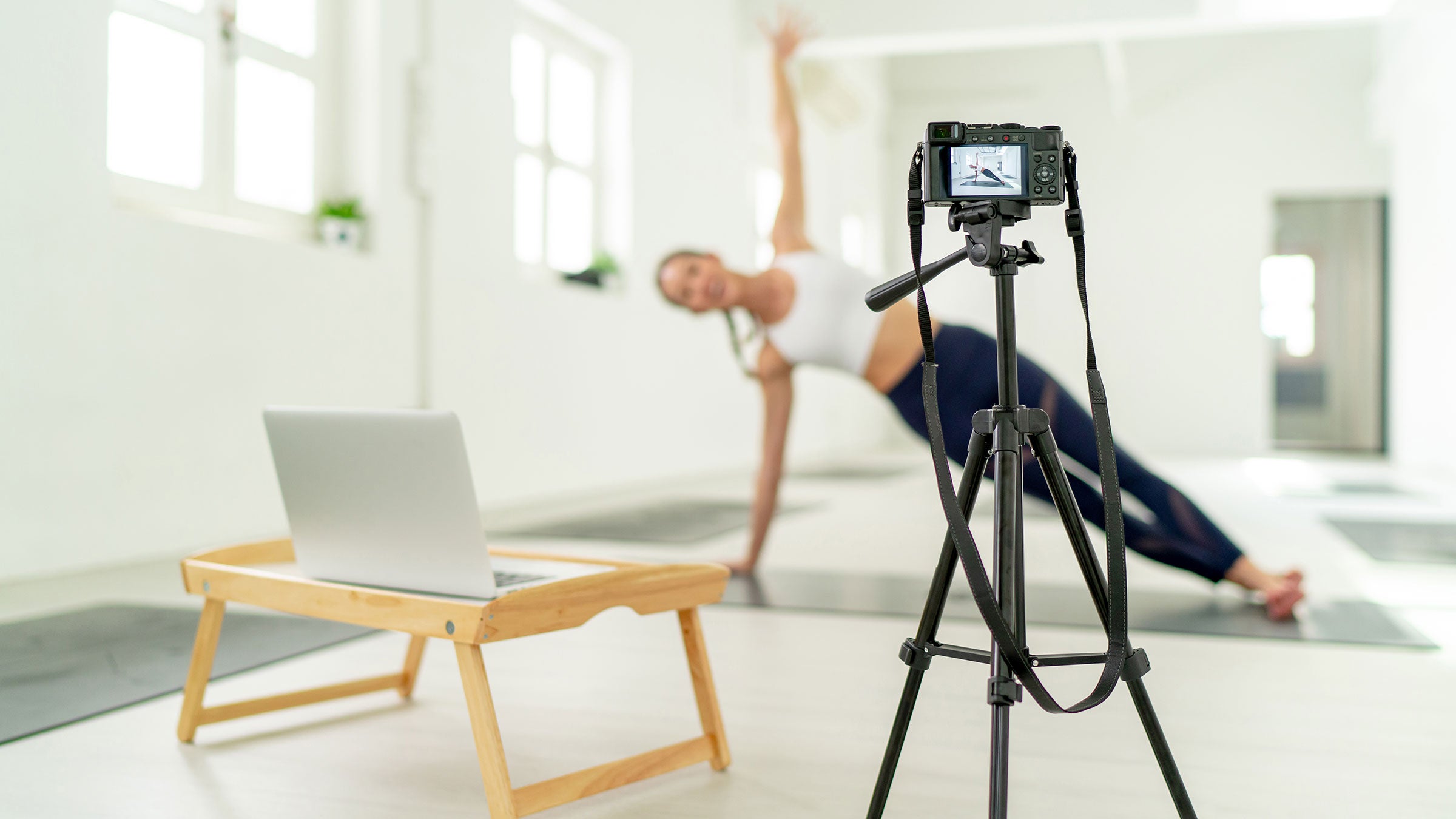
(Photo: Getty Images)
Long before a global pandemic sent countless yoga classes virtual, teachers have had to guide students through an asana class without physical touch. Even as studios, gyms, and other spaces that offer yoga start to reopen, it’s safe to say that online classes will be sticking around, which means that guiding your students through hands-off pose adjustments will remain as important as ever.
“I think physical touch is by far one of the most popular and effective ways to get a point across, but there are many times when it isn’t appropriate or even necessary,” says San Francisco-based yoga teacher Jenny Clise. “We shouldn’t rely on it as the only way to effectively guide students through a safe practice.”
Adjustments should be a dialogue between you and your students, and your students and themselves, Clise says. Whether your cues are verbal or nonverbal, there is power in staying present with your students and getting inventive. After all, teaching and taking classes online requires that everyone—teachers and students alike—get creative.
Here are 9 tips on how to virtually guide your yoga students through adjustments.
See also: How to Build Real-Life Community While Teaching Virtually
ADVERTISEMENT
Embrace the positives
While teaching remotely creates physical distance between you and your students, it also allows for opportunities to teach students who might not usually attend your classes—or who might not even live in your city. “At first it was completely unsettling being separated from my students through technology,” says California and New York City-based yoga teacher Sarah Girard. “But I’ve really come to enjoy it as I’ve been connecting with students around the world.”
Online adjustments also offer a powerful way for students to connect with and build presence with themselves, says Dana Slamp, New York City-based yoga teacher and founder of Prema Yoga Institute. “We know in our cells how healing touch can be. Because we are apart online, I look for every opportunity for the students to lay a hand on their chest, their belly, or even in a self-assist. This gets them continually coming back to the grounding experience of the body.”
Consider a camera-optional policy
Girard uses what she calls a “comfort policy,” for her classes. This means students only keep their cameras on if they’re comfortable doing so. “If your camera is on, it’s assumed you are open to receiving praise and/or adjustments.” She clarifies this policy in the opening of class. She says that a great deal of trust must be built for adjustments to be given, and this policy helps build and honor that trust.
ADVERTISEMENT
“Personally I’ve needed to practice with my camera off many times,” Girard says. “And the times when I leave the camera on I’ve made myself vulnerable to the teacher for comment. Again, this is a personal choice.”
Tune into that screen
Over a year into this pandemic, and we’re all suffering from Zoom fatigue. But online classes are not the time to tune out from your screen.
Clise encourages teachers to “get intimate with those tiny Zoom squares. Keep your eyes and ears on your students and check in on them. Tell them they can unmute themselves if they need to communicate with you! When we aren’t there in person, we need to let go of the traditional etiquette of a yoga class and make communication from our students to us more accessible.”
See also: Suffering from Zoom Fatigue? Try These 3 Simple Mindfulness Practices
ADVERTISEMENT
Un-learn some of your teacher training and pace yourself
Unless you’ve recently taken a teacher training, you were most likely trained to teach in person. Don’t be afraid to adjust some of what you learned in training to benefit your online students. “It is OK and sometimes necessary to do the once much-frowned-upon demoing on your mat now,” says Clise.
Michelle Briks Prosper, founder of Ohra Yoga in Mount Kisco, New York, advocates for slowing down the pace of class so students can really digest what you are teaching. “I find that I can offer about 75 to 80 percent of what I could offer before as far as the number of poses and the length of my sequences,” she says. “And that’s OK. Slowing down to break things down is important, especially when teaching virtually.”
Clise advocates physically showing in your own body the adjustments you want students to make. “Exaggerate them and point to the cues in your body,” she says.
ADVERTISEMENT
Guide students through self-adjustments
Whether their cameras are on or not, “students can improve their proprioception to feel the adjustments for themselves,” says San Francisco-based yoga teacher Sarah Ezrin. “Even having them manually manipulate their bodies, like hooking a thumb to the front hip and pulling the front hip back and in Warrior Pose I,” can be an effective way to improve body awareness.
“In some ways, this is very exciting, because students know their bodies best and can control the adjustments,” Ezrin says.
ADVERTISEMENT
Here are some questions that can help students build proprioception and mindfulness. Clise says you can sprinkle questions like these into class as needed:
- Where do you feel your weight shift?
- What part of your foot is the weight in?
- Where do you feel your breath?
- What action is the foot doing? Are the toes gripping the ground for balance? If so, can you relax them?
- Are you gripping or holding tension anywhere else you can relax?
- Listen to sounds close by and far away.
Get creative with your language and visual cues
Slamp says she likes to offer verbal adjustments for her students throughout class. She’ll gently call a student by name, and say, for instance: “Imagine my hands were on your scapula, gently guiding your upper body back in Down Dog.” Most of the time, the verbal cues work. “I’ve been relieved at how quickly students respond to this languaging,” she says.
Clise embraces the power of metaphors: “I get descriptive and try to be relatable. For me, there is no such a thing as too imaginative if it gets people into their bodies.”
Here are some examples Clise has found effective:
- Imagine you are “holding a ___, pressing into ____, reaching for ____, breathing into a ____, squeezing a ___, etc.”
- An example could be: Imagine rubber bands between your hips and your ribs. The goal is to keep the rubber bands taut but not over-stretched. “I love that one for people who tend to have hyper-lordotic curves and/or for poses like Trikonasana (Triangle Pose), where we want to keep the length in each side of the waist the same,” says Clise.
ADVERTISEMENT
Deploy the power of yoga props
“I’m all about DIY-ing our adjustments now with props,” Ezrin says.
Clise agrees: “Sometimes students need actual feedback to engage certain muscles in a way they don’t have in their muscle memory bank.”
Props (including household items) are powerful yoga tools because:
- They can reinforce an action and better help a student understand what the action should look and feel like. For example, a block between your inner thighs in Tadasana (Mountain Pose) can help you more fully activate your legs and core in the posture.
- They can provide a safe anchor for exploring poses in different ways. For example, using a wall can help you drive your heels into in Down dog as you lift up through the fronts of your legs.
- They offer ways to modify poses. For example, you can use a couch or chair to modify backbends, warriors poses, and more.
- They help students connect with their breath. For example, Clise finds the floor is a powerful teaching tool. She often teaches diaphragmatic breath by having her students lay prone or supine and feel the belly and low back rising or pressing into the mat.
- They can offer anchoring, traction, and opening. For example, Ezrin says: “Try putting a strap around a door knob and then over thighs in down dog to help lengthen the spine. Another prop trick to try: rolling a blanket over the tops of your thighs and folding over that in Paschimottanasana (Seated Forward Bend) to descend the tops of your femurs (thigh bones) down.
ADVERTISEMENT
Offer options and keep the connection alive
Los Angeles-based yoga teacher Alexa Silvaggio advocates “giving people a permission slip so that they can pull back or push a bit. I find that that helps people stay more present.”
Girard puts her focus on building connections, which can happen before or after class. “This is something that begins with a person’s first outreach through my website,” she says. “I make sure to respond to them (rather than have my assistant or automation) first. This immediately gives them a chance to get to know me so that when they show up to class, there aren’t surprises. I’ve found that in pandemic times, and old-fashioned email reply helps a ton. People are aching for a moment of connection.”
See also:
Tips for Leading Stellar Online Yoga Teacher Trainings
