Updated March 22, 2025 11:07PM
Reverse Plank | Upward Plank Pose
Purvottanasana counteracts the effects of Chaturanga by stretching the pectoralis major, pectoralis minor, and anterior deltoids.

(Photo: Andrew Clark)
If you frequently practice Surya Namaskar (Sun Salutations) or take every vinyasa your teacher offers, you’ll develop a strong upper body—and possibly a muscle imbalance. That’s because all of those push-ups cause your chest and shoulders to become tighter and your back to become weaker. This can lead to injury—unless you incorporate poses like Purvottanasana (Reverse Plank or Upward Plank Pose) to counterbalance these actions.
While Chaturanga strengthens the front of your body, Upward Plank Pose stretches the front and strengthens the back. In fact, Purvottanasana asks you to engage just about every muscle in your body. Practiced correctly, you’ll stretch tight muscles in your shoulders, chest, and the front of your ankles, while strengthening your arms, wrists, and legs.
Practicing complementary poses will help you build strength that is balanced with flexibility—and help you continue to practice yoga safely and injury-free.
Sanskrit
Purvottanasana (purr-vo-tahn-AHS-ah-nuh)
ADVERTISEMENT
Reverse Plank: Step-by-step instructions
- Begin seated in Dandasana (Staff Pose) with your legs extended forward and your hands next to your hips, with your fingertips pointing forward.
- Touch your big toes together and keep a small amount of space between your heels.
- Flex your ankles to draw your toes toward your knees. Press forward with your big toe mounds.
- Rotate your inner thighs down, and firm your outer ankles into your midline.
- Lean back slightly, and slide your hands back about 8 inches.
- As you inhale, move your shoulder blades in, and lift and open your chest.
- As you exhale, point your feet, reach toward the floor with your big toe mounds, and lift your hips.
- Press toward the floor with your big toe mounds. Rotate your inner thighs in and down while you directing your buttocks toward the backs of your knees.
- Press down with your hands to lift your thoracic spine toward your sternum and your sternum toward the ceiling. Inflate your chest.
- Allow your head to drop back, making sure the curve of your neck is a continuation of the curve of your upper back
- Hold for 5–10 breaths. Press into your feet and hands as you exhale; life your hips and chest as you inhale.
- Release back to the floor.
Variation: Reverse Tabletop
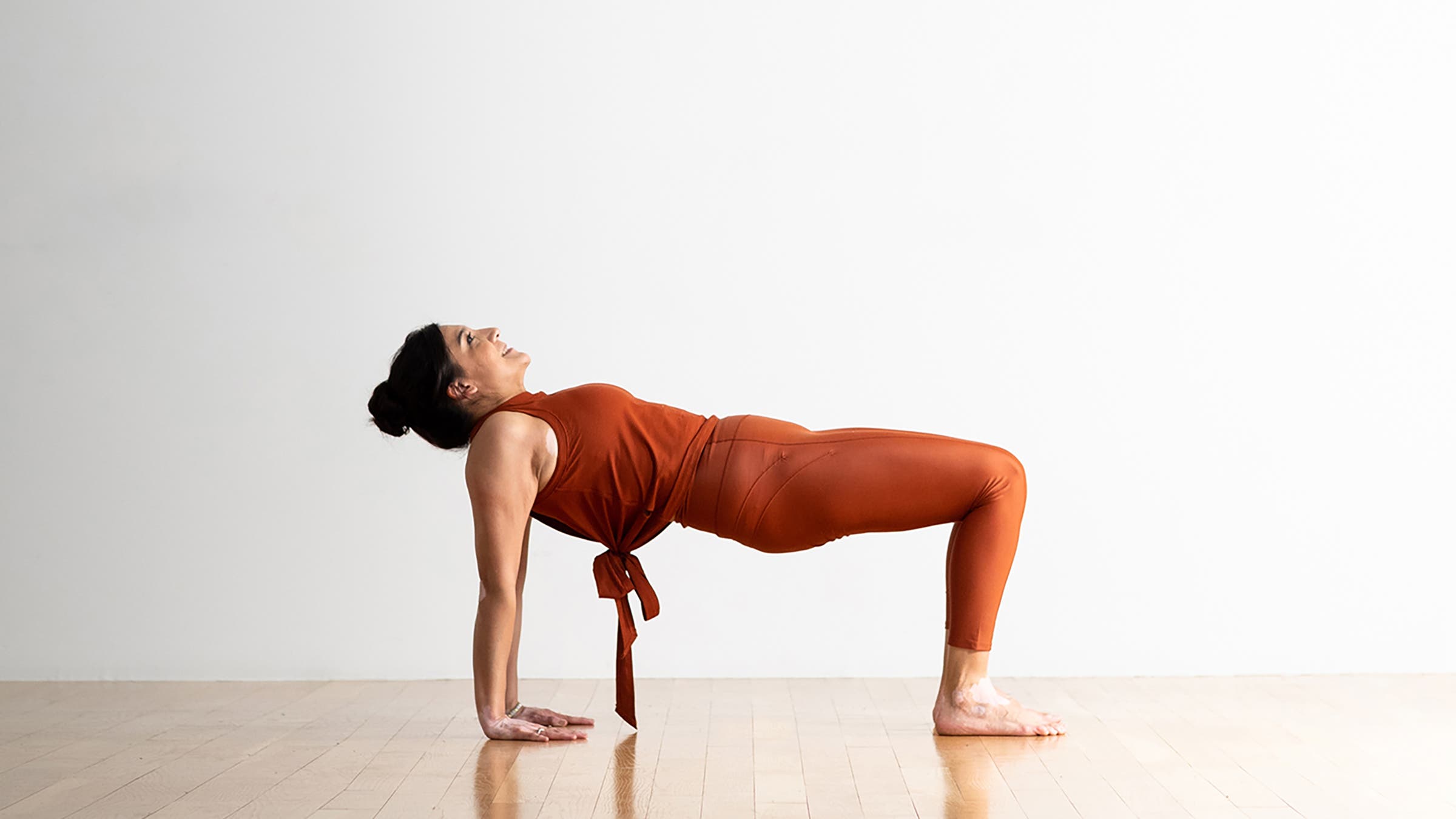
Begin seated on the floor with your knees bent and your feet flat on the floor. Press your hands into the floor behind you (palms facing down and fingertips facing forward). Slowly begin to lift your hips and press your chest upward. Avoid dropping your head back. Instead, keep your neck in line with the rest of your spine (or chin may be tucked slightly). Hold for several breaths, then slowly release your hips back down as you draw your chin in toward your chest.
Reverse Plank | Upward Plank Pose basics
Pose type: Arm balance
Targets: Full body
ADVERTISEMENT
Pose benefits
Upward Plank Pose strengthens your arms, wrists, and legs, while stretching your shoulders, chest, and front ankles.
Become a member today to access Yoga Journal’s comprehensive Pose Library, which blends expert insights from top teachers with video instruction, anatomy know-how, variations, and more for 50+ poses, including Reverse Plank. It’s a resource you’ll return to again and again.
Beginner’s tip
Practice with a chair support: Sit near the front edge of the seat and wrap your hands around the back edge. Inhale to lift your pelvis, then extend each leg with as you inhale.
ADVERTISEMENT
Why we love it
“This pose activates every muscle in my body,” says Yoga Journal staff writer Ellen O’Brien. “For that reason, I used to dread it—and as a result, I put way too much pressure and tension into my arms and shoulders. Once I learned how to stretch, expand (and breathe!) into the pose, I found myself enjoying it much more.”
Teaching Purvottanasana
- Students can modify this pose by placing their hands on two blocks. The blocks extend the length of the student’s arms, making it easier to get the soles of their feet toward the mat. If you’re advising a student who has wrist pain, have them slant the blocks against a wall to decrease the angle of wrist flexion in this pose.
- This is a great pose to insert into a Chaturanga-heavy sequence, since it stretches the front of the body and strengthens the back of the body.
Preparatory and Counter Poses
Preparatory poses
Marjaryasana (Cat Pose)
Bitilasana (Cow Pose)
Humble Warrior
ADVERTISEMENT
Dolphin Plank Pose (Forearm Plank)
Salabhasana (Locust Pose)
Setu Bandha Sarvangasana (Bridge Pose)
Counter poses
Ananda Balasana (Happy Baby Pose)
Ardha Matsyendrasana (Half Lord of the Fishes Pose)
Paschimottanasana (Seated Forward Bend)
ADVERTISEMENT
