Published January 14, 2016 11:20PM
Three-Legged Down Dog in Simple Steps
More than a transition, when practiced mindfully this pose prepares the body for Warrior III, Standing Splits, and Handstand. Get more out of it every time.

Three-Legged Dog can come up a lot in a vinyasa yoga class. It typically occupies the space from the inhalation between each Downward-Facing Dog and subsequent standing pose. You might spend a full cycle of breath here during Surya Namaskar. And your teacher may use longer holds in this pose as a stretch. But do you pay attention to how lifting that leg affects the rest of your body?
Here’s a chance to unlearn unconscious patterns, break bad habits, and see if you can’t makeover your entire flow by re-focusing on a few foundational basics.
To get more out of Three-Legged Dog, try to keep everything else neutral when you lift your leg. If you keep your foundation exactly the same as in Down Dog, this variation of it looks nearly identical. Even experienced students, however, tend to collapse into the standing leg side of the body, open their hip, shorten their side waist, and arch their back as soon as they lift a leg. But when practiced mindfully, integrating the actions below, this pose will make Warrior III, Standing Splits, and even hopping into Handstands much easier.
How to Practice Three-Legged Dog
Rather than rush through your Three-Legged Dog, slow down. Bring a little more awareness to what happens elsewhere in your body the moment you lift your leg.
ADVERTISEMENT
1. Ground weight evenly into both hands
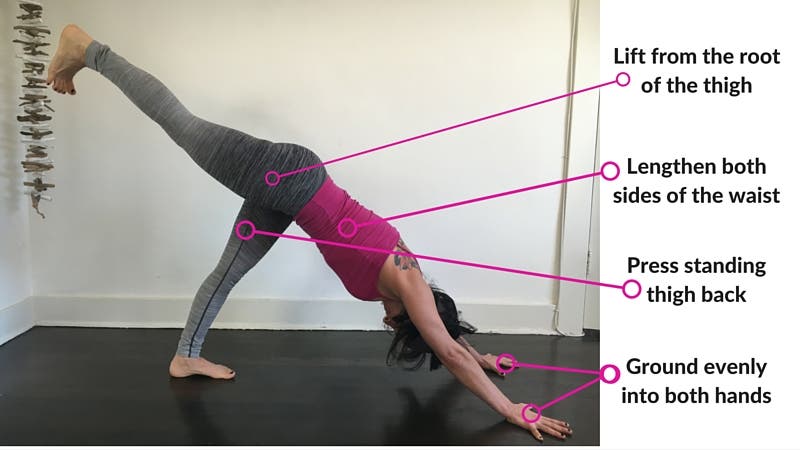
Try lifting the leg from the root of the thigh, deep in the hip socket. Often the weight shifts into the standing leg, so the work is to find length on that side of the waist by pressing the standing thigh straight back into the upper hamstring. This keeps weight evenly grounded into both hands and even space on both sides of the waist for a more balanced low back.
2. Maintain a neutral curve in the lower back
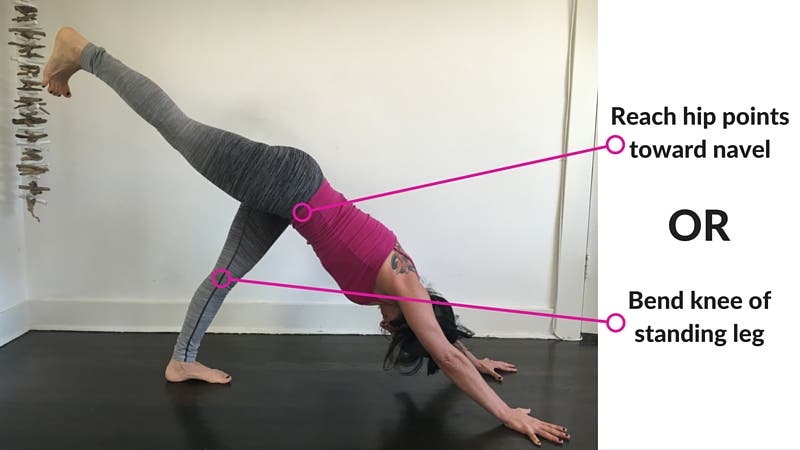
Notice how lifting the leg affects the curve of your low back. If you have open hamstrings, try reaching your frontal hip points up toward your navel as you lift the leg. This will help bring the front body toward the back body and turn on your abdominals to keep you from dumping in the low back. If you have tight hamstrings, try bending the knee of your standing leg to bring more flexion into the hip and avoid any pull in the low back.
3. Turn off your glute max
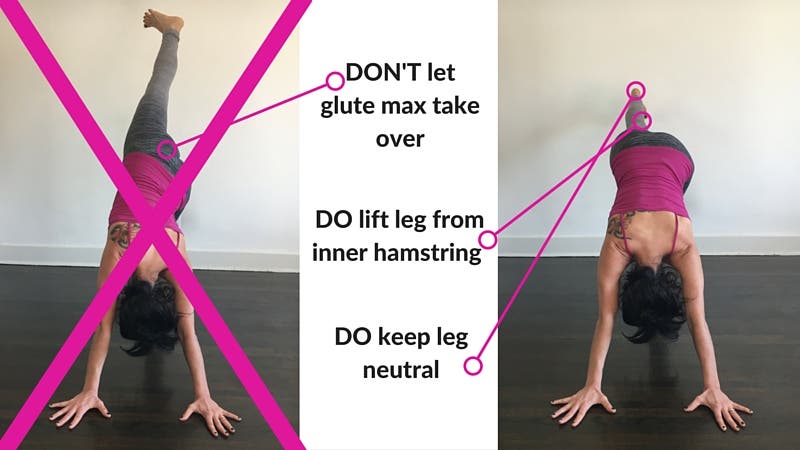
When the lifted leg moves into extension, sometimes the gluteus maximus, which is a hip extensor and external rotator, can muscle through the job of lifting the leg. Unfortunately, it also externally rotates the leg away from neutral in the process. Instead, try lifting the leg from the innermost hamstring, maintaining neutral alignment as the leg moves into extension. This will remind the glute max to stay quiet and employ the hamstrings to do the heavy lifting.
ADVERTISEMENT
4. Flex the foot
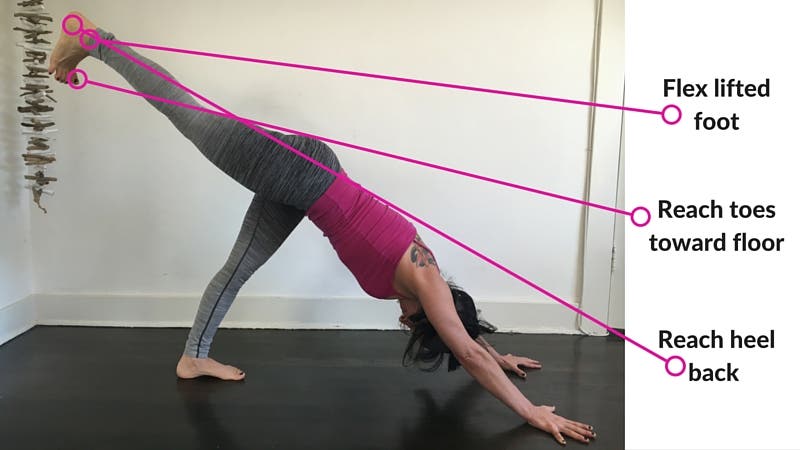
Once the leg is lifted, flex through the foot, reaching the toes toward the floor and the heel toward the back of the room without moving them in space. Notice how that lifts the root of the thigh and, more specifically, that side of the waist, turning on your deepest core muscles.
5. Recommit to your roots
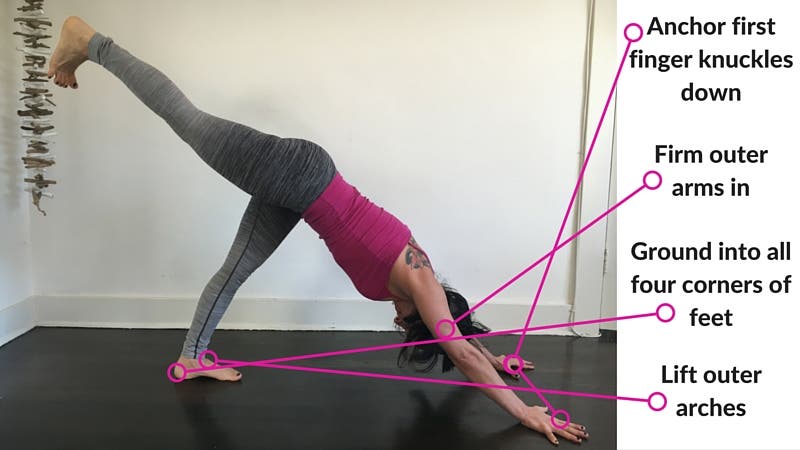
Once a leg is lifted, students often collapse into the outside edge of the opposite hand and foot. Their forearm drops, their side waist shortens, and even the standing leg shifts away from center. Recommit to rooting evenly into the hands. Anchor your first finger knuckles down as you push the floor away and firm the arms into the midline. Check back in with your standing foot: As you ground into all four corners, also lift the outer arch of the standing leg to wake up the outer shin and hug the thigh into the midline.