Updated February 25, 2025 12:45PM
If you buy through our links, we may earn an affiliate commission. This supports our mission to get more people active and outside.Learn about Outside Online's affiliate link policy
Warrior 1 Pose
Virabhadrasana 1 is a foundational yoga pose that balances flexibility and strength in true warrior fashion.

(Photo: Andrew Clark)
Virabhadrasana 1 may be one of the more common yoga poses. It may also be one of the most challenging. Warrior 1 Pose requires you to push past your perceived physical, mental, and emotional limitations to move into a deeper expression of the asana. It’s an opportunity to focus and practice determination.
It may seem strange to name a yoga pose after a warrior; after all, aren’t yogis known for their non-violent ways? But remember that one of the most revered of all the yoga texts, the Bhagavad Gita, is the dialog between two famous and feared warriors, Krishna and Arjuna, set on a battlefield between two great armies preparing for an epic fight.
What’s really being commemorated in this pose’s name—and held up as an ideal for all practitioners, is the “spiritual warrior,” who bravely does battle with the universal enemy, self-ignorance (avidya), the ultimate source of all our suffering.
Warrior 1 Pose is filled with opposing alignments, but when all of the opposing movements work together, the pose offers a full-body experience. You will stretch the ankles and calves, strengthen the quadriceps and back, lengthen the psoas, and stretch your upper body and arms. There’s almost no body part that doesn’t reap the rewards of holding Virabhadrasana 1.
ADVERTISEMENT
Sanskrit
Virabhadrasana I (veer-uh-buh-DRAHS-uh-nuh)
vira = hero
bhadra = friend
ADVERTISEMENT
How to do Warrior 1 Pose
- From Adho Mukha Svanasana (Downward-Facing Dog Pose), step your right foot forward so your toes are in line with your fingertips, and shift your foot slightly to the right.
- Bend your front knee 90 degrees. Your thigh should be approximately parallel to the floor, your knee stacked over your ankle, and your right outer hip pinned back.
- Pivot your left heel to the floor so your foot forms a 45-degree angle to the side of the mat. Align your left heel with your right heel, or place the feet slightly wider for more stability.
- Press your left thighbone back so your left knee is straight.
- As you inhale, raise your torso and reach up with the arms, hands shoulder-distance apart and palms facing each other. Allow your shoulder blades to open out and up, away from your spine and toward your outer armpits. Rotate your biceps back, and firm your triceps into your midline. You may bring your palms together and look up at your thumbs.
- Keep pressing your left femur back while releasing your tailbone toward the floor. Draw your lower belly back and up away from your right thigh.
- Hold for 5–10 breaths.
- Release your hands to the floor, step back to Downward-Facing Dog, and repeat on the other side.
Warrior I variations
This pose can be performed with your arms in various positions. For example, you can keep your hands resting on your hips or you can clasp your hands behind your back, stretch your knuckles away from you, and lift your chest.
Or, try one of these creative variations:
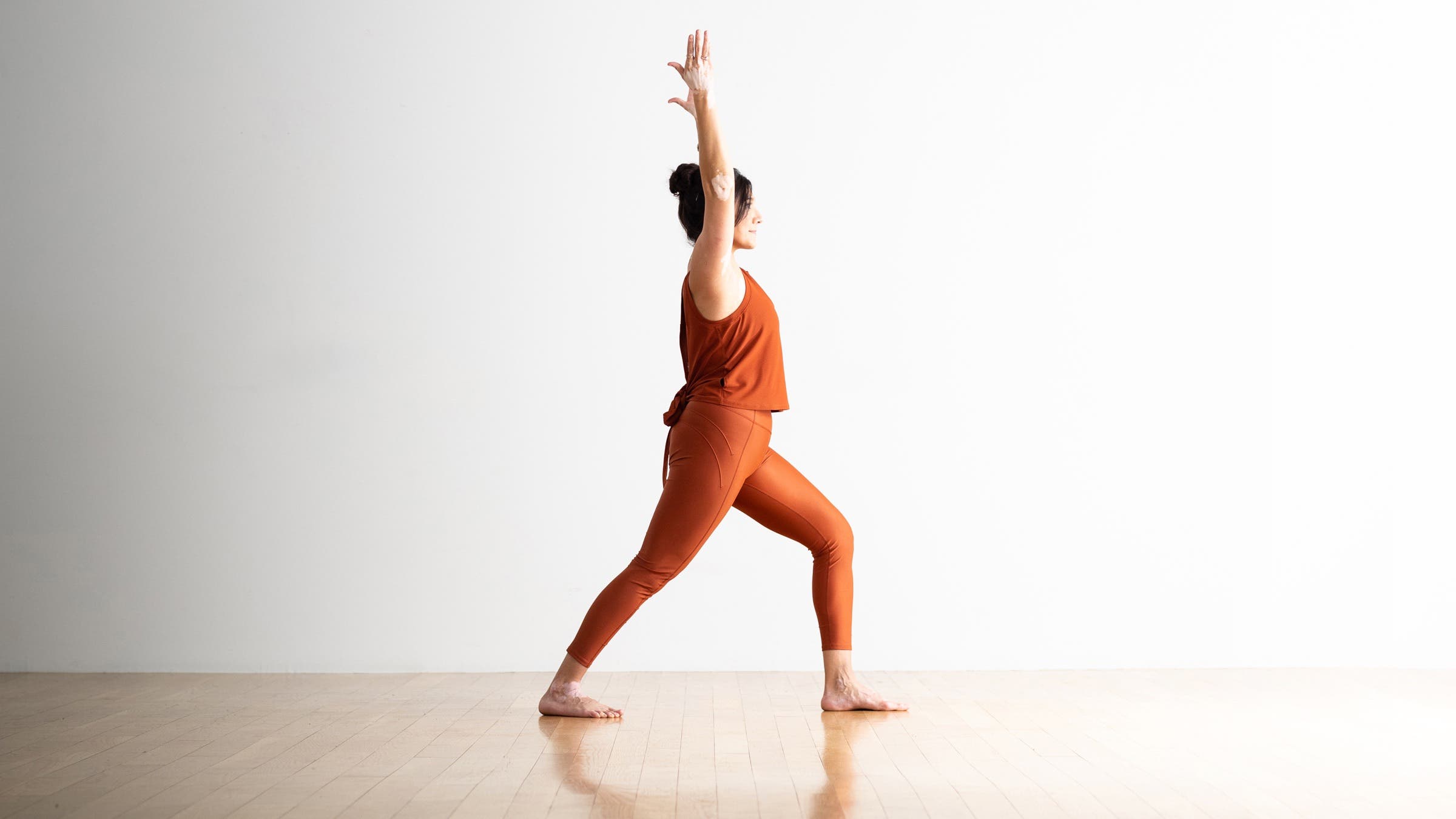
Warrior I with a shorter stance
Take a shorter stance so your feet are closer. You can still keep your feet hip-distance apart for balance. This will keep you more upright. Make sure your front knee is either directly above your ankle or behind it (not in front of it). If this position is not comfortable or possible for your back foot, try tucking your toes under and lifting your heel as you would in High Lunge.
ADVERTISEMENT
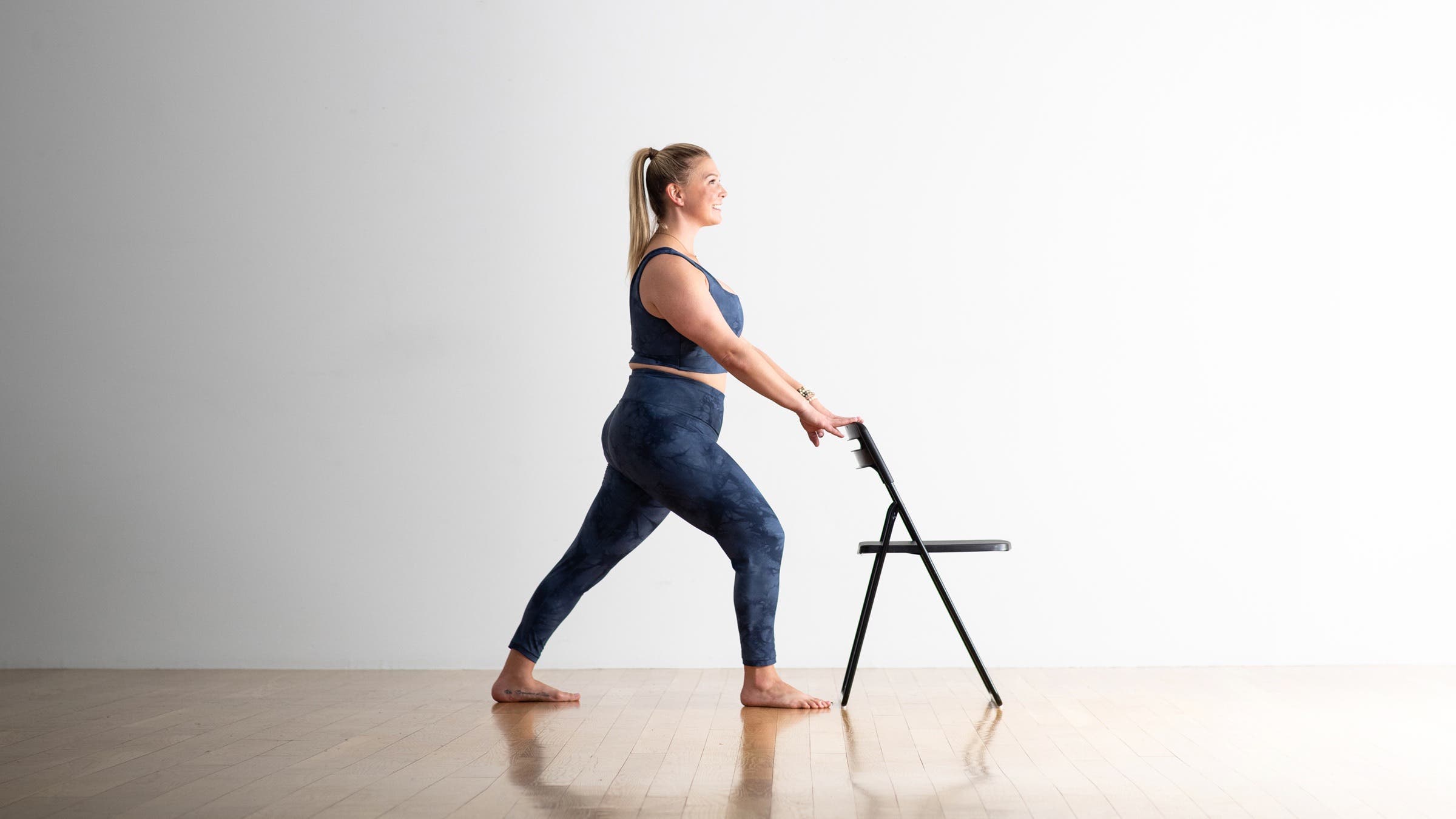
Warrior I holding onto a chair
Try holding onto a chair for better balance. Stand facing the back of a sturdy chair, holding onto it lightly, then step one foot pack into position. To test your balance, let go of one or both hands for a few moments.

Warrior I seated in a chair
Sit near the front edge of a sturdy chair. Turn your body to the right and move your buttocks closer to the left edge of the chair to create a support for you right thigh. Extend your left leg back and straighten it as much as possible.
ADVERTISEMENT
If it’s comfortable, tuck your back toes under in a lunge position. If not, keep your foot flat on the ground. Lift your arms up if comfortable, or place your hands on your hips or on the seat of the chair for support.
Pose basics
Pose type: Standing
Targets: Full body
Benefits: Warrior I strengthens and stretches your legs and buttocks (glutes), the front of your hips (hip flexors), and shins. In your front leg, this pose strengthens the your thigh, calf, and ankle. In your back leg, it stretches the back of your thigh (hamstring) and calf muscles.
It’s also a powerful pose for the upper body. Reaching up stretches your torso from your psoas along your chest up to your shoulders. It also stretches and strengthens the area around your shoulders and builds power in your back and arms.
ADVERTISEMENT
Other Warrior I perks:
- Boosts energy, helps fight fatigue, and improves balance
- May help build confidence and empowerment
- Improves posture and counteracts the effects of prolonged sitting and doing computer work
Beginner tips
- Yoga teacher Annie Carpenter explains that the greatest challenge in this pose is often maintaining the deep bend in the front knee while reaching the torso upward without compressing the lower back. She advises students to bring the pelvis toward a more upright or neutral position by lifting your front hip points.
- If you are new to the pose or have low back concerns, ease up on the bend in your front knee. This lessens the intensity of the pose and also lessens the compression in your lumbar region.
- The front knee may tend to drift inward in Warrior I. Engage the muscles on the outer side of your bent knee to subtly draw the knee toward the side of your mat. Move the knee just enough to offset the inward rotation and keep your knee directed forward.
- If you feel unbalanced in the pose, create a more stable base by inching your front foot a little farther out to the side from the center of your body. The wider your stance, the better your balance.
Partnering
Here’s a partnering exercise for three people. (It’s helpful if you and your partners are similar in height.) You need a thick pole like a broomstick. Have your partners stand, facing you, to either side of your torso and hold the pole horizontally above your head. Grasp the pole with your raised hands, then you and your partners push the pole up until your arms are fully extended. Imagine then, as all three of you push, that your torso and legs are “hanging” from the pole.
Deepen the pose
After you raise your arms overhead and find your balance in the pose, you can go deeper by bringing your palms together overhead and looking up to your thumbs. If you take this variation, be mindful not to let your ribs flare open.
Common misalignments
- Make sure not to aggressively tuck your tailbone. It creates tension, constricts the breath, and blocks energetic flow from your back heel to your head.
Be mindful!
- If you feel a strain on your back knee, engage your thigh muscles as if you meant to draw your kneecap toward your hip while you keep your back leg fully straightened.
- Keep your front knee aligned directly over the ankle and heel. Don’t let it move ahead of your ankle or away from center. Avoid or modify if you have a hamstring or groin tear or injury, or if you have a hip injury or hip replacement.
- If you tend to easily come off balance, consider a pose variation using a chair or the wall for stability.
- If the foot position causes pain to your back foot, ankle, or knee, modify the pose and try Anjaneyasana (Low Lunge) foot position with the back heel lifted off the mat. Or you can take a shorter stance.
- Do not tense your shoulders up toward your ears in this posture. If you find that you cannot keep your biceps by your ears and your arms straight without experiencing shoulder discomfort, let your arms fall away from one another in a “V” shape until your shoulders are able to release. If your shoulders ache, bring your palms together in the center of your chest instead of lifting them.
Why we love this pose
“Warrior 1 has a reputation for being a basic, vanilla pose—no sprinkles or syrup. But it is a pose that helps you really focus on alignment and positioning,” says Tamara Jeffries, Yoga Journal’s senior editor. “Are the hips facing forward? Is there space in your lower back? Where is your center of gravity? How are you grounding with your feet? If you’re holding it for a while, it’s a real power pose—in more ways than one. It takes some strength, yes, but the pose is very heroic and victorious.”
ADVERTISEMENT
Teacher tips
These tips will help protect your students from injury and help them have the best experience of the pose:
- Beginners may find it difficult to keep the back heel grounded and the lower back lengthened in this pose. As a short-term solution, advise students to raise their back heel on a sand bag or other height.
- If you’re teaching students with shoulder problems, have them keep their raised arms parallel (or slightly wider than parallel) to each other, rather than bring the palms together. Alternately, they may want to keep their hands on their hips.
Preparatory and counter poses
Prior to practicing Warrior I, take your time in poses that stretch your hamstrings and shoulders and align your hips toward the front of the mat. Afterward, come into poses that lengthen your back to counter the slight backbend of Warrior I.
Preparatory poses
Adho Mukha Svanasana (Downward-Facing Dog)
Parsvottanasana (Intense Side Stretch/Pyramid Pose)
ADVERTISEMENT
Counter poses
Adho Mukha Svanasana (Downward-Facing Dog)
Uttanasana (Standing Forward Bend)
Virabhadrasana II (Warrior II)
Parivrtta Parsvakonasana (Revolved Side Angle Pose)
ADVERTISEMENT
Anatomy
Warrior I demonstrates the concept of balancing simultaneous movements in different directions to create stillness. As your front hip bends and descends to stabilize the pelvis, your chest lifts upward. At the same time, that bend in the front hip creates a sense of forward movement while your back hip extends to maintain your rear foot on the mat in a grounding fashion. As a result of these simultaneous movements and unleashed tension, your body becomes a storehouse for potential energy.
In the drawings below, pink muscles are stretching and blue muscles are contracting. The shade of the color represents the force of the stretch and the force of contraction. Darker = stronger.
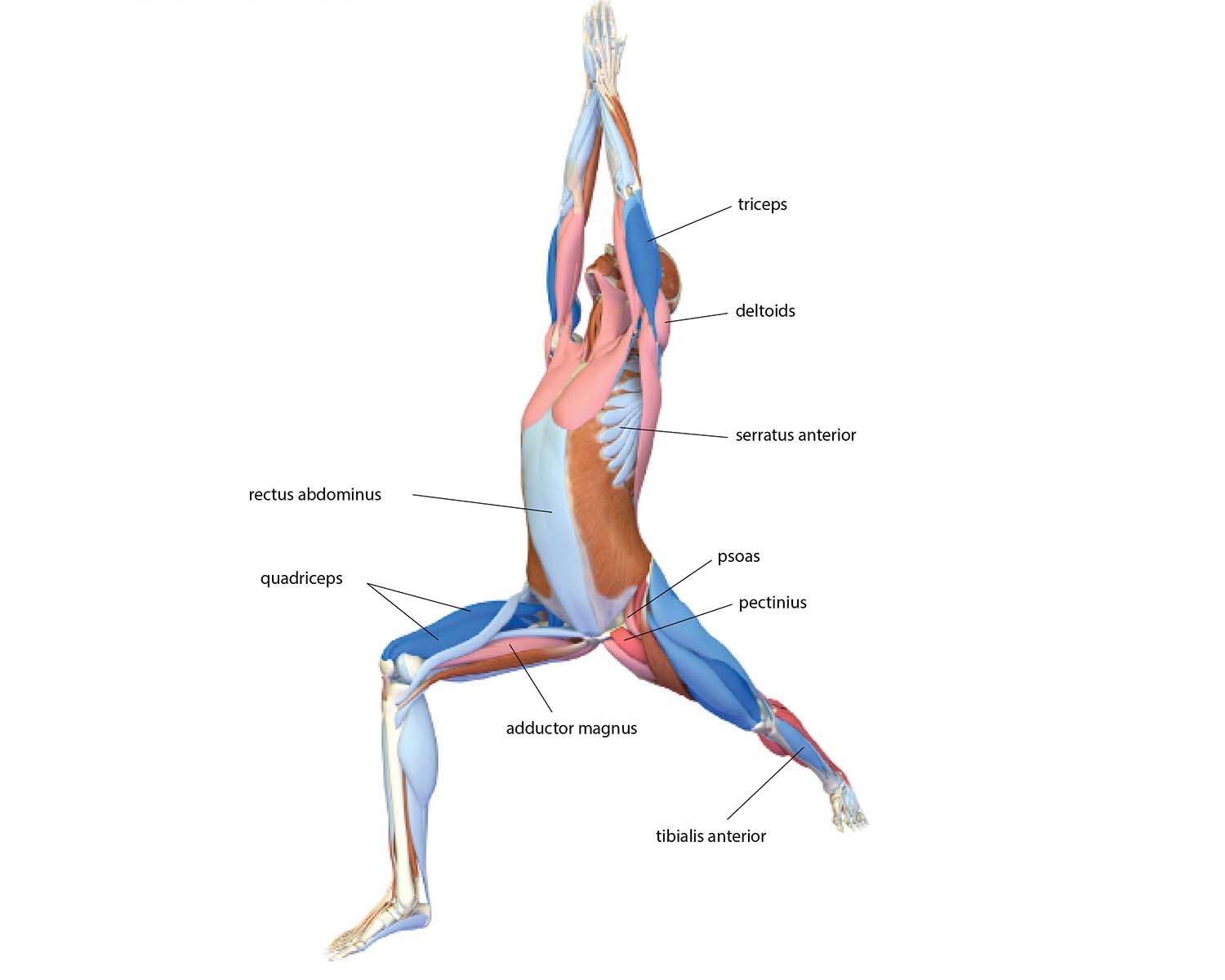
The flex in your front hip happens as a result of the contraction of your psoas and pectineus. The front knee has a tendency to drift inward in this pose. Continue to engage the abductor muscles on your outer front leg to keep your knee pointed straight ahead.
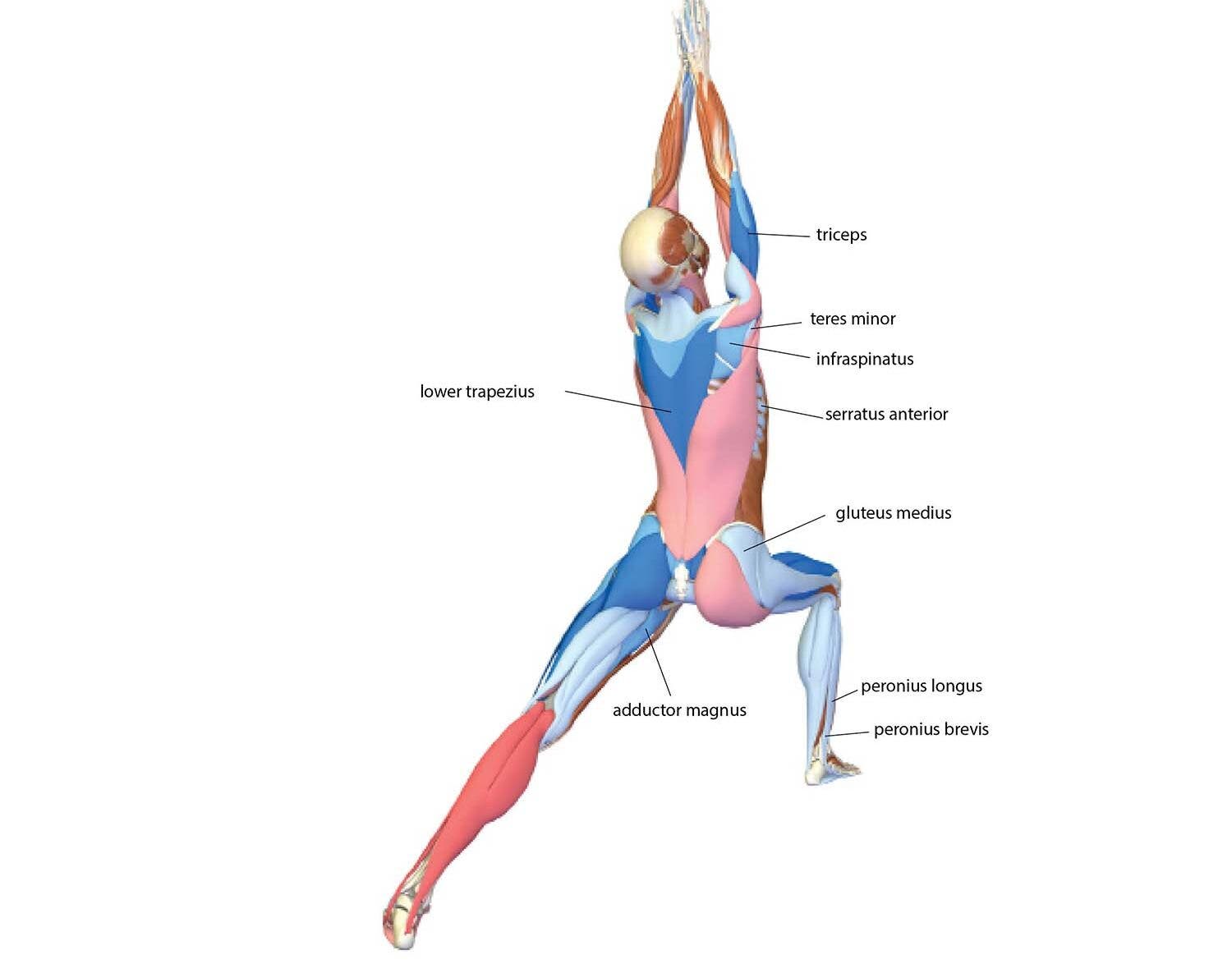
The muscles that extend from your heel to above your hips along your back body create a line of forceful engagement even if there is no apparent movement. These muscles include the tibialis anterior, adductor magnus, gluteus maximus, gluteus minimus, quadratus lumborum, and erector spinae.
Bring your attention to your chest and shoulders. The lower part of the trapezius muscle draws your shoulders down your back, releasing tension from your neck. The serratus anterior runs from the side of your rib cage to your shoulder blade and turns the lower edge of the shoulder blade outward. The contraction of the infraspinatus and teres minor muscles roll your arm bones outward and open your chest. The front deltoids activate and shorten to raise your arms. The triceps straighten your elbows while assisting the serratus anterior in rotating the scapulae.
Draw your lower ribs downward to engage the rectus abdominus that runs along your chest.
Excerpted with permission from The Key Poses of Yoga and Anatomy for Vinyasa Flow and Standing Positions.
ADVERTISEMENT
Put Warrior I into practice
Here are a few flows to try that feature Warrior I:
- A Home Practice to Awaken Your Inner Warrior
- A Sequence for (Re)connecting to Your Heart
- 9 Clarifying, Cleansing Poses to Welcome Spring
About our contributors
Teacher and model Natasha Rizopoulos is a senior teacher at Down Under Yoga in Boston, where she offers classes and leads 200- and 300-hour teacher trainings. A dedicated Ashtanga practitioner for many years, she became equally as captivated by the precision of the Iyengar system. These two traditions inform her teaching and her dynamic, anatomy-based vinyasa system Align Your Flow. For more information, visit natasharizopoulos.com.
Ray Long is an orthopedic surgeon and the founder of Bandha Yoga, a popular series of yoga anatomy books, and the Daily Bandha, which provides tips and techniques for teaching and practicing safe alignment. Ray graduated from the University of Michigan Medical School and pursued post-graduate training at Cornell University, McGill University, the University of Montreal, and the Florida Orthopedic Institute. He has studied hatha yoga for over 20 years, training extensively with B.K.S. Iyengar and other leading yoga masters, and teaches anatomy workshops at yoga studios around the country.
