Updated February 25, 2025 12:37PM
If you buy through our links, we may earn an affiliate commission. This supports our mission to get more people active and outside.Learn about Outside Online's affiliate link policy
Bridge Pose
Setu Bandha Sarvangasana can be whatever you need—energizing, rejuvenating, or luxuriously restorative.
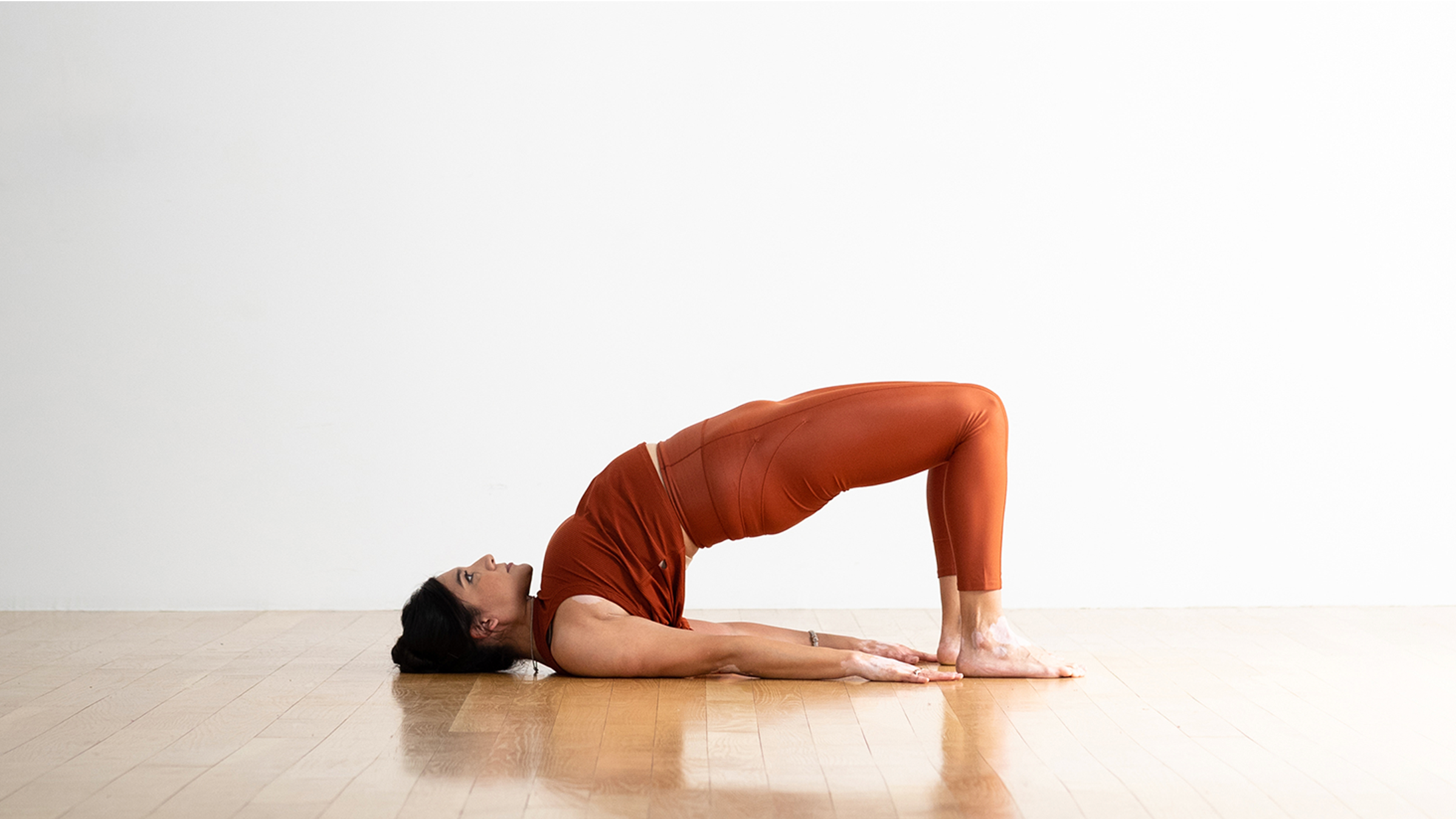
(Photo: Andrew Clark)
Bridge Pose (Setu Bandha Sarvangasana) is a versatile pose. It can be performed dynamically or restoratively, as a strengthener or as a resting pose. It allows you ample options for finding a version of the backbend that works for you.
When you practice Bridge, the shape you make with your body uses all your limbs. Maybe what’s being bridged is your understanding that yoga doesn’t need to come from a place of struggle or mustering effort and that it can instead be about breathing and finding ease.
Sanskrit
Setu Bandha Sarvangasana (SET-too BUHN-dah Sahr-von-GAH-sah-nah)
Setu = bridge
Bandha = lock
Sarva = all
Anga = limb
ADVERTISEMENT
How to do Bridge Pose
- Lie on your back with your knees bent and your feet on the mat, hip-distance apart. Inch your feet as close to your glutes as you can.
- Bring your arms alongside your body, palms down.
- As you inhale, press down firmly through your feet and lift your hips, initiating the movement from the pubic bone rather than the navel.
- Press your upper arms down. You can clasp your hands behind your back and press your pinkie fingers into the mat. Broaden your collarbones and roll your shoulders beneath you.
- Continue to press down firmly through your heels and draw your thighs toward one another to keep them hip-distance apart. Reach the backs of your thighs toward your knees to lengthen your spine.
- To finish, exhale as you release your hands and slowly lower yourself to the mat.
Variations
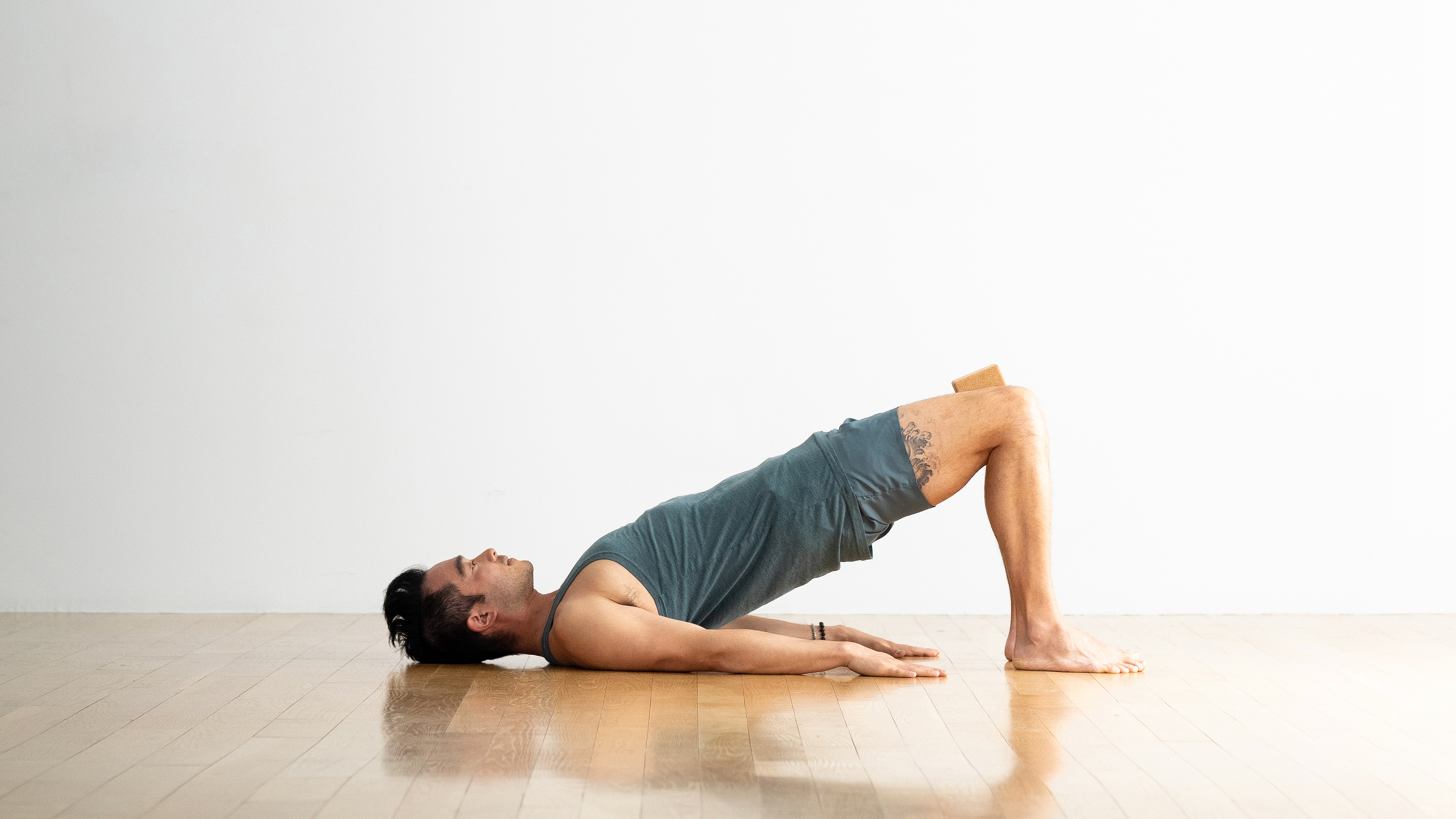
Bridge Pose With a Block
If you or your students tend to splay your knees to the side, place a block between your thighs and squeeze. This develops strength in the adductor muscles of the inner thighs.
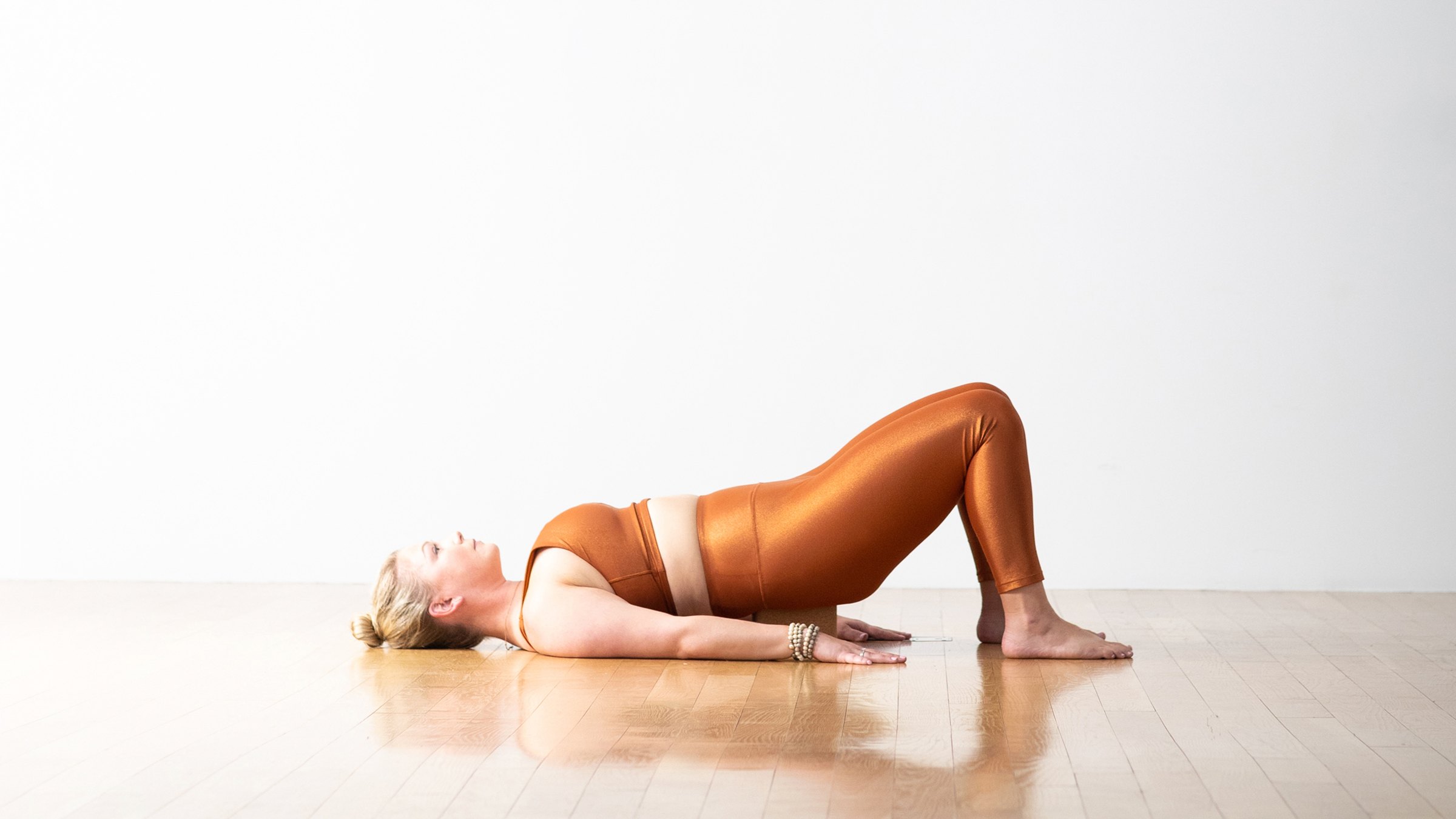
Supported Bridge Pose
For a more restorative approach, place a block on its lowest or medium height under your sacrum, the flat part of your very low back. You may want to use a blanket on the block for extra padding. If it’s more comfortable, turn your palms up. Stay here as long as comfortable.
ADVERTISEMENT
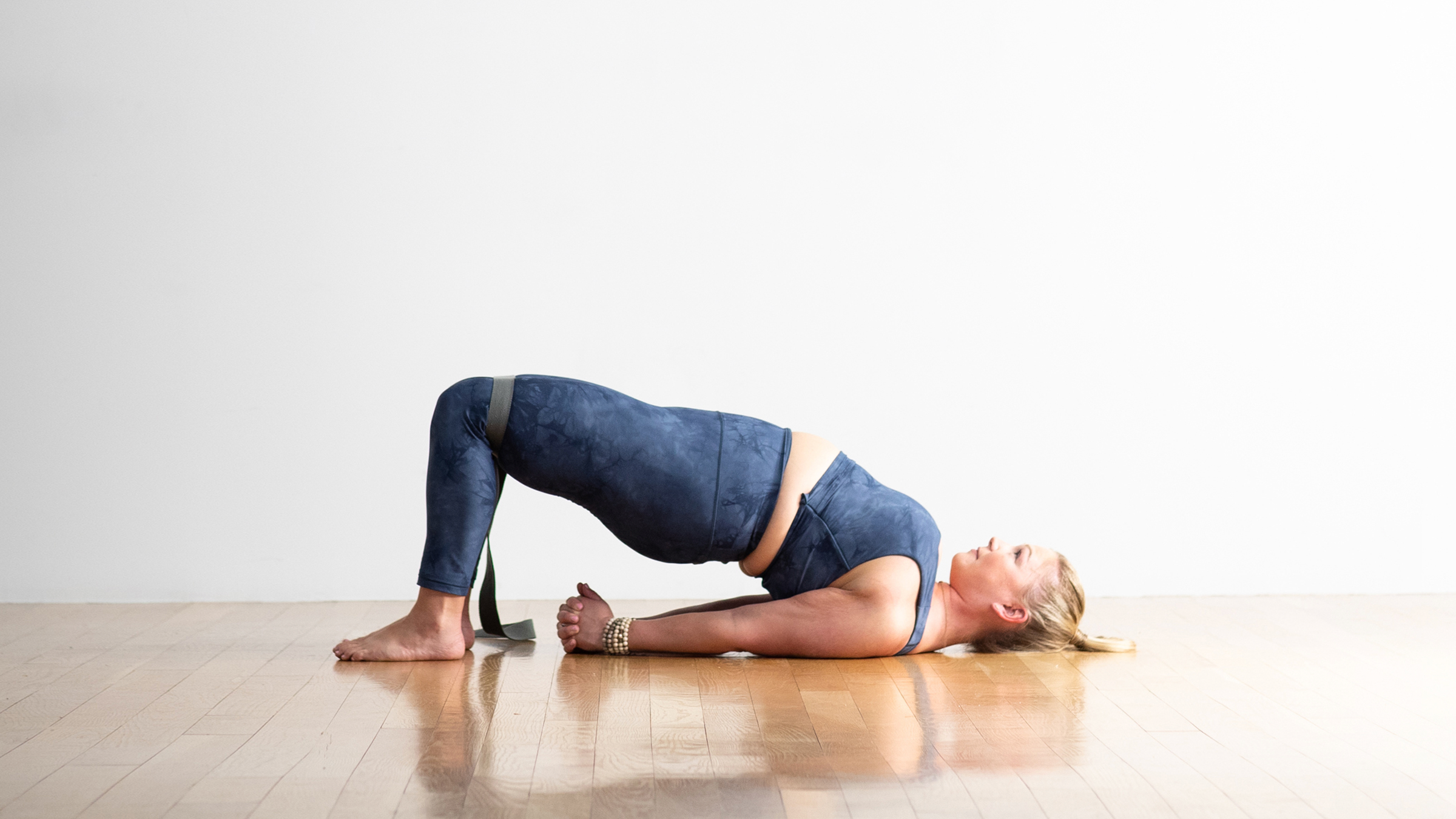
Supported Bridge Pose With a Strap
Bring a looped strap around your thighs, securing it so your knees are about hip-distance apart. For an active version of the pose that strengthens your outer thighs, press your knees against the resistance of the strap (as shown above). For a more restorative version, place a block at any height below your sacrum (the flat part of your very low back) and rest in the pose for as long as comfortable.
Bridge Pose Basics
Pose type: Backbend
Targets: Core
Benefits: Bridge Pose gently stretches your chest, shoulders, and abdomen while strengthening your mid- to upper-back muscles, buttocks (glutes), thighs, and ankles. The backbend can improve posture, counteract the effects of prolonged sitting and slouching, and may help relieve low back pain and ease kyphosis (abnormal curvature of the spine).
Because Bridge Pose brings your head beneath your heart, it shares many of the benefits of conventional inversions. It can be used as an alternative to coming into Headstand and Shoulderstand.
ADVERTISEMENT
Beginner Tips
- If you have tight shoulders or feel intense discomfort when you try to bind your hands behind your back, simply keep your arms alongside your body, palms down.
- Maintaining the natural curve of your neck is a crucial element of the pose. Don’t press the back of your neck into the mat.
- If you clasp your hands, broaden through your chest and shimmy your upper arms underneath your shoulders. Don’t forcefully draw your shoulders away from your ears, which can overstretch your neck.
- Do not turn your head to one side while you’re in this pose. Keep your gaze straight toward the ceiling.
Why We Love Bridge Pose
“Bridge is one pose I can sneak in while getting my kids ready for bed or before or after a workout. In fact, it was one of the first poses I did postpartum—supported, of course, and under the guidance of a physical therapist,” says Erin Skarda, Yoga Journal‘s former digital director. “On its face, Bridge is not a challenging pose, but when you really tune into your body and breath, even slight adjustments (squeeze those pelvic floor muscles, press those hands into the floor!) make it work for you. As a restorative pose, Bridge is the reset my lower back craves post-walk or hike. But when I want to take it up a notch, I add in some single-leg variations or raise and lower my hips. The next thing I know, I’ve had a little workout—all without standing up!”
How to Teach Bridge Pose
- If a student needs more support for an achy or weak back, advise them place a block (experiment with the right height) under their sacrum, the flat triangular bone at the base of the spine. They can rest their weight on the block and focus on keeping their knees hip-width apart.
- For students who wish to make this pose more challenging, invite them to exhale and lift their right knee into their torso, then inhale and extend the leg perpendicular to the floor. Advise them to hold for 30 seconds, then release their foot to the floor again with an exhalation. Then they can repeat the movement with their left leg for the same length of time.
- Once in Bridge Pose, lift your heels off the floor to lift higher and push your tailbone up, a little closer to the pubis. Then lower the heels back to the floor again.
- “When your Bridge is aligned so that there is no compression in the lower back and the emphasis is on opening the middle and upper back, the pose can release tight spots in ways that will benefit you in both your practice and your daily life,” explains Yoga Journal contributor Natasha Rizopoulos. “It will also help you in Shoulderstand (Salamba Sarvangasana) and deeper backbends.”
Preparatory and Counter Poses
Preparatory Poses
Urdhva Mukha Svanasana (Upward-Facing Dog Pose)
ADVERTISEMENT
Counter poses
Paschimottanasana (Seated Forward Bend)
Anatomy
Setu Bandha Sarvangasana combines brings a stretch to the upper body by arching your back and extending your shoulders. Additionally, the pose stretches the hip flexor muscles along the front of the pelvis, explains Ray Long, MD, a board-certified orthopedic surgeon and yoga instructor.
ADVERTISEMENT
In the drawings below, pink muscles are stretching and blue muscles are contracting. The shade of the color represents the force of the stretch and the force of contraction. Darker = stronger.
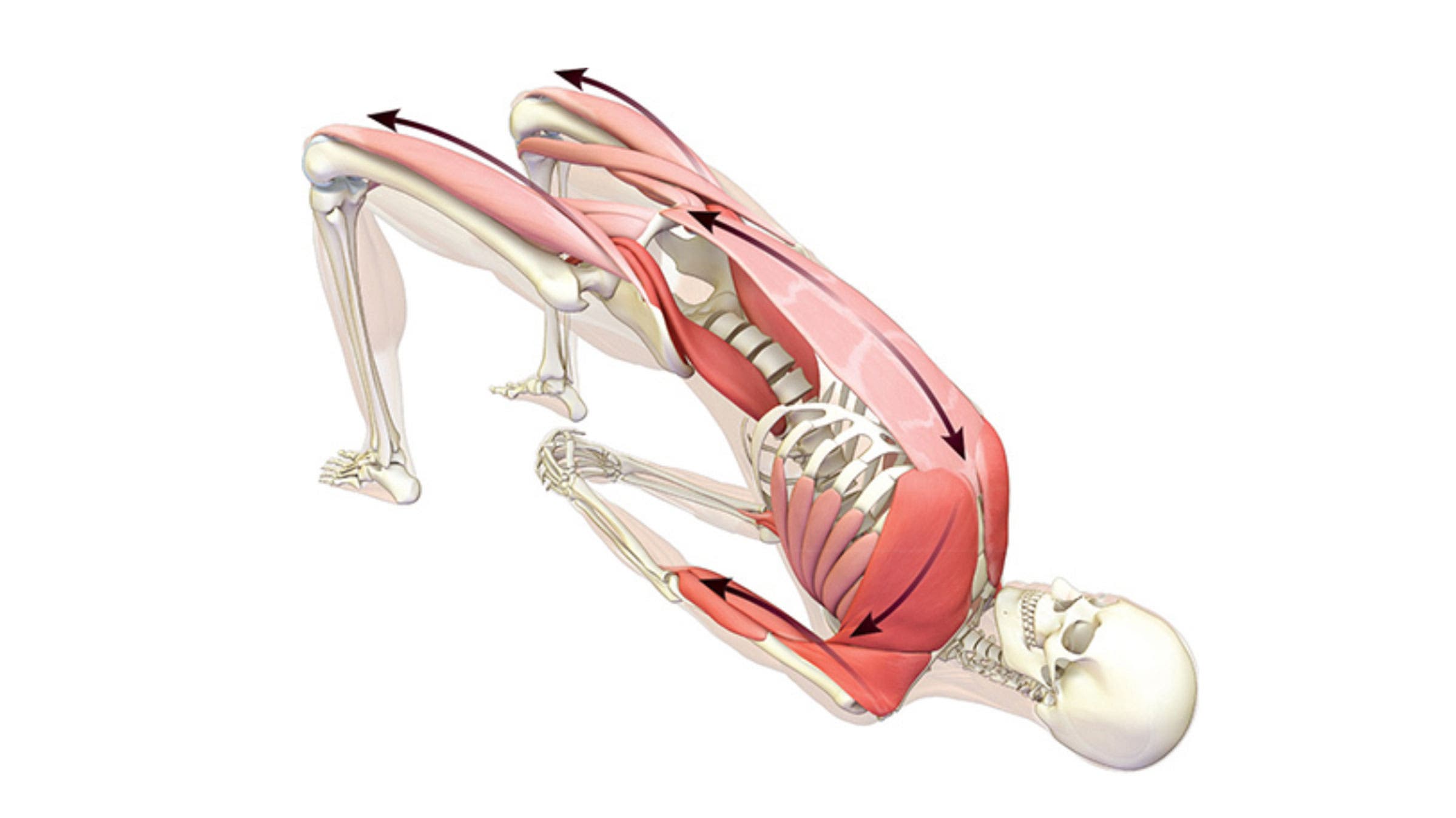
The pose also passively stretches the quadriceps along the front of your thigh and hip flexors of your upper thighs, including the psoas and its synergists: the pectineus, the adductors longus and brevis, and the sartorius. Also lengthened by this pose are the rectus abdominis along your abdomen, the pectoralis major your chest, the deltoids cloaking your shoulders, and the biceps at the front of your upper arms.
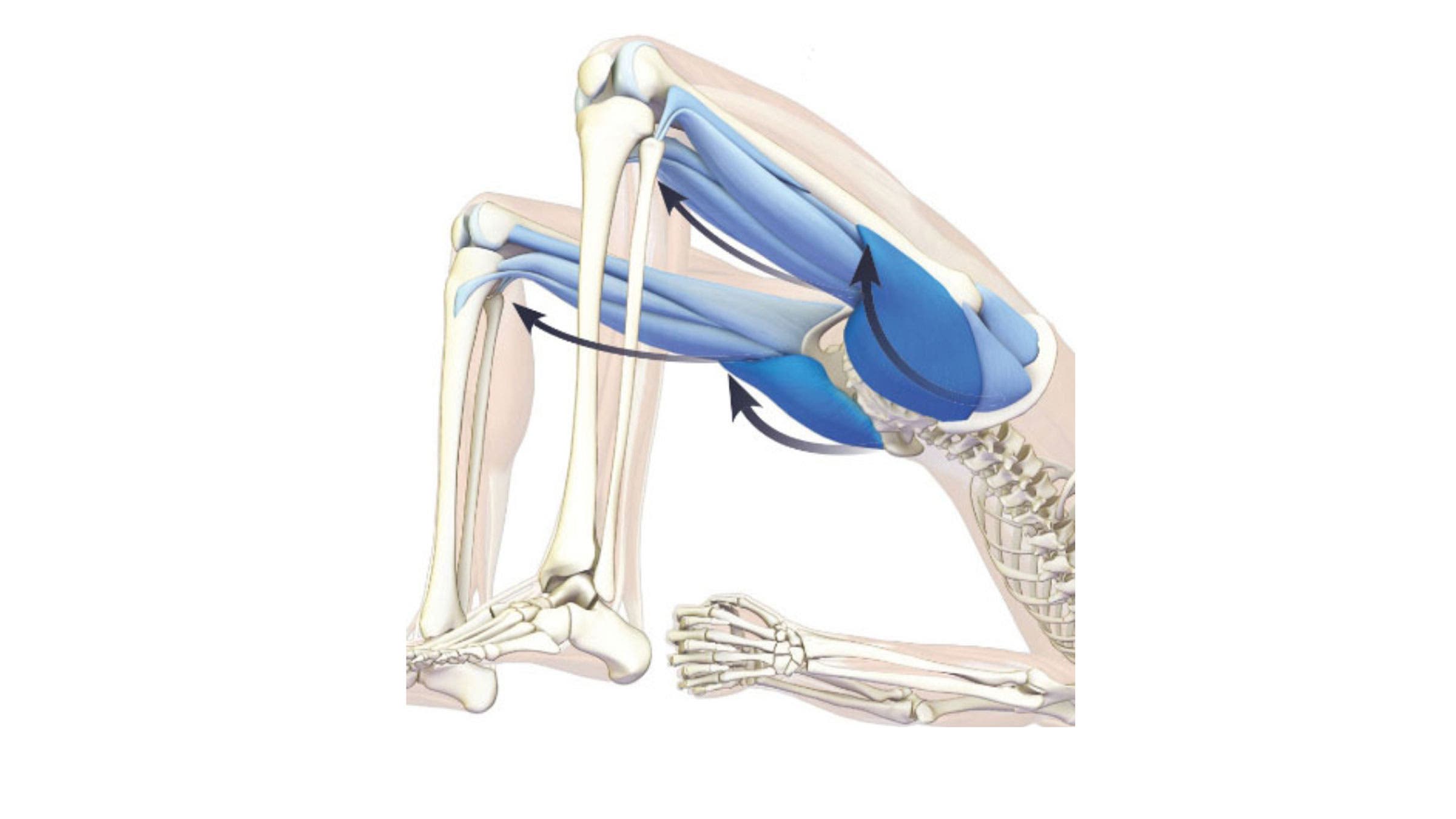
The contraction of the gluteus maximus and hamstring muscles lifts the pelvis.
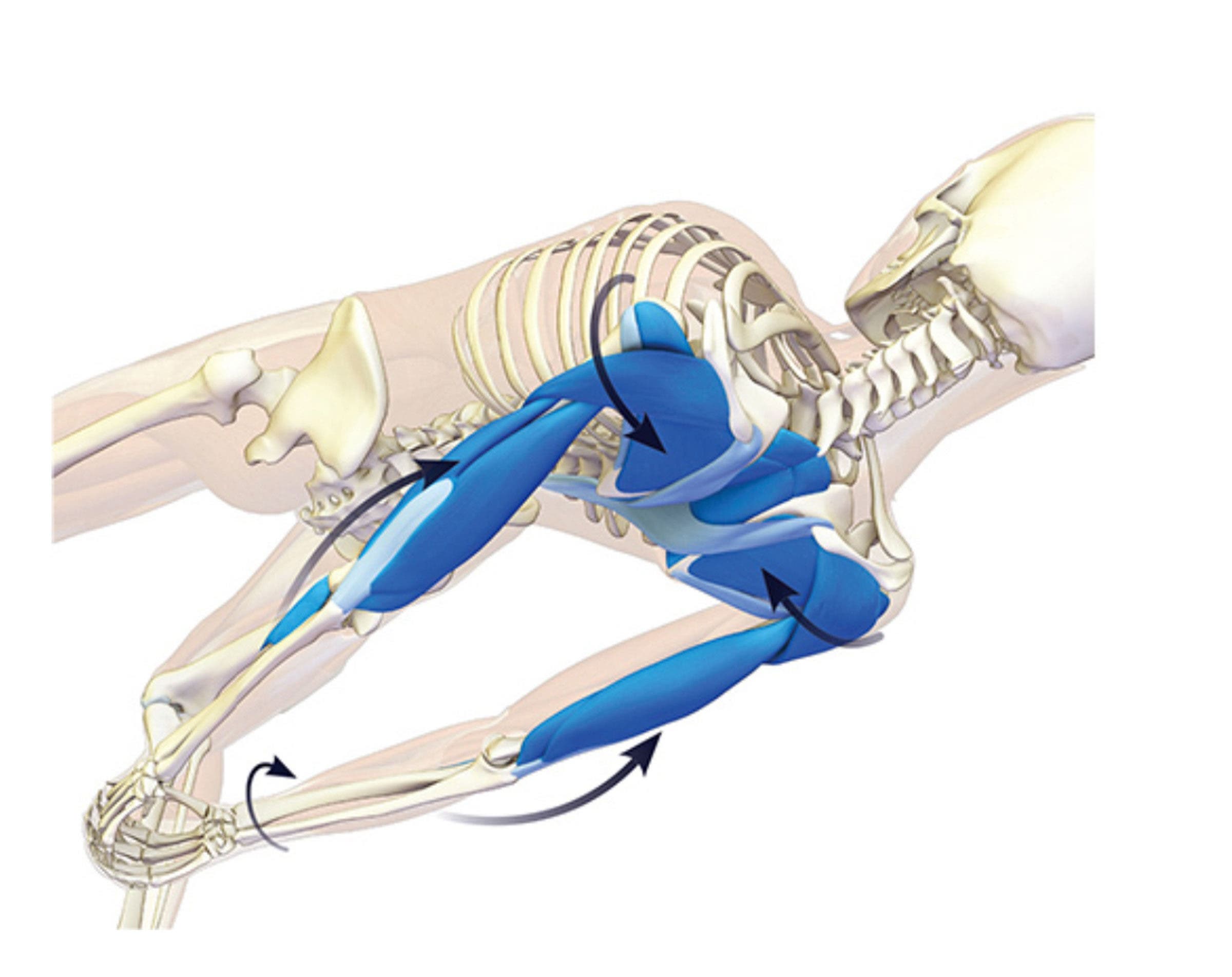
Contracting the triceps extends your elbows and straightens your arms. Interlacing your fingers and gently turning your palms upward supinates your forearms. Drawing your shoulder blades toward the midline of your body stretches the serratus anterior muscles.
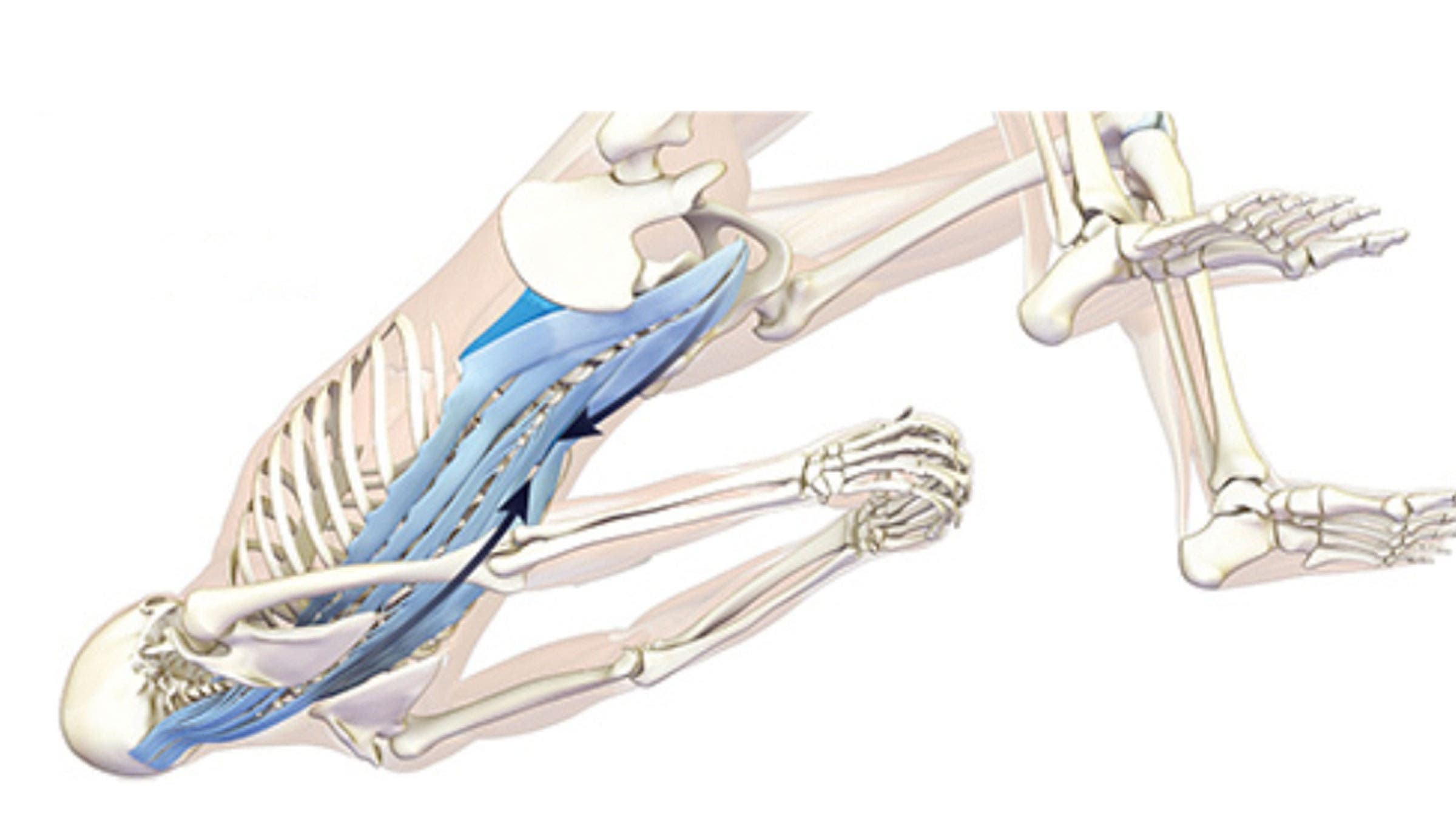
The contraction of the erector spinae and quadratus lumborum muscles along the spine causes your back to arch. Continue to engage these muscles along with the gluteals so the pelvis tilts into retroversion (backward) while the lumbar spine extends.
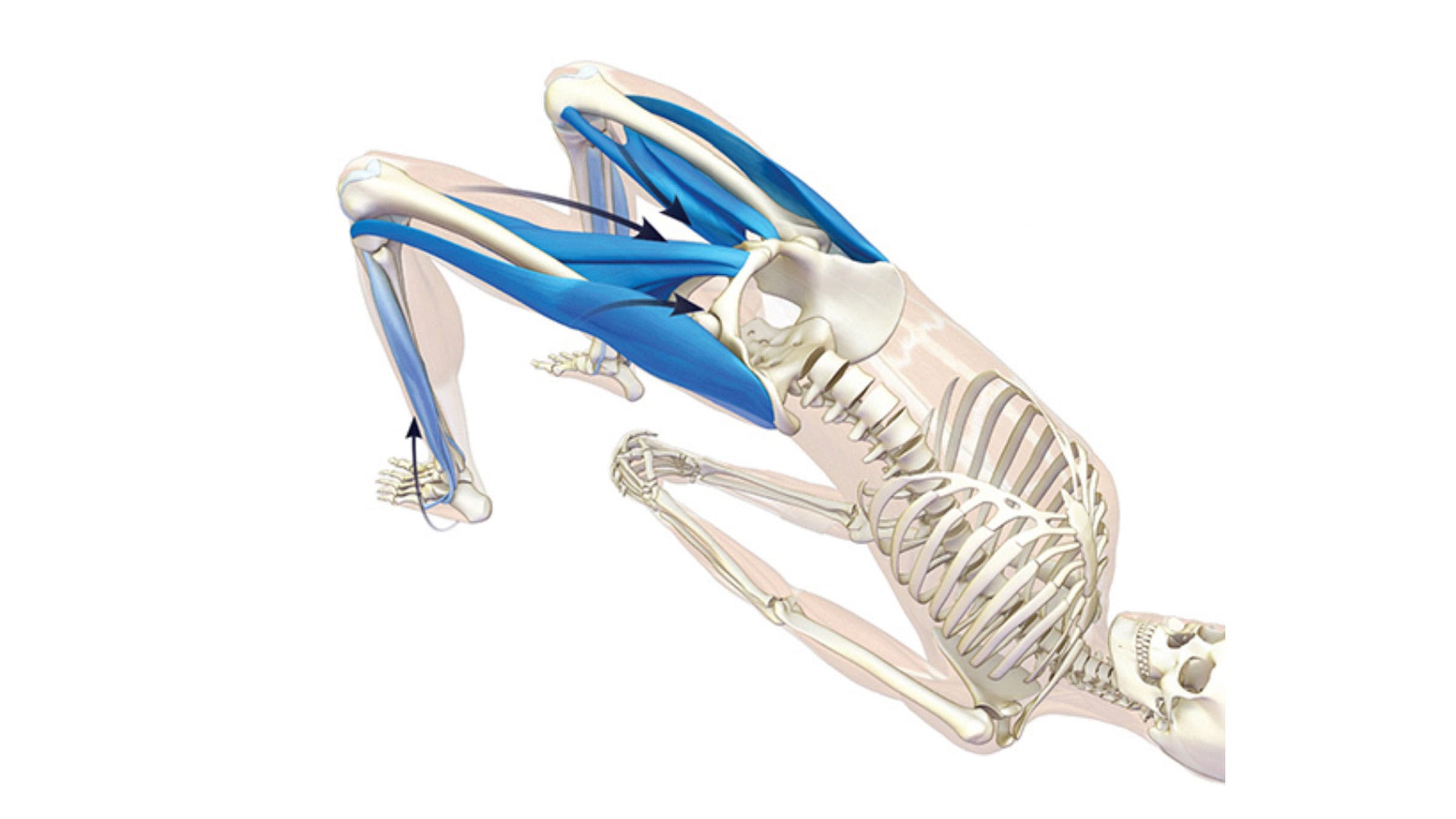
Draw your inner thighs toward one another and slightly down. When you find the shape of the pose, you can relax the hamstrings and activate the quadriceps to deepen the pose. (Because the quadriceps activate the knees, attempting to straighten your knees lifts your torso when your feet are fixed on the mat.)
Excerpted with permission from The Key Poses of Yoga and Anatomy for Backbends and Twists by Ray Long.
Cautions & Contraindications
Avoid this pose if you have a neck or shoulder injury.
Learn more about finding alignment and balancing effort with ease in this pose in Bridge Pose: The Complete Guide for Students and Teachers. You’ll access expert insights from top teachers—including anatomy know-how, variations, and more—on this and other poses when you become a member. It’s a resource you’ll return to again and again.
Setu Bandha Sarvangasana in Practice
10 Yin Yoga Poses to Help You Overcome Fear
These Are the 9 Poses We Turn To When We’re Stressed Out and Anxious
Head Off A Migraine Before It Starts With These Yoga Poses
Same Shape, Different Pose: Bridge, Camel, and Bow
ADVERTISEMENT
About Our Contributors
Teacher and model Natasha Rizopoulos is a senior teacher at Down Under Yoga in Boston, where she offers classes and leads 200- and 300-hour teacher trainings. A dedicated Ashtanga practitioner for many years, she became equally as captivated by the precision of the Iyengar system. These two traditions inform her teaching and her dynamic, anatomy-based vinyasa system Align Your Flow. For more information, visit natasharizopoulos.com.
Ray Long is an orthopedic surgeon and the founder of Bandha Yoga, a popular series of yoga anatomy books, and the Daily Bandha, which provides tips and techniques for teaching and practicing safe alignment. Ray graduated from the University of Michigan Medical School and pursued post-graduate training at Cornell University, McGill University, the University of Montreal, and the Florida Orthopedic Institute. He has studied hatha yoga for over 20 years, training extensively with B.K.S. Iyengar and other leading yoga masters, and teaches anatomy workshops at yoga studios around the country.
