Updated March 22, 2025 12:00AM
If you buy through our links, we may earn an affiliate commission. This supports our mission to get more people active and outside.Learn about Outside Online's affiliate link policy
Corpse Pose | Savasana
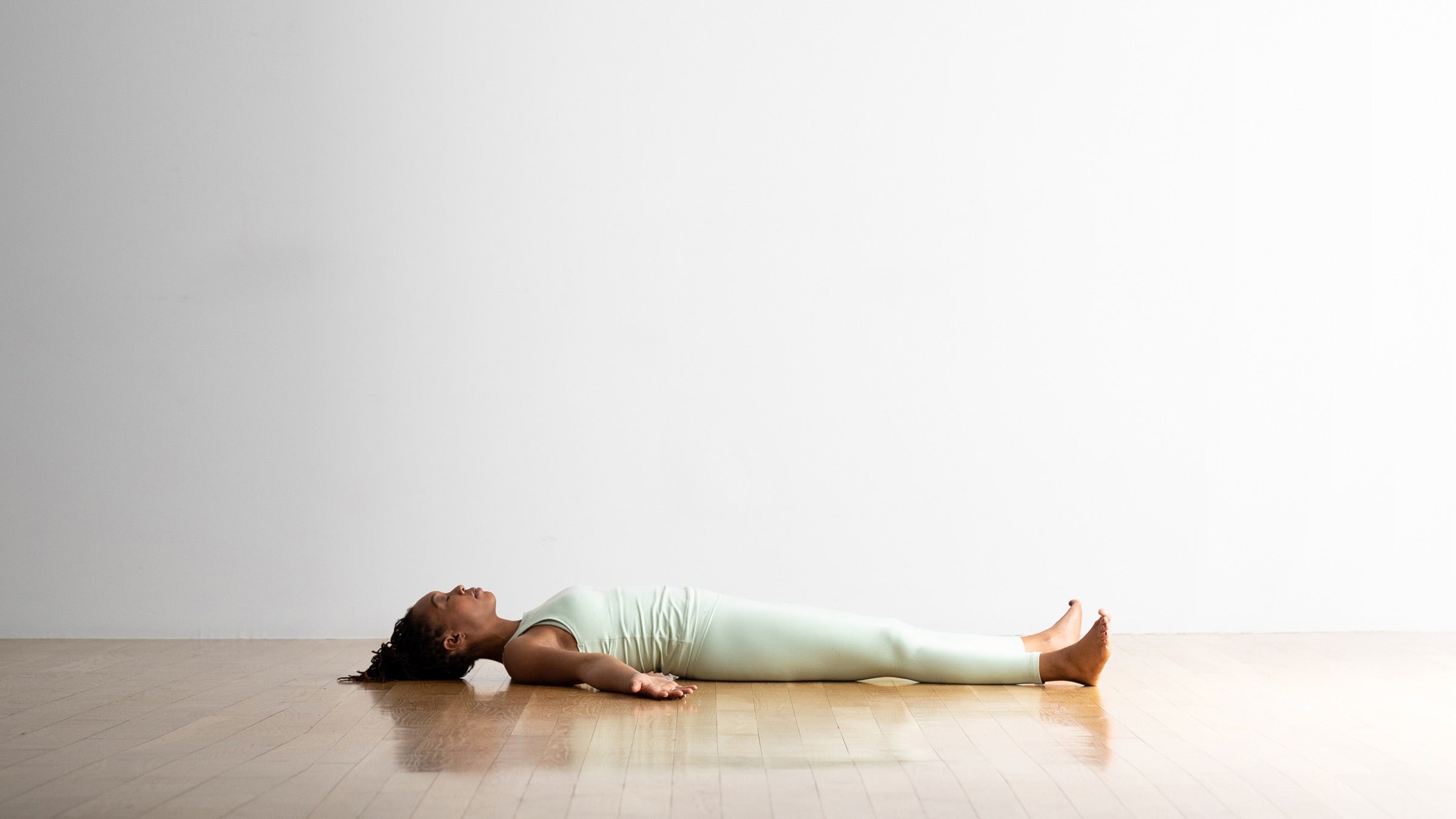
Savasana is a pose of total relaxation—making it one of the most challenging.
(Photo: Andrew Clark)
Despite its many benefits for body and mind, more than a few practitioners still view Savasana (Corpse Pose) as an afterthought, the yogic equivalent of the cool-down in an aerobic workout, and ideal if you have time but not essential. Also, boring. But this final resting pose has a very important purpose in your practice. After using active asanas to stretch, open, and release any tension that might have been in your body, Savasana allows you to integrate the physical practice you just completed.
The key: to find a comfortable, neutral position as you lie on your mat. Lengthen from your neck through your tailbone, open across your chest, and move your shoulder blades away from your spine. Let gravity do the rest. Allow your body to feel heavy; let go and sink into the mat.
Notice your thoughts without getting attached to them. Feel sensations in your body without having to do anything about them. Over time, your mind will start to settle, your nervous system will quiet down, and you may even drop into a meditative state during Savasana. Take this time to recalibrate and reset and experience the yogic teachings of surrender, non-attachment, and self-awareness.
Sanskrit
Savasana (shah-VAHS-anna)
sava = corpse.
This pose is also called Mrtasana (pronounced mrit-TAHS-anna, mrta = death)
ADVERTISEMENT
How to
- Sit on the floor with your knees bent, feet on the floor. Lean back onto your forearms.
- As you inhale, slowly extend your legs with your feet apart and toes turned out equally.
- Narrow the front of your pelvis and soften (but don’t flatten) your lower back. Lift your pelvis off the floor, slightly tuck your tailbone. (You may use your hand to sweep your buttocks away from your lower back. ) Lower your pelvis.
- With your hands, lift the base of your skull away from the back of your neck creating length. If it’s more comfortable, support your head and neck with a folded blanket. Make sure your shoulders are down and away from your ears.
- Reach your arms toward the ceiling, perpendicular to the floor. Rock slightly from side to side and broaden the back ribs and the shoulder blades away from the spine. Then release your arms to the floor, angled evenly away from the sides of the body.
- Turn your arms outward and extend them toward to bottom of the mat. Rest the backs of your hands on the floor. Make sure your shoulder blades rest evenly on the floor.
- Soften your mouth and tongue, and the skin around your nose, ears, and forehead. Let your eyes sink to the back of your head, then turn them downward to gaze toward your heart.
- Stay in this pose for at least 5 minutes.
- To exit, exhale and gentle roll onto one side. Take 2 or 3 breaths. With another exhale, press your hands against the floor and lift your torso, bringing your head slowly after.
Variations
If your low back is achy, relax your back and relieve your legs by placing your mat in front of a chair or couch and lying in the center of your mat with your knees bent. Lift your legs and place the backs of your calves on the seat.
Or, try one of the creative variations below.
Corpse Pose with knee support
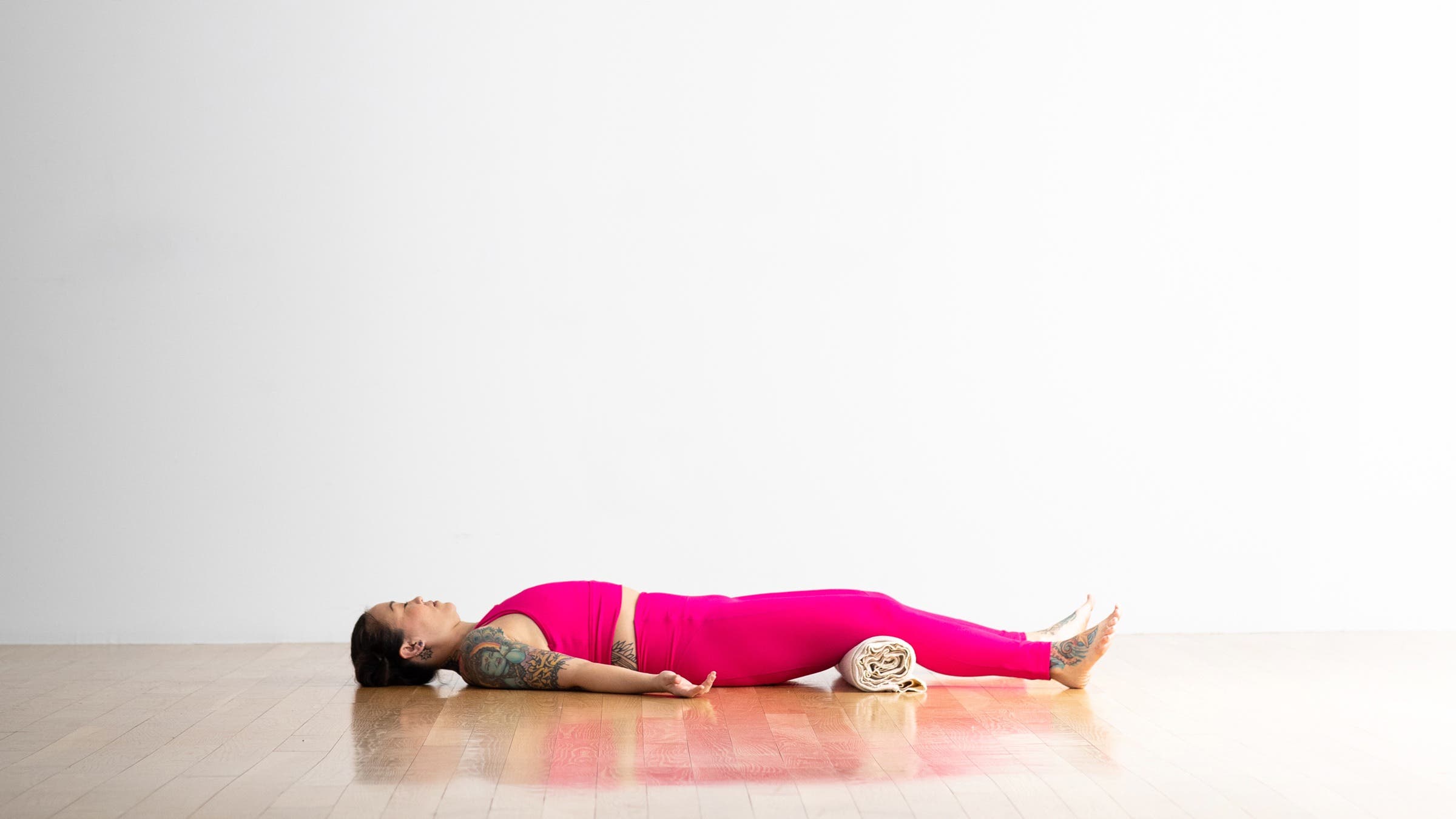
For low back, hip, and knee comfort, put a bolster, rolled blanket, or rolled yoga mat under your knees. You may also want to place a blanket under your head as a cushion.
ADVERTISEMENT
Legs Up a Chair
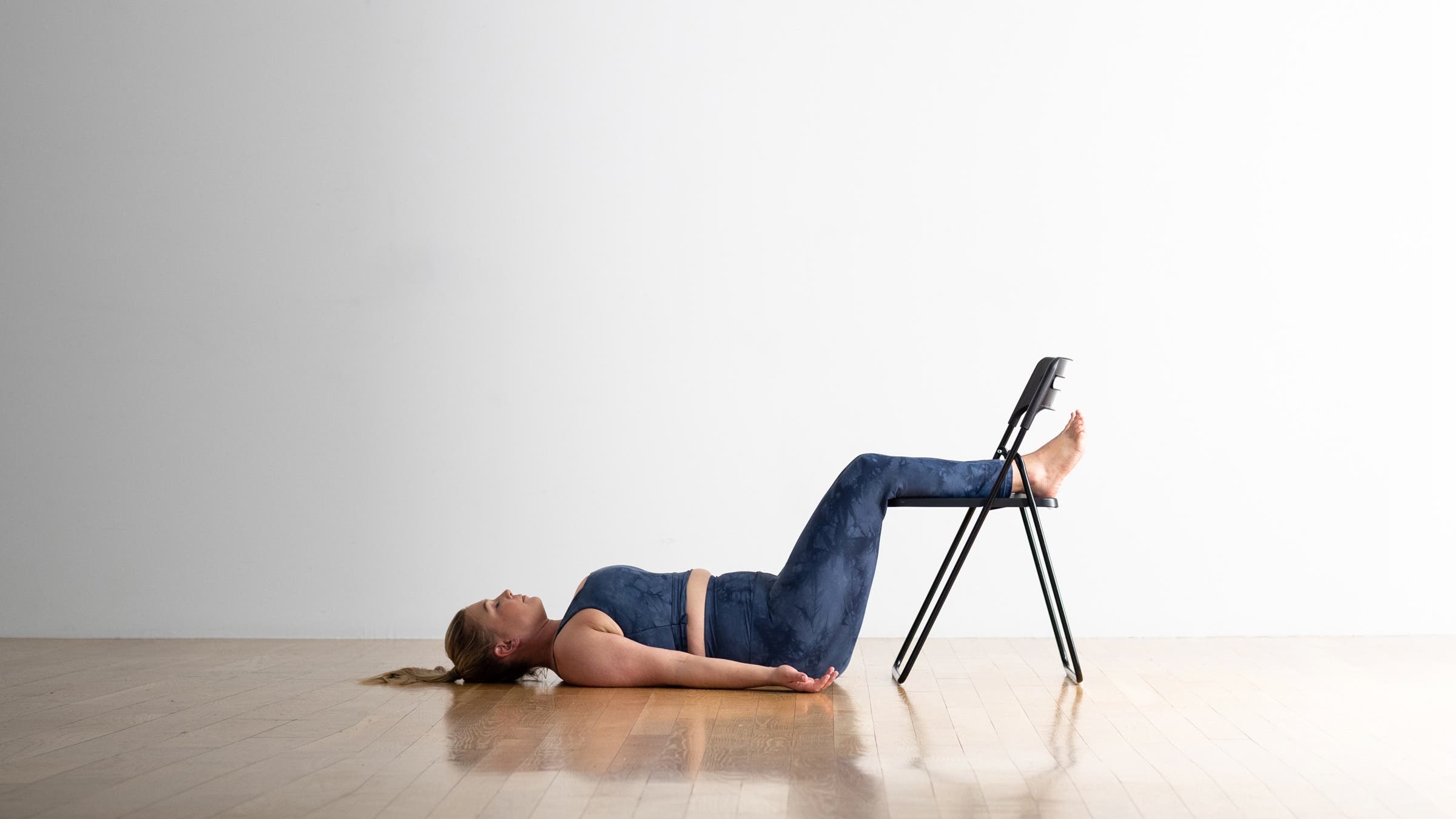
Try lying on your back and putting your legs up on a chair. You may need to turn the chair sideways if the back of the chair gets in the way of your feet. You may also want to use a folded blanket on the chair for extra cushioning.
If you are practicing at home, try lying on the floor and putting your legs up on the couch.
Pose basics
Pose Type: Supine
Target Area: Full Body
Benefits: Corpse Pose can help manage stress by activating the relaxation response (parasympathetic nervous system) and deactivating the stress response (sympathetic nervous system). Savasana may also help lower or regulate blood pressure and can help relieve muscular tension.
ADVERTISEMENT
Beginner tips
- If you find it difficult to quiet your mind during Savasana, try to remove sensory input. Complete darkness can help. You may want to consider trying an eye pillow. Or simply drape the sleeve of a sweatshirt or the edge of a blanket over your closed eyes.
- To help relax the eyes, gently place a soft cloth or eye pillow over your eyes to block out the light and relax the pupils.
- To bring ease to your abdomen, place a block, a pillow, or a few folded blankets horizontally across your lower abdomen.
- To support your neck, place a folded blanket or cushion under your neck and head until your forehead is slightly higher than your chin.
- To reduce tension in the lower back, place a rolled-up blanket or cushion beneath your knees.
Be mindful!
- If you have a back injury or any discomfort, you can do this pose with your knees bent and your feet flat on the mat, hip-distance apart. Either slide a bolster (or a couple pillows) beneath your bent knees and let the weight of your legs rest on the support or bind your thighs parallel to each other with a strap (taking care not to position the heels too close to the buttocks).
- If you are pregnant, raise your head and chest on a bolster.
Modifications and props
- Usually Savasana is performed with the legs relaxed, which can cause them to turn outward. Sometimes though, after a practice involving lots of outward rotation of the legs (as in standing poses), it feels good to do this pose with the legs turned in. Take a strap and make a small loop. Sit on the floor with your knees slightly bent and slip the loop over your big toes. Lie back and turn your thighs inward, sliding your heels apart. The loop will help maintain the inward turn of the legs.
Deepen the pose
- Often it is difficult to release the heads of the thigh bones and soften the groin in this pose. This creates tension throughout the body and restricts the breath. Take two 10-pound sand bags and lay one across each top thigh, parallel to the crease of the groin. Then imagine that the heads of the thigh bones are sinking away from the weight, down into the floor.
Partnering
- In Savasana, it’s especially useful to have a partner check your physical alignment. One of the most difficult parts of the body to align on your own is your head. Have your partner sit at your head and observe its position relative to your shoulders. It’s common for students’ heads to be tilted or turned to one side or the other. The partner should gently cradle your head in his/her hands and draw the base of the skull away from the back of the neck, lengthening the shorter side of the neck, so that both ears are equidistant from the shoulders. Then your partner can lay your head back down on the floor, making sure that the tip of your nose is pointing directly toward the ceiling.
Why we love this pose
“So many people say they look forward to Savasana because it signals that yoga class is finally over. But it’s a difficult pose for some people. If you’re agitated, upset, or have attention deficit challenges, lying still can be a real struggle. I’ve found that people who have experienced trauma may feel too exposed in this ‘spread eagle’ position. Turning down lights and having people close their eyes can also be triggering. You wouldn’t think there would be a need to modify this seemingly simple pose, but when I’m teaching, I offer a lot of options—knees up, hands on your belly, eyes partially open, lights on, even doing it stomach down—whatever will make people feel more like they can relax and absorb the benefits.
Personally, I had one of the most profound experiences while lying in Savasana. I had lain there long enough to be in a completely relaxed but lucid state. (One of the few times I hadn’t drifted off to sleep!) I felt, rather than heard, a voice: ‘Everything you need will come.’ I didn’t move, but suddenly I was really aware that I was receiving an important message. It was incredibly comforting and has given me so much confidence over the years. Whenever my path seems dark or tangled, I remember the promise that came to me in Savasana.” —Tamara Jeffries, Yoga Journal Senior Editor
Preparatory and counter poses
Any poses you practiced prior to Savasana serve as your preparatory poses. Corpse Pose is the culmination of your practice, so there are no counter poses afterward. However, after you slowly make your way out of Savasana, you can follow it with Sukhasana (Easy Pose) for quiet meditation.
ADVERTISEMENT
Your body in Corpse Pose | Anatomy
In Savasana, your body is completely at rest. The various poses completed prior to this position have lengthened the muscles surrounding the various joints and stimulated nerve conduction. It is time to complete your practice through deep relaxation. Find complete repose and relaxation in your body. There should be no strain or discomfort.
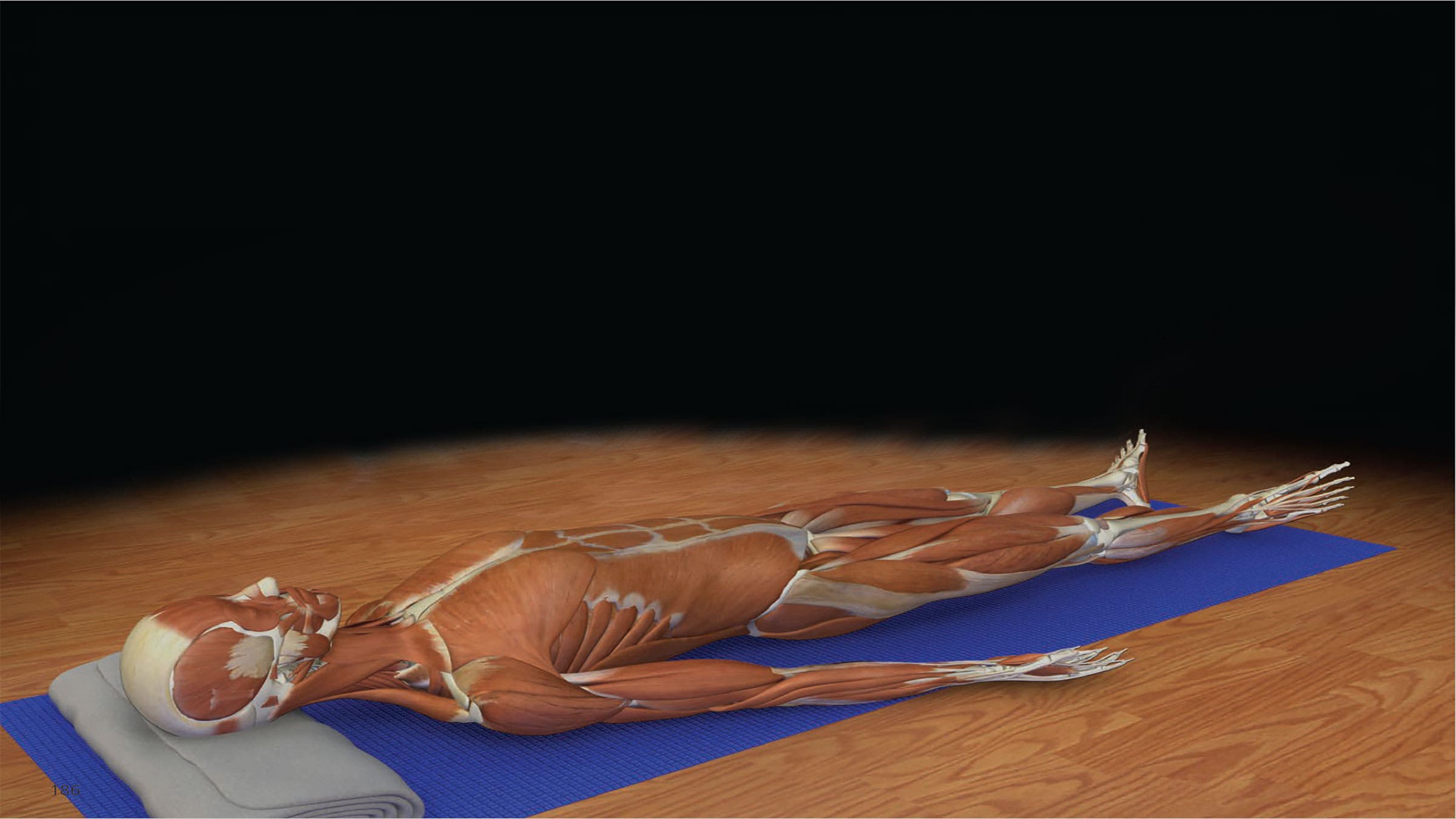
Excerpted with permission from The Key Poses of Yoga by Ray Long.
Put Corpse Pose into practice
- The Subtle Struggle of Savasana
- Heavenly Rest: Why Corpse Pose Is So Key
- Find Serenity Now With This Restorative Yoga Practice
About our contributors
Teacher and model Natasha Rizopoulos is a senior teacher at Down Under Yoga in Boston, where she offers classes and leads 200- and 300-hour teacher trainings. A dedicated Ashtanga practitioner for many years, she became equally as captivated by the precision of the Iyengar system. These two traditions inform her teaching and her dynamic, anatomy-based vinyasa system Align Your Flow. For more information, visit natasharizopoulos.com.
Ray Long is an orthopedic surgeon and the founder of Bandha Yoga, a popular series of yoga anatomy books, and the Daily Bandha, which provides tips and techniques for teaching and practicing safe alignment. Ray graduated from the University of Michigan Medical School and pursued post-graduate training at Cornell University, McGill University, the University of Montreal, and the Florida Orthopedic Institute. He has studied hatha yoga for over 20 years, training extensively with B.K.S. Iyengar and other leading yoga masters, and teaches anatomy workshops at yoga studios around the country.
