Updated February 24, 2025 09:45PM
Cow Face Pose
Can't see the cow face? Notice that the crossed legs look like the lips. The bent-elbow arms, one up and one down, are the ears.
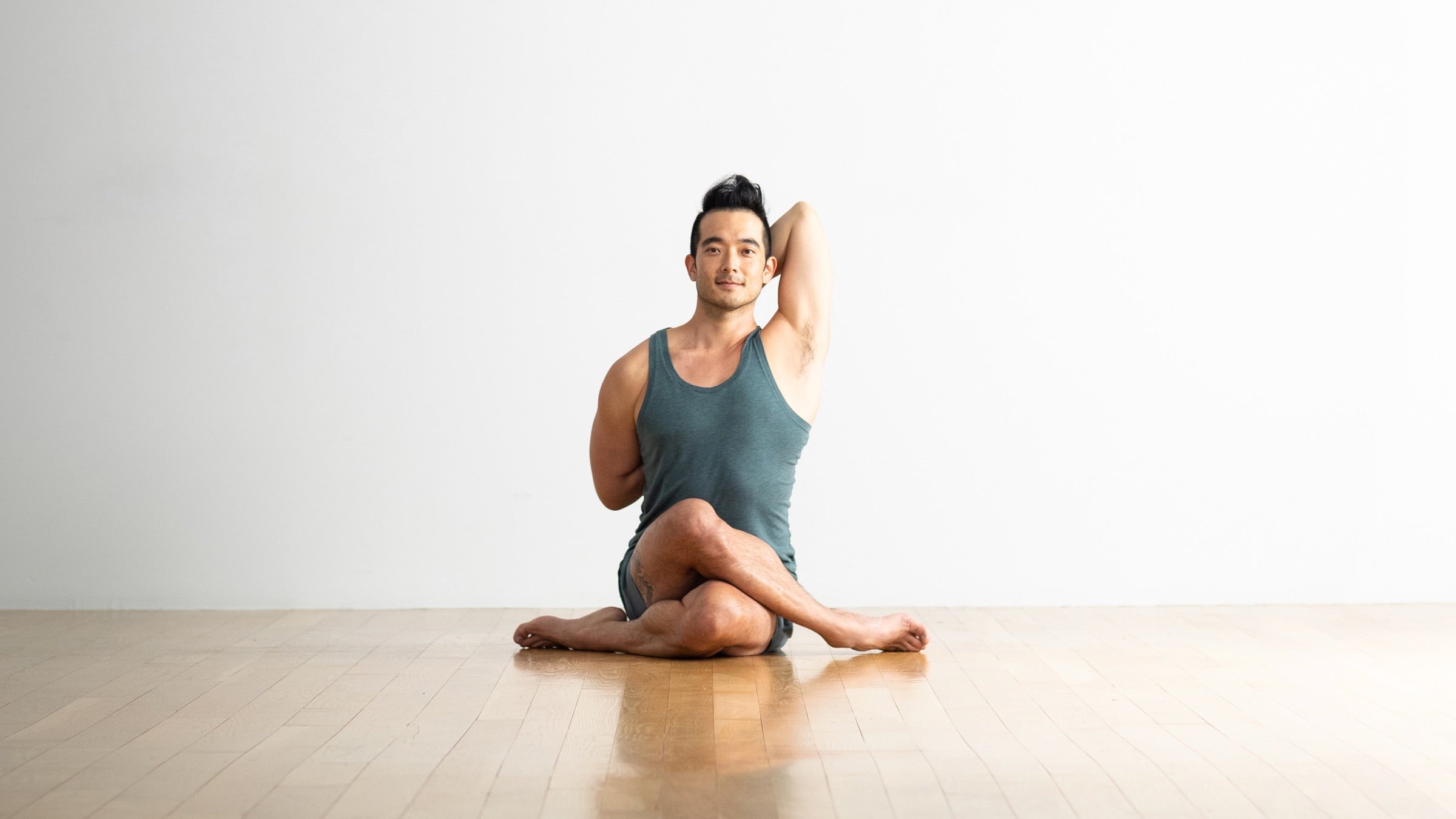
(Photo: Andrew Clark)
Gomukhasana (Cow Face Pose) stretches your entire body—your shoulders and arms, your ankles, hips, thighs and back. In the pose, the folded legs are said to resemble a cow’s mouth; the elbows form the shape of a cow’s ears.
It’s a pose that allows you many opportunities to explore the symmetry of the body. When you cross one knee over the other, notice a difference in how it feels right over left versus left over right. Similarly, the arm position will tell you instantly if one shoulder is tighter than the other.
Another thing to pay attention to in Gomukhasna is the length and position of your back, neck, and head. You can practice bringing length to the spine all the way up through your neck to your skull. When bringing the upper arm close to the face, students tend to bend the neck and lean the head to the side. Be mindful to keep the spine straight.
Use props to make this pose more accessible. If tight shoulders make it difficult to clasp your fingers together behind your back in Cow Face Pose, use a strap. You may sit on a block or blankets to give your legs more space to move into the pose.
ADVERTISEMENT
Sanskrit
Gomukhasana (go-moo-KAHS-anna)
go = cow (Sanskrit go is a distant relative of the English word “cow”)
mukha = face
ADVERTISEMENT
How to
- Start in Dandasana (Staff Pose), then cross your right leg over your left, stacking knee on top of knee and bringing your right heel to the outside of your left hip.
- Bend your left knee, bringing your left heel to the outside of your right hip.
- With your knees stacked and centered, press down evenly with your sitting bones.
- Elongate your spine and lift out of your lower back.
- Inhale, take your right arm out to the side and rotate it so your palm faces back and your thumb points down.
- As you exhale, bend your elbow and bring your right arm behind your back, with your palm facing out and the upper arm pulled in close to your body. Your elbow points towards your sacrum and your right fingers point towards the base of your neck.
- With your next inhale, take your left arm out to the side and up to the ceiling with your hand facing the midline.
- Bend your left elbow and reach your hand down toward your neck. Bring your elbow in close to your face and up toward the ceiling as your hand reaches down the spine.
- Reach your hands toward each other until they touch. Clasp hands or fingers if possible.
- To exit the pose, exhale and carefully release your arms out to your sides and return to Dandasana.
- Repeat on the opposite side.
Variations
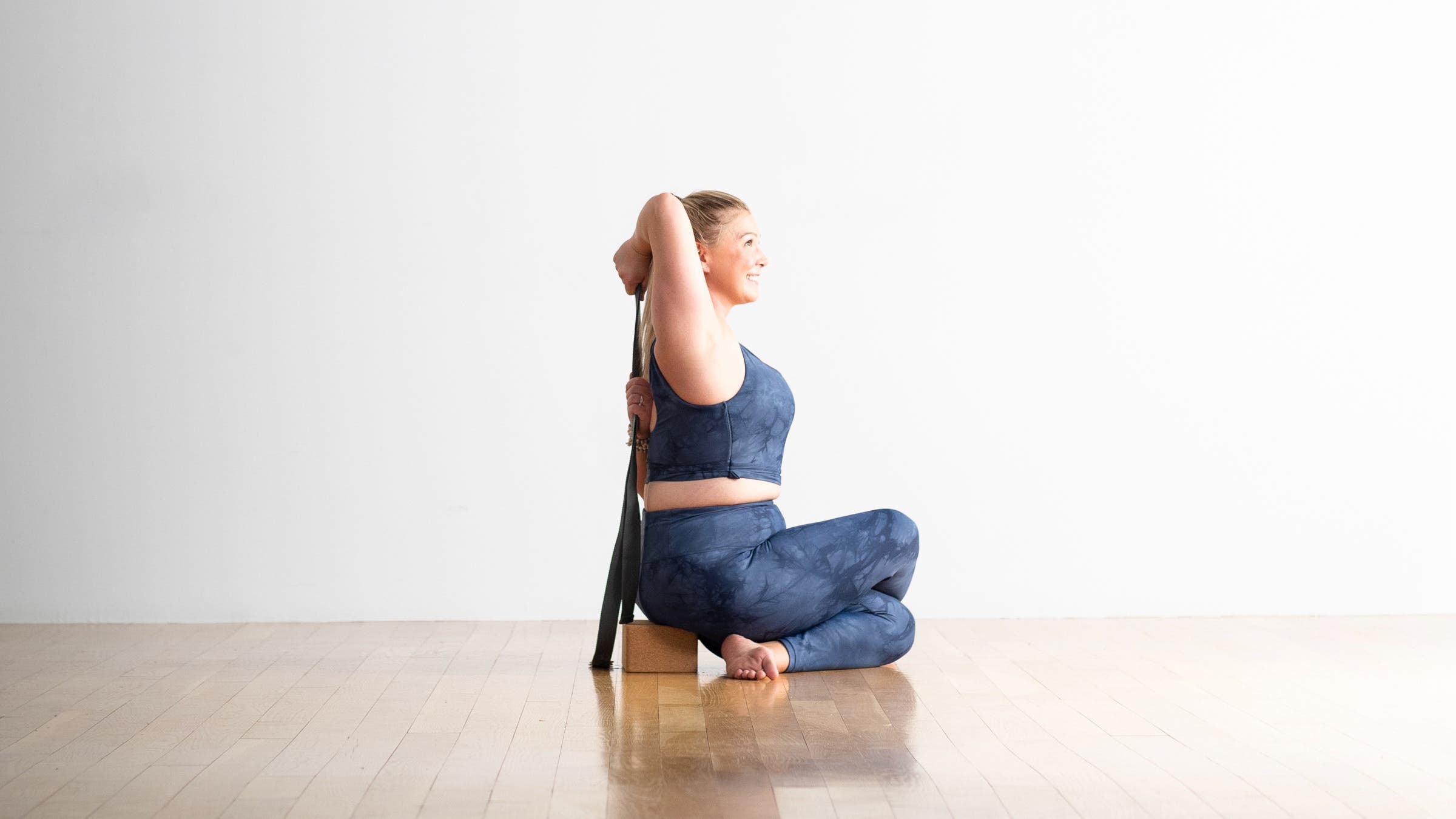
Cow Face Pose with a Block and a Strap
Sit on a block or a pillow to allow more space for your legs to move into the position and help bring your low back into neutral, avoiding slouching. Use a strap to extend your reach if your hands cannot easily clasp.
ADVERTISEMENT
If tight shoulders make it difficult to clasp your fingers together behind your back in Cow Face Pose, use a strap. Hold the strap between your hands. Begin the pose with the strap draped over the shoulder of your bottom arm. Then as you swing your bottom arm behind your back, slide the forearm as high on your back torso as possible, keeping your elbow close to your side. Then grab the bottom end of the strap. Stretch your other arm overhead, then reach down your back for the other end of the strap. Pull on the strap with your top arm and see if you can draw your bottom arm higher onto your back. You’re trying to work your hands toward each other and eventually clasp them. You may be able to clasp the hands on one side, but not the other.
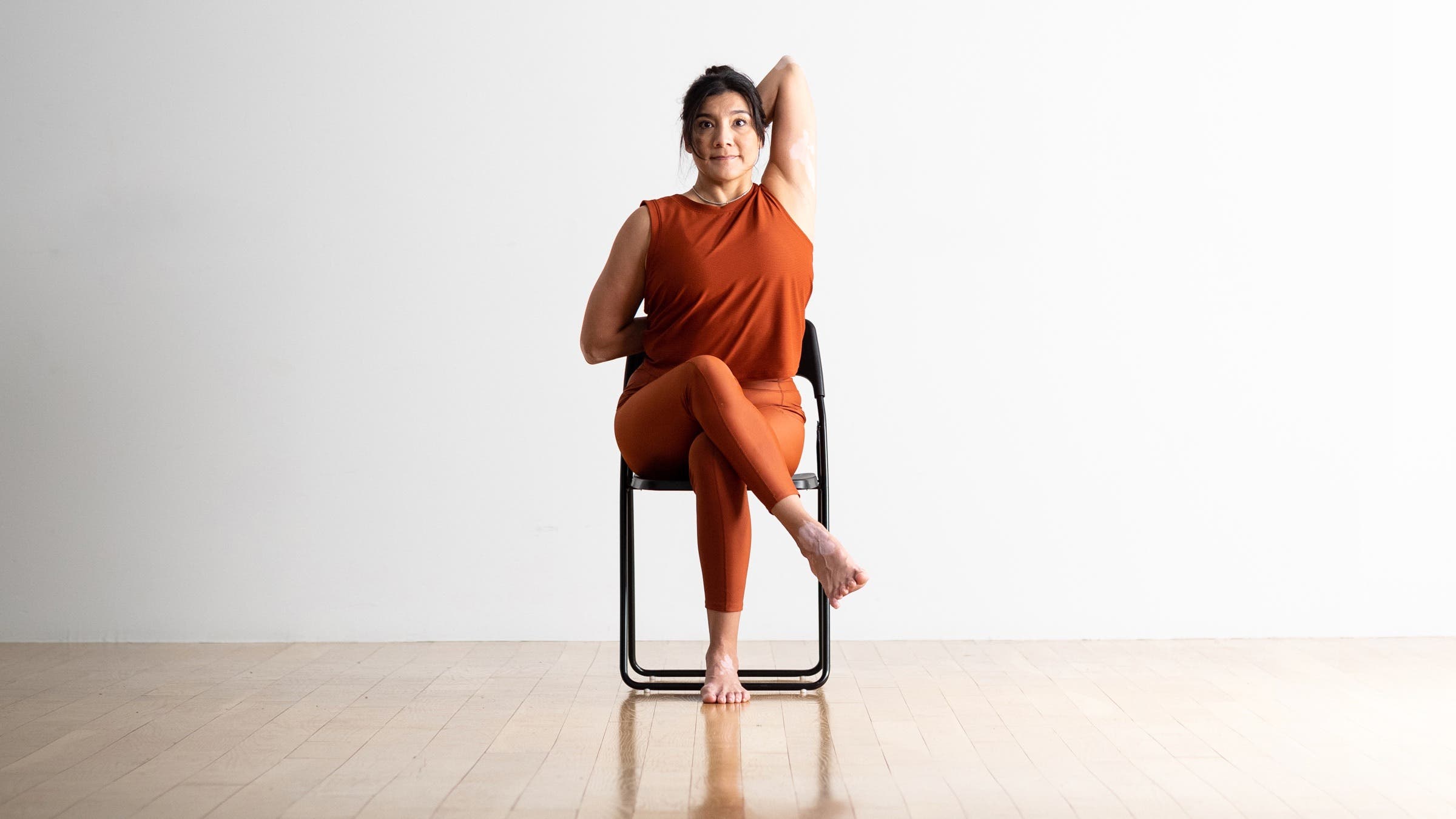
Cow Face Pose in a Chair
Try sitting in a chair instead of on the floor. Consider using a strap.
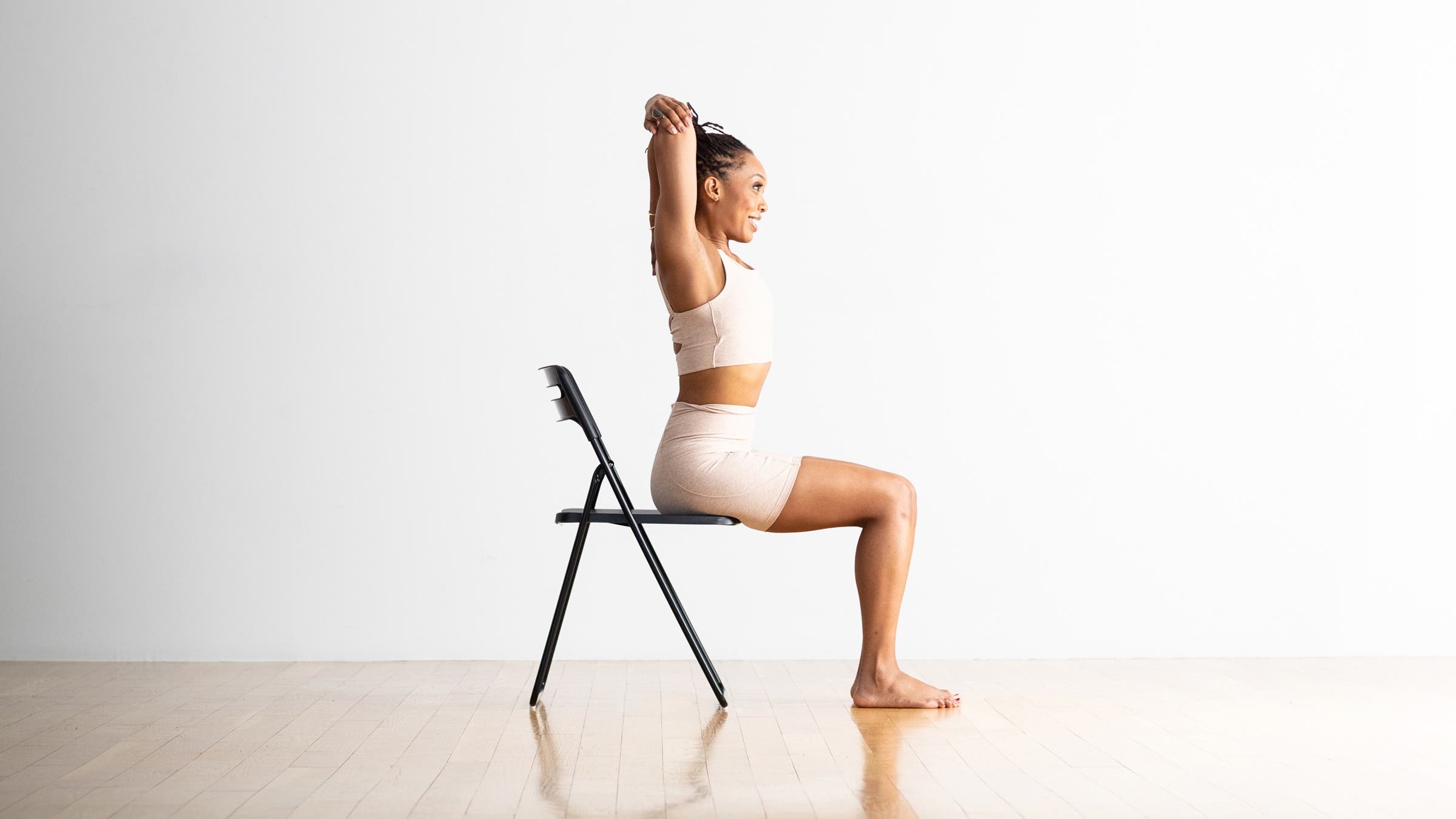
Triceps Stretch in a Chair
Sit in a chair with your feet under your knees at hip-distance apart and your thighs parallel to the ground. If you are taller, you may need to sit on folded blankets. If you are shorter, you may need to put folded blankets or blocks under your feet. Sit as tall as you can. Reach one arm up toward the ceiling, and bend your elbow so your hand drops toward your back. Use the other arm to grab your elbow to slightly intensify the stretch. • Stay for several deep breaths, then repeat on the other side.
Cow Face Pose Basics
Pose type: Seated
Targets: Full body
Benefits: Cow Face Pose improves posture and counteracts the effects of prolonged sitting and doing computer work by dynamically stretching around your shoulders, buttocks (glutes), and fronts of thighs (quadriceps).
ADVERTISEMENT
Other Cow Face Pose perks:
- Opens the shoulders, expands the chest, and extends the latissimus dorsi.
- Excellent preparation for backbends and inverted poses such as Handstand (Adho Mukha Vrksasana)
Beginner tip
If your hips feel tight, sit on the edge of a folded blanket or on a block.
Deepen the pose
You can increase the stretch in this pose if you’re a little more flexible in the shoulders and armpits by moving your hands away from the back of your torso.
ADVERTISEMENT
Intensify the stretch in Cow Face Pose by folding forward. Keep the weight in your sitting bones, not in your knees.
Why we love this pose
“Gomukhasana is a quiet, seated pose, but it’s anything but simple,” says Tamara Jeffries, Yoga Journal senior editor. “You’re reaching up and reaching down, making room for the stretch in your arms and shoulders. The pose also requires your full attention to the position of the knees, the elbows, the shoulders, the head. When you do it with attention to alignment, it is great for posture awareness.”
Teacher tips
These cues will help protect your students from injury and help them have the best experience of the pose:
- You can also start the pose from all fours. From Tabletop, cross your legs bringing your left knee to the inside of your right knee. Lower your hips in between your feet.
- This pose requires deep shoulder rotation, so be careful coming into and exiting the pose.
Preparatory and Counter Poses
Preparatory poses
- Baddha Konasana (Bound Angle Pose)
- Garudasana (Eagle Pose)
- Supta Baddha Konasana (Reclining Bound Angle Pose)
