Updated February 25, 2025 12:58PM
If you buy through our links, we may earn an affiliate commission. This supports our mission to get more people active and outside.Learn about Outside Online's affiliate link policy
Crow Pose | Crane Pose
A compact arm balance, Crow Pose and Crane Pose tone the abs and the arms, strengthen in the core, and focus the mind.
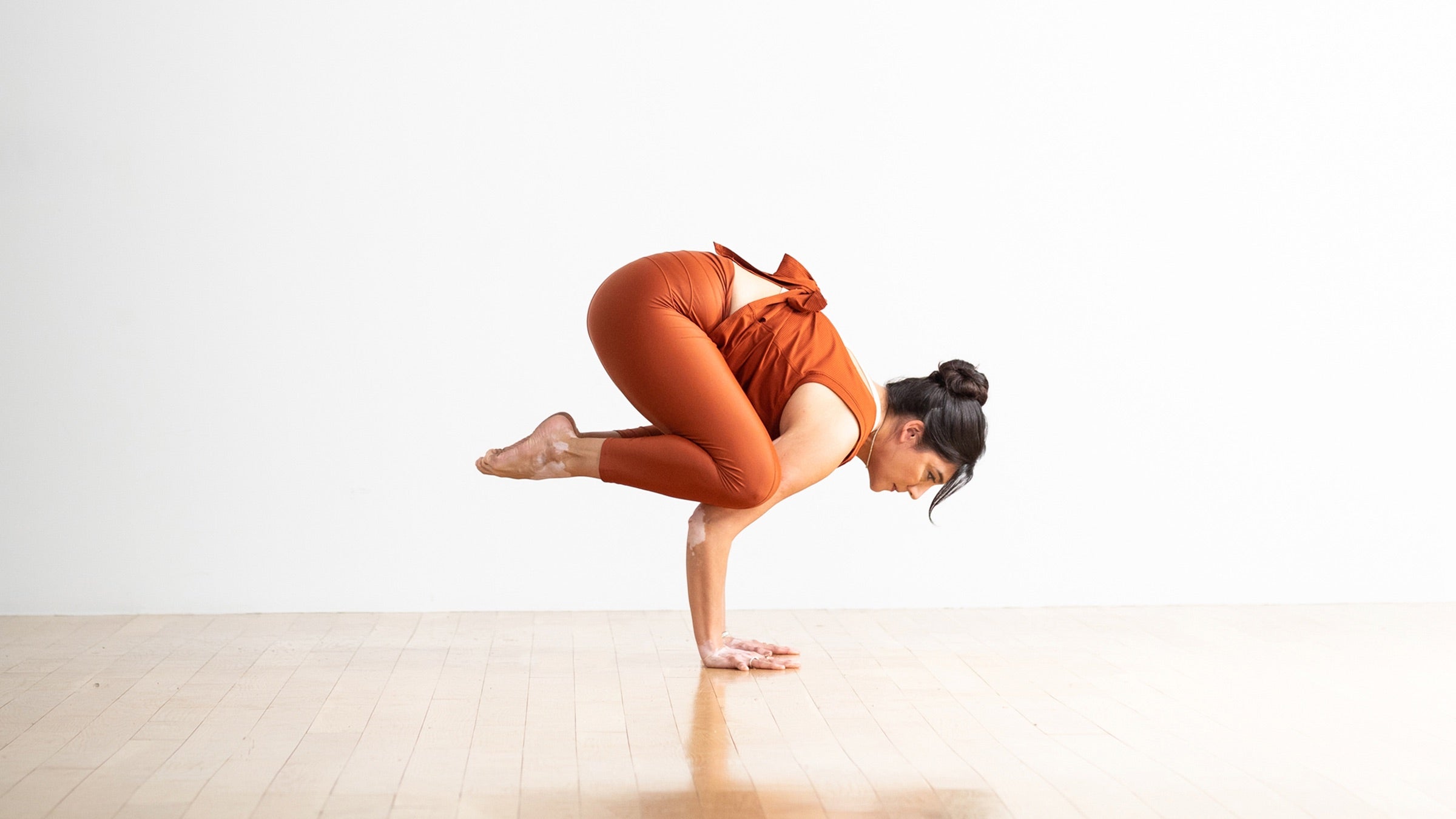
(Photo: Andrew Clark; Clothing: Calia)
For many of us, our first attempt at an arm balance isn’t always successful (or pretty), which makes this type of yoga pose challenging to the body and the ego. Bakasana (Crane Pose) and Kakasana (Crow Pose) are among the first arm balances that many students achieve. Getting into the pose can feel nearly impossible—until it doesn’t. These poses offer you an opportunity to feel both strong and flexible, which can motivate you to challenge yourself in other ways in your practice.
While Crane and Crow are technically two different poses, many people practice these as modifications of one another. Kakasana (Crow Pose) is done with your arms bent and your knees resting on your upper arms. In Bakasana (Crane Pose), your arms are straight and your knees are tucked closer to your underarms. Play with variations that work best for your body.
To get into either pose, you need to activate your abdominal muscles, press into your hands, engage your shoulder blades, squeeze your legs together in midline, and above all else, trust yourself. Bakasana teaches you to create connections between your arms and knees, abdominals and spine, mind and body.
ADVERTISEMENT
The result? Strengthened abdominal muscles, arms, and wrists, and a stretch in your upper back and inner groin. But perhaps even better, you may enjoy the confidence that comes with facing your fears and somehow managing to hold it all together while simultaneously letting go.
Sanskrit
Kakasana (kahk-AHS-ah-nah); Bakasana (bahk-AHS-ah-nah)
baka = crane
kaka = crow
ADVERTISEMENT
How to
- Begin in a squat with your knees wide apart. Your feet may be together or apart.
- Place your hands on the floor 6–8 inches in front of your feet and shoulder-distance apart. If your shoulders are tight, your hands can be a little wider.
- Come onto the balls of your feet and lift your hips high. Bring your knees toward your upper arms.
- Tilt your torso forward so that your shoulders fit between your knees.
- Firmly press your knees to your upper arms. You can balance them on your triceps for Crow or tuck them closer to your armpits for Crane.
- Continue to reach your chest forward until your elbows stack over your wrists and you feel your center of gravity shift.
- Lift your heels toward your buttocks. Your knees can either grip your outer shoulders or balance on your triceps.
- For Crane, press your arms as straight as possible while bringing your feet and buttocks toward each other.
- Hold for 5–10 breaths, then either release your feet to the floor.
RELATED: 12 Cues for Crow Pose You Probably Haven’t Heard Before
Variations
Because Bakasana and Kakasana are so closely related, these poses offer a great deal of flexibility in finding “your” pose. You can practice subtly different degrees of bending in your elbows and various knee positions to find what works for your body. You can also work with props to help support you in lifting into the pose.
ADVERTISEMENT
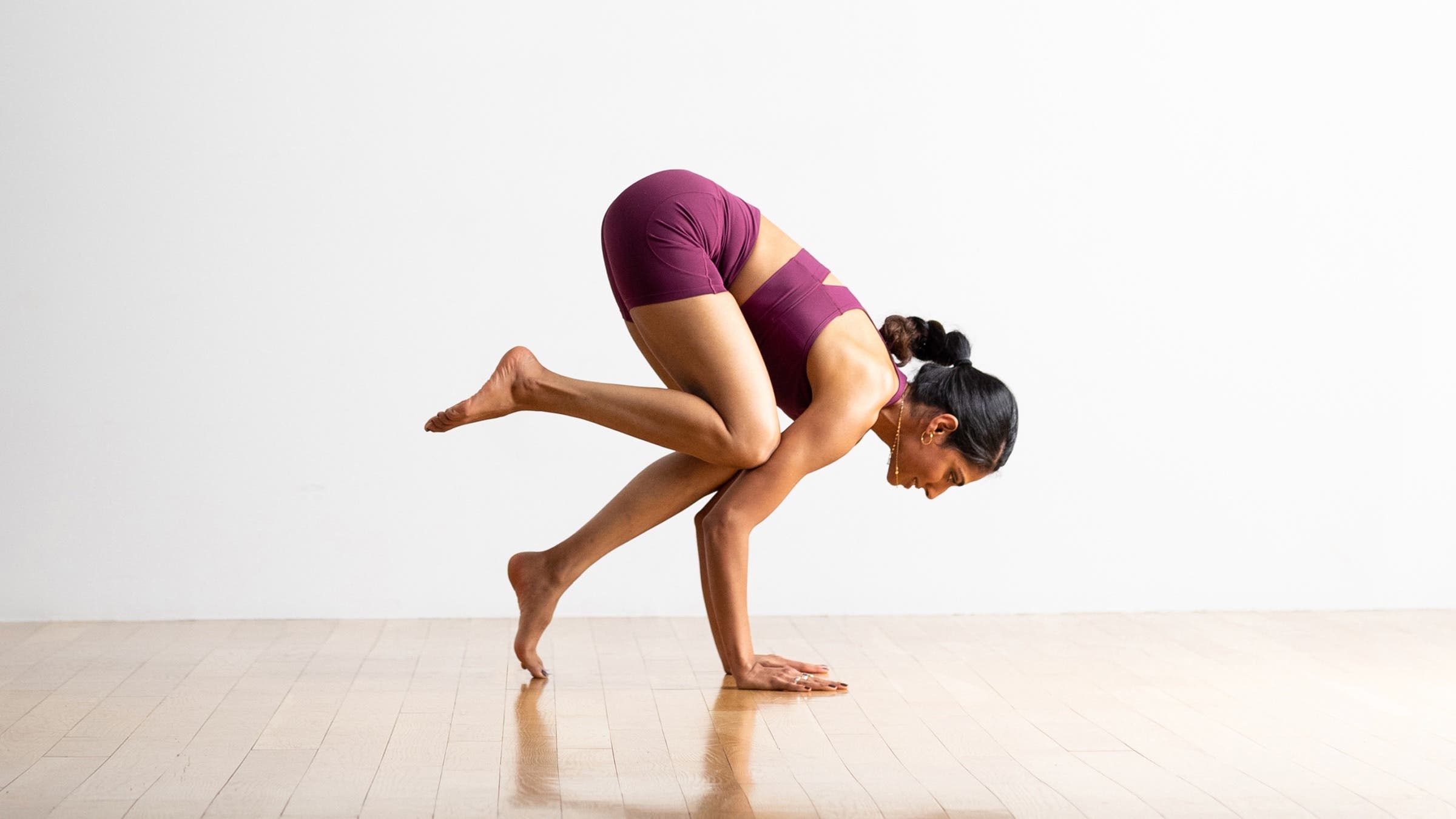
Crow Pose prep
Press your arms into your knees and knees into arms to find strength and stability. Shifting your body forward, come up on the tips of your toes. Engage your ab muscles as you lift one leg. Lower that leg and lift your other leg. Work toward lifting both feet at the same time.
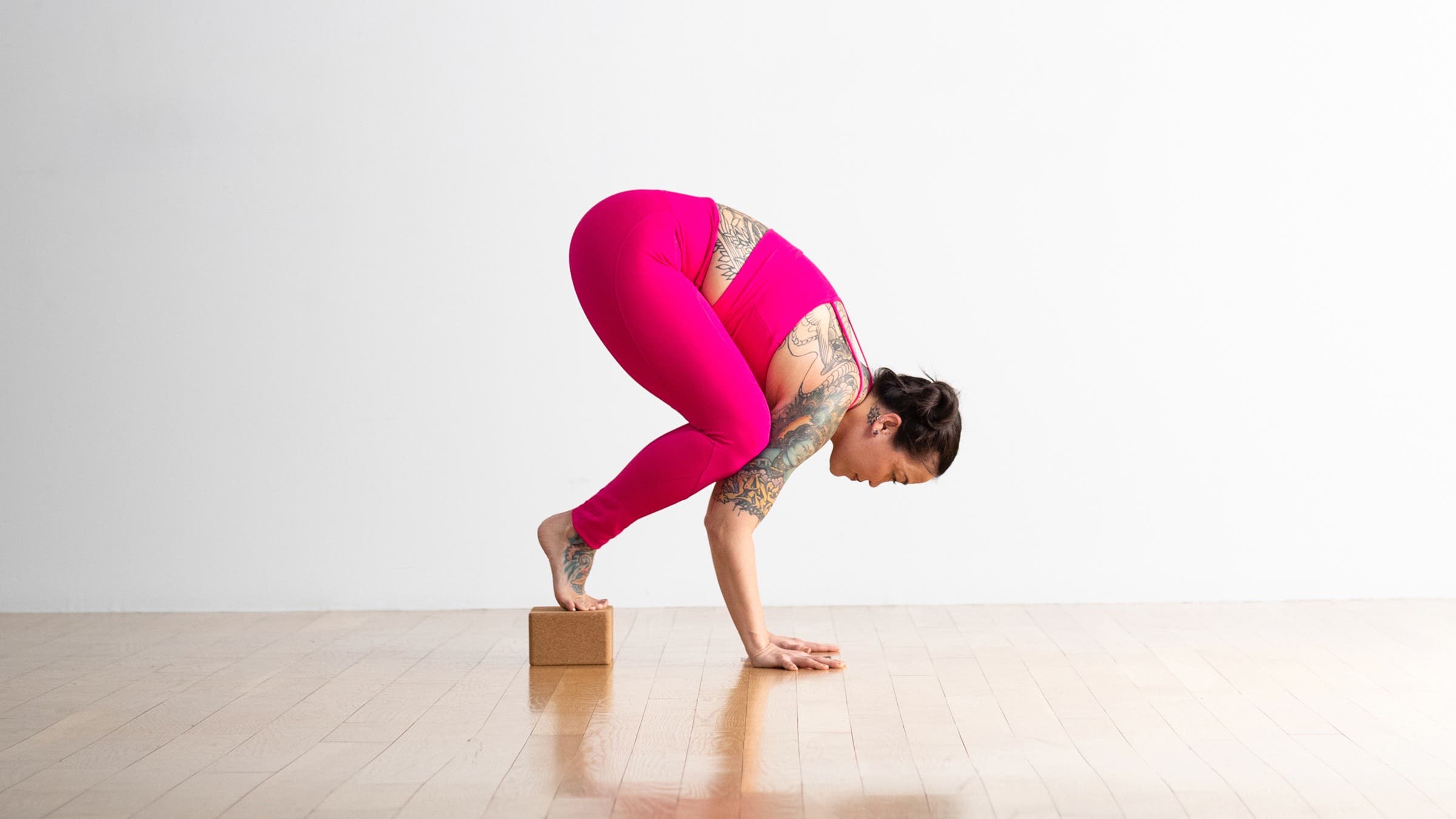
Crow Pose with a block
Try placing a block underneath your feet. This enables you to bring your shins higher on your upper arms, even if you have tight hips; this increases the likelihood of you getting into the pose. Engage your ab muscles as you lift one leg. Lower that leg and lift your other leg. Work toward lifting both feet at the same time.
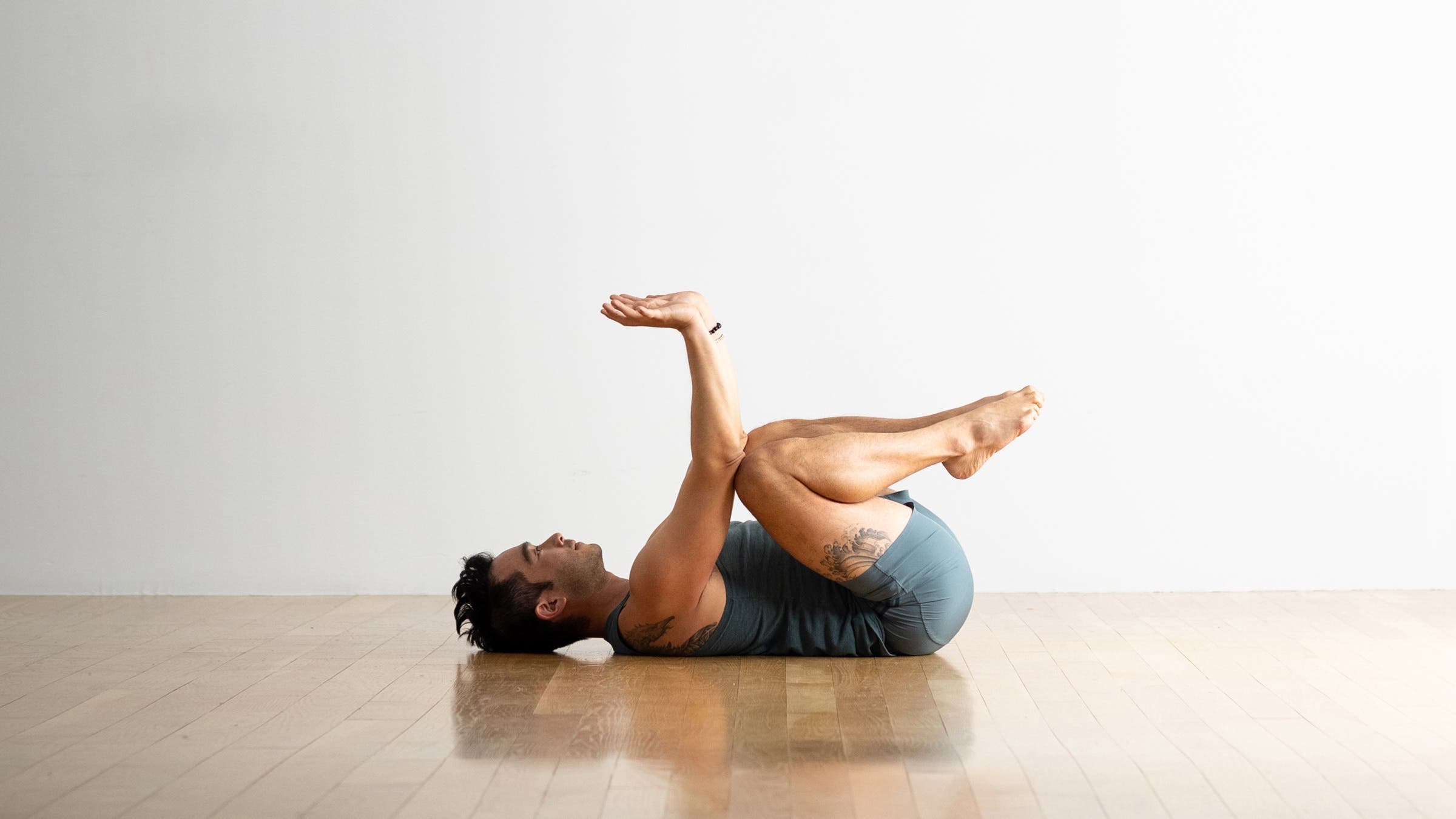
Reclining Crow Pose
To get a feel for experiencing this shape without needing to balance your weight, try coming into Crane or Crow on your back. Bring your shins to the outside of your upper arms, and press your shins and arms against one together. You can keep your head down or lift it for a few breaths. Your elbows can be bent or straight.
ADVERTISEMENT
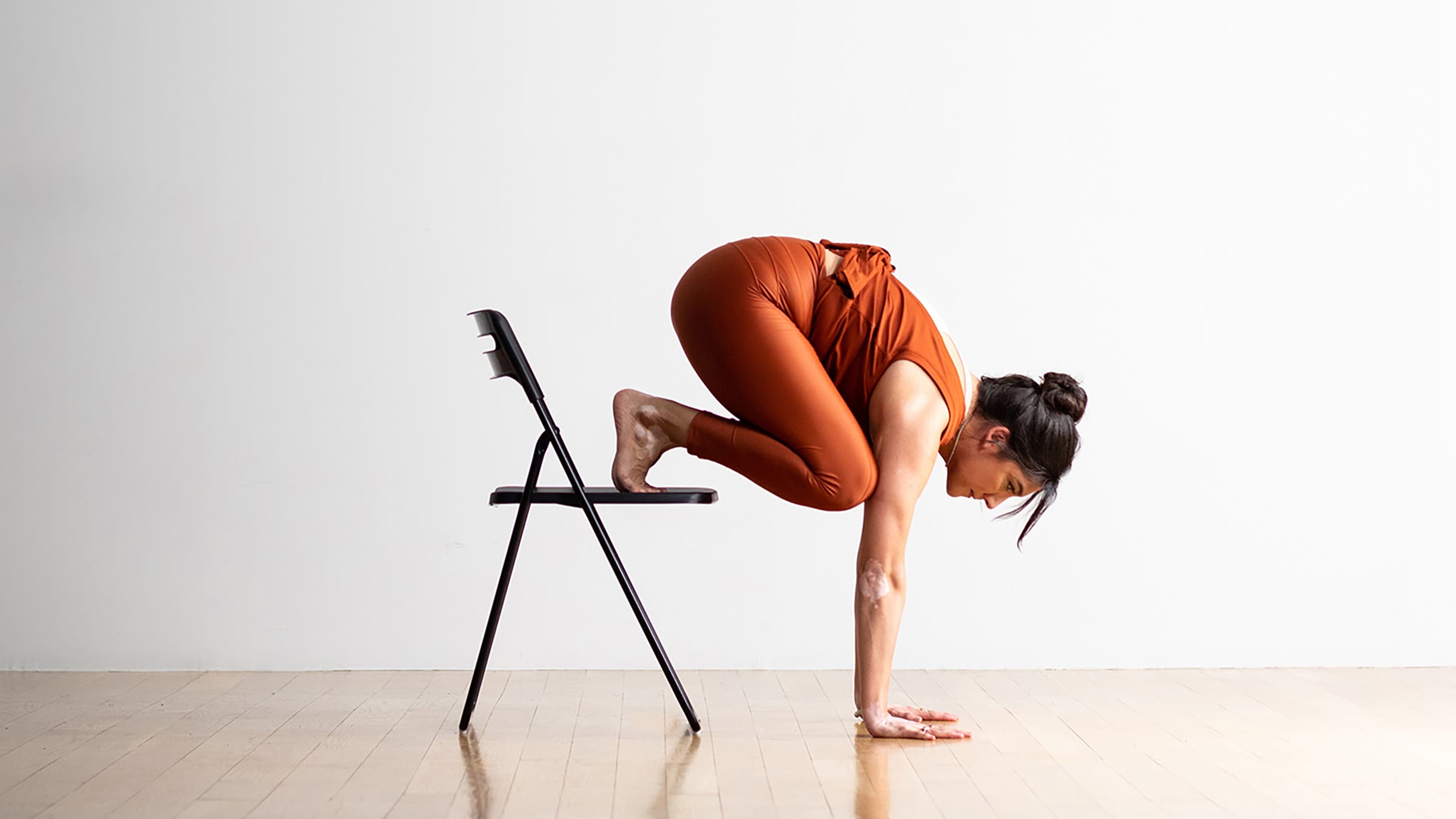
Crow Pose with a chair
As you work on straightening your arms, try bringing your feet onto the seat of a chair and bringing your hands on the ground below underneath your shoulders. Bring your knees to your upper arms so you can start to feel the shape required without having to balance or bear your full weight.
Crow Pose and Crane Pose basics
Pose type: Arm Balance
Target area: Upper body
ADVERTISEMENT
Benefits
Crow Pose and Crane Pose improve focus and stretch your buttocks (glutes), front of your thighs (quadriceps), and the palm sides of your wrists (wrist flexors). These poses also strengthen your core, upper back, chest, front of your hips (hip flexors), back of your thighs (hamstrings), arms, shoulders, forearms, and back of your wrists (wrist extensors).
Beginner tips
- Warm up your wrists before you attempt these poses.
- Beginners tend to move into this pose by lifting their buttocks high away from their heels. Instead, try to keep yourself tucked tight, with your heels and buttocks close together.
- When you are ready to take your feet off the floor, push your upper arms against your shins and draw your inner groin into your pelvis to help you with the lift.
- Core strength helps. It might seem as though Crow and Crane require tremendous arm strength, but most of the work comes from your abdominals. As your abs grow stronger, you can rest less weight on the backs of your arms.
- Don’t rush the pose or quickly propel yourself forward hoping to find balance. Move slowly, finding your balance at every point.
- Pressing your arms into your knees and knees into arms will help you feel stable and strong.
- If your elbows splay out or your shoulders dip, practice moving from Plank to Chaturanga Dandasana (Four Limbed Staff Pose), keeping the elbows in and shoulders back away from your ears. This will strengthen the upper body and prepare you for Crane or Crow.
- Fear of falling can be a big hindrance to getting into Crane or Crow. It can help to put a folded blanket, bolster or cushion on the ground under your head while you’re learning this pose.
Modifications and props
Some students have a difficult time lifting into Crow Pose or Crane Pose from the floor. It’s often helpful to prepare for these poses by squatting on a block so that your feet are a few inches off the floor.
Deepen the poses
The full poses sometimes cause varying degrees of pain in the wrists. Instead of spreading the fingers on the floor, curl them slightly. This should take some of the pressure off the wrists.
ADVERTISEMENT
Create a strong connection between your arms and legs and legs by pressing your knees/shins into your arms and your arms into your knees. Keep the elbows pulled in close to the body. If your elbows jut out, you may have more difficulty coming into the pose.
Be mindful!
Avoid this pose or use caution if:
- You have vertigo, dizziness, or certain eye conditions
- You have wrist arthritis, wrist pain, or carpal tunnel problems
- You have any back pain or back injuries, including surgeries, osteoporosis, disc bulging or herniation, or arthritis.
- You have a hip replacement or experience hip pain in the pose.
Why we love this pose
“Crow was the first challenge pose that I ever tried, and to this day it’s still the pose that I turn to when I want to feel strong, grounded, and confident,” says Kyle Houseworth, former YJ assistant editor. “For years I had to constantly check step-by-step guides to make sure I was practicing it correctly (where should the knees go?) and that’s why it’s still a staple in my practice. There’s always something new to tweak, no matter how many times I get into it.”
Preparatory and Counter Poses
Preparatory poses
Chaturanga Dandasana (Four-Limbed Staff Pose)
Adho Mukha Svanasana (Downward-Facing Dog Pose)
Baddha Konasana (Reclining Bound Angle Pose)
Prasarita Padottanasana (Wide-Angled Standing Forward Bend)
ADVERTISEMENT
Counter poses
Purvottanasana (Reverse or Upward Plank)
Urdhva Mukha Svanasana (Upward-Facing Dog Pose)
ADVERTISEMENT
Anatomy
Alignment is as important as strength in these arm balances. Engaging the correct muscles provides the necessary force required for stability, explains Ray Long, MD, a board-certified orthopedic surgeon and yoga teacher. Bakasana and Kakasana connect the upper and lower extremities at the inner thighs and upper arms. The adductors in the inner thighs grip the upper arms. The arms direct the center of gravity down to the mat. The abdominals activate to flex and lift the trunk upward. Flex the hips and draw the feet up, and evert the ankles (turn them out) to open the soles of the feet.
In the drawings below, pink muscles are stretching and blue muscles are contracting. The shade of the color represents the force of the stretch and the force of contraction. Darker = stronger.
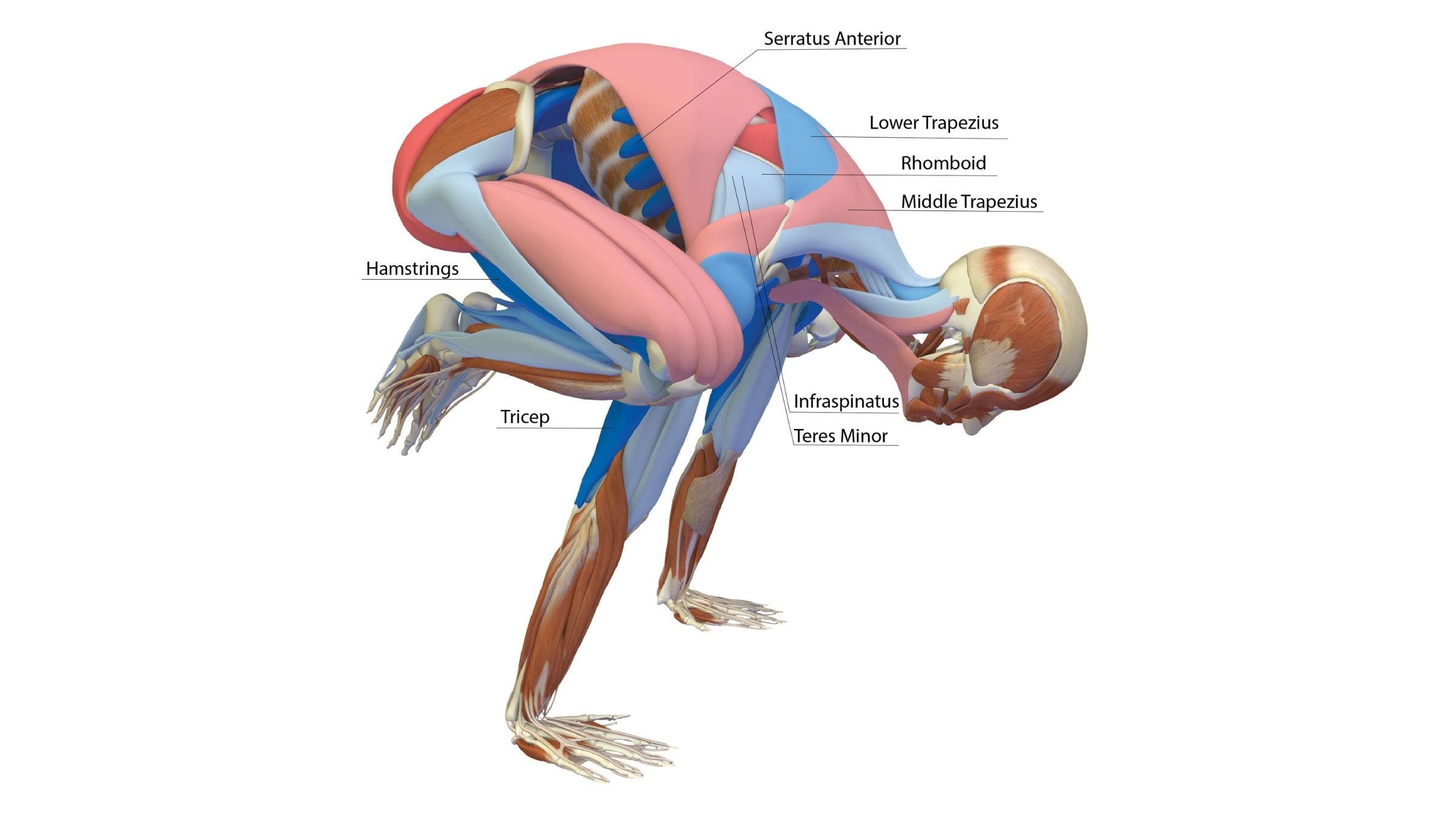
Squeeze the thighs against the outer arms using the adductor group of muscles along the inner thigh. Draw your lower legs up by engaging the hamstrings. The gluteus minimus also helps draw the hips into flexion.
Engage the deltoid muscles that lie over your shoulder joint, especially the anterior and lateral thirds, to lift the body and press outward through the arms and into the legs. The main stretch in this pose is of the rhomboids and middle third of the trapezius, due to abduction of the scapulae. The serratus and pectoralis muscles create reciprocal inhibition of the rhomboids and trapezius, resulting in some degree of relaxation in the stretch.
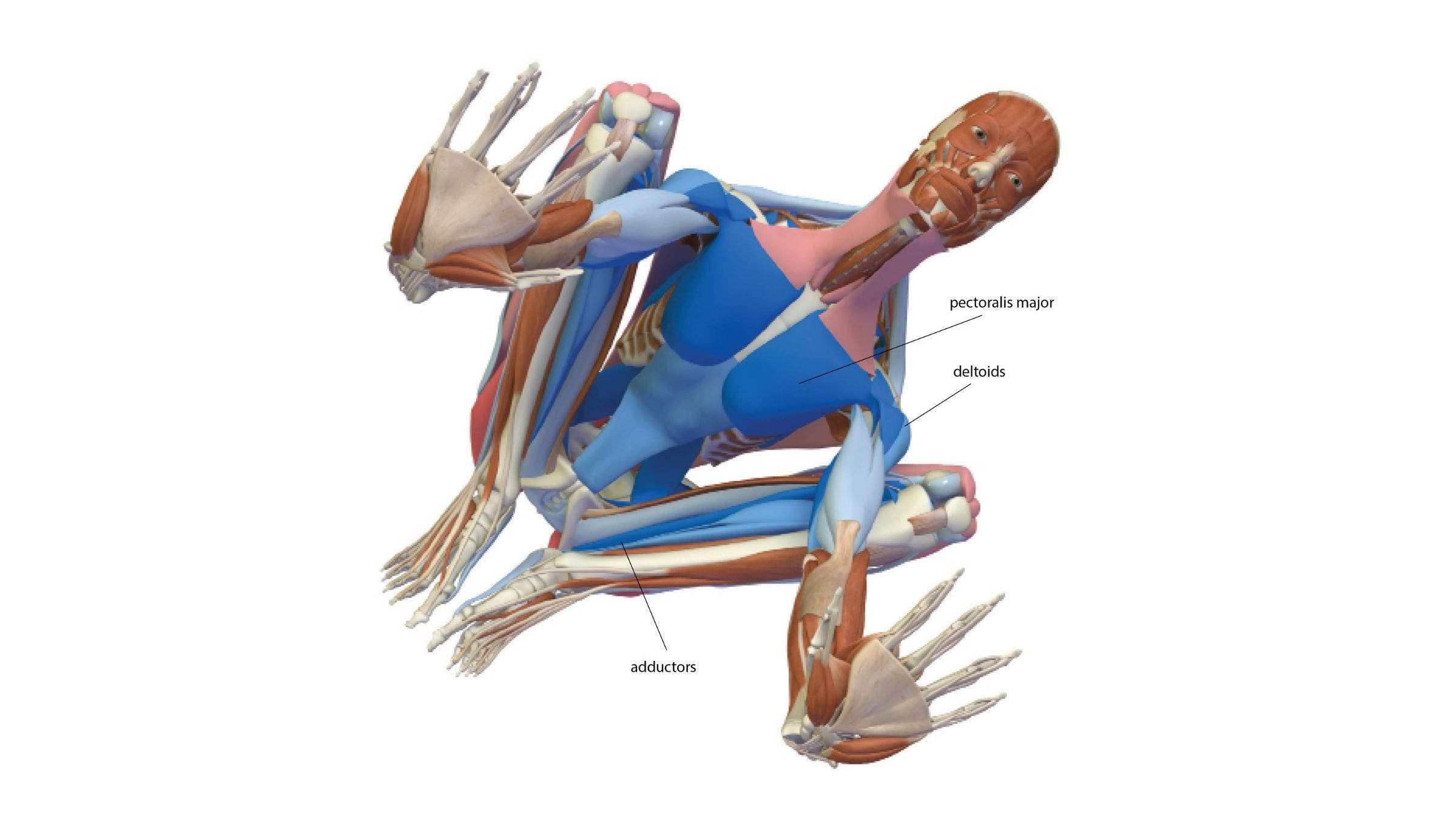
Press the palms into the floor by activating the pronator teres and quadratus and the wrist flexors. Then spread the weight from the inner side of the palms across the hands. Externally rotate the upper arms to create a coiling effect through the elbows, into the wrists, and connecting with the hands.
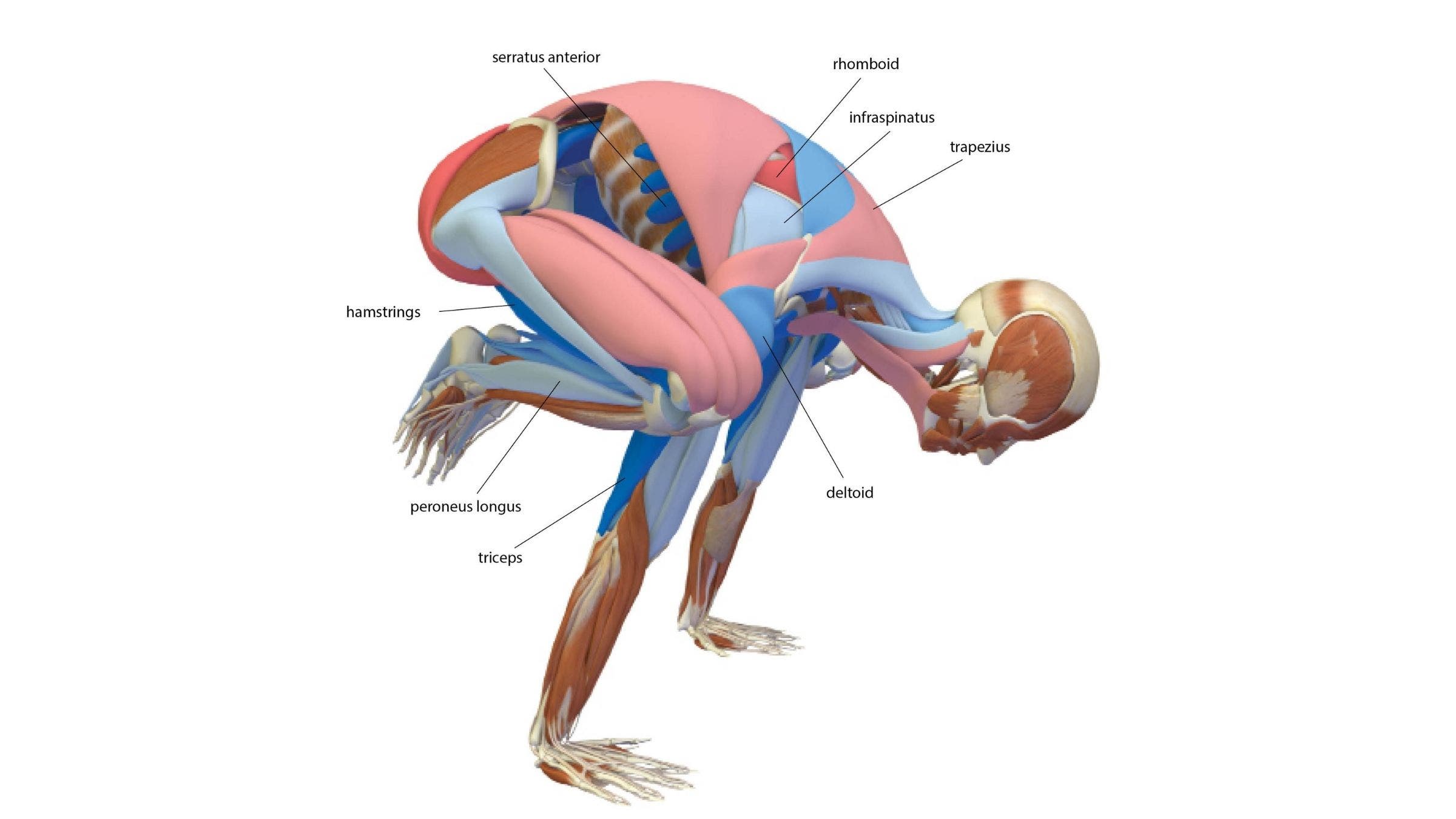
Bring the feet together. Dorsiflex and evert the ankles. This uses the tibialis anterior and peroneus longus and brevis.
Excerpted with permission from The Key Poses of Yoga and Anatomy for Arm Balances and Inversions by Ray Long.
Put Crow and Crane Pose into practice
- 9 Yoga Poses to Build Arm Strength
- 5 Yoga Poses that Build Strength and Flexibility
- 5 Cool Ways to Use Props for Arm Balances
About our contributors
Teacher and model Natasha Rizopoulos is a senior teacher at Down Under Yoga in Boston, where she offers classes and leads 200- and 300-hour teacher trainings. A dedicated Ashtanga practitioner for many years, she became equally as captivated by the precision of the Iyengar system. These two traditions inform her teaching and her dynamic, anatomy-based vinyasa system Align Your Flow. For more information, visit natasharizopoulos.com.
Ray Long is an orthopedic surgeon and the founder of Bandha Yoga, a popular series of yoga anatomy books, and the Daily Bandha, which provides tips and techniques for teaching and practicing safe alignment. Ray graduated from the University of Michigan Medical School and pursued post-graduate training at Cornell University, McGill University, the University of Montreal, and the Florida Orthopedic Institute. He has studied hatha yoga for over 20 years, training extensively with B.K.S. Iyengar and other leading yoga masters, and teaches anatomy workshops at yoga studios around the country.
ADVERTISEMENT
