Updated March 21, 2025 02:48PM
If you buy through our links, we may earn an affiliate commission. This supports our mission to get more people active and outside.Learn about Outside Online's affiliate link policy
Boat Pose
Boat Pose, or Paripurna Navasana, requires you to balance on the tripod of your sitting bones and tailbone to build mental and physical focus, inspiring a full-body awareness.
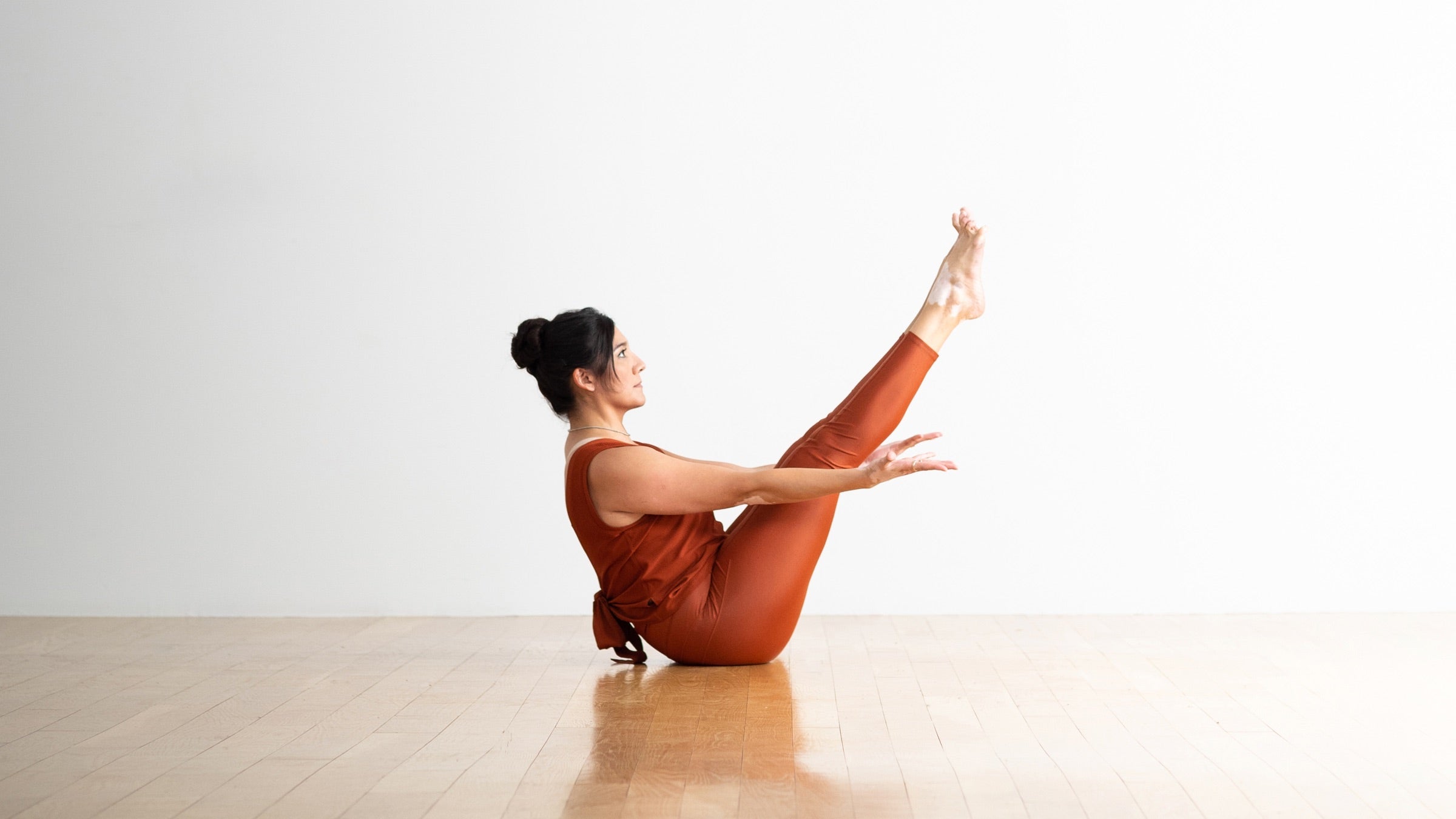
(Photo: Andrew Clark; Clothing: Calia)
Table of Contents
When you think of Paripurna Navasana (Boat Pose), you probably think of holding an abs-olutely core-crushing position. Yes, the pose does work your abdominal muscles. You’ll build the core strength required for inversions and arm balances like Crow or Firefly. And let’s face it: a strong core is key. It helps you stand taller, helps prevent injury, and makes you better at other activities like running or rock climbing.
But Boat Pose also strengthens your hip flexors, adductors (groin), and the lower back muscles that support your spine. It offers a mental test, as well. You need to dig deep in Navasana to extend, expand, and open your body while pushing through heat and discomfort. But it’s a pose with enough variations to allow you to find your way a fully extended pose. If you are working on building the core strength to hold the pose with your arms and legs outstretched, try holding on to your legs behind your knees. In time, you’ll find Boat Pose smooth sailing.
Sanskrit
Paripurna Navasana (par-ee-POOR-nah nah-VAHS-anna)
How to
- Sit on the floor with your legs straight in front of you. Press your hands on the floor a little behind your hips.
- Lift through the top of the sternum and lean back slightly, making sure your back doesn’t round. Balance your weight on the tripod of your sitting bones and tailbone.
- Exhale and bend your knees, then lift your thighs so they are angled about 45 degrees above the floor, with your knees still bent.
- If possible, slowly straighten your knees, raising the tips of your toes slightly above the level of your eyes. If that is not possible, keep your knees bent, your shins parallel to the floor.
- Keeping your heart open and your spine long, draw your shoulders back and extend both arms forward alongside the legs, parallel to the floor, with your palms facing in. Try to keep your lower belly flat and firm, but not hard and thick.
- Point your toes or flex through your heels, and breathe. Try to stay in the pose for 10 to 20 seconds, slowly increasing your time to a minute.
ADVERTISEMENT
Variations
Bent-Knee Boat Pose
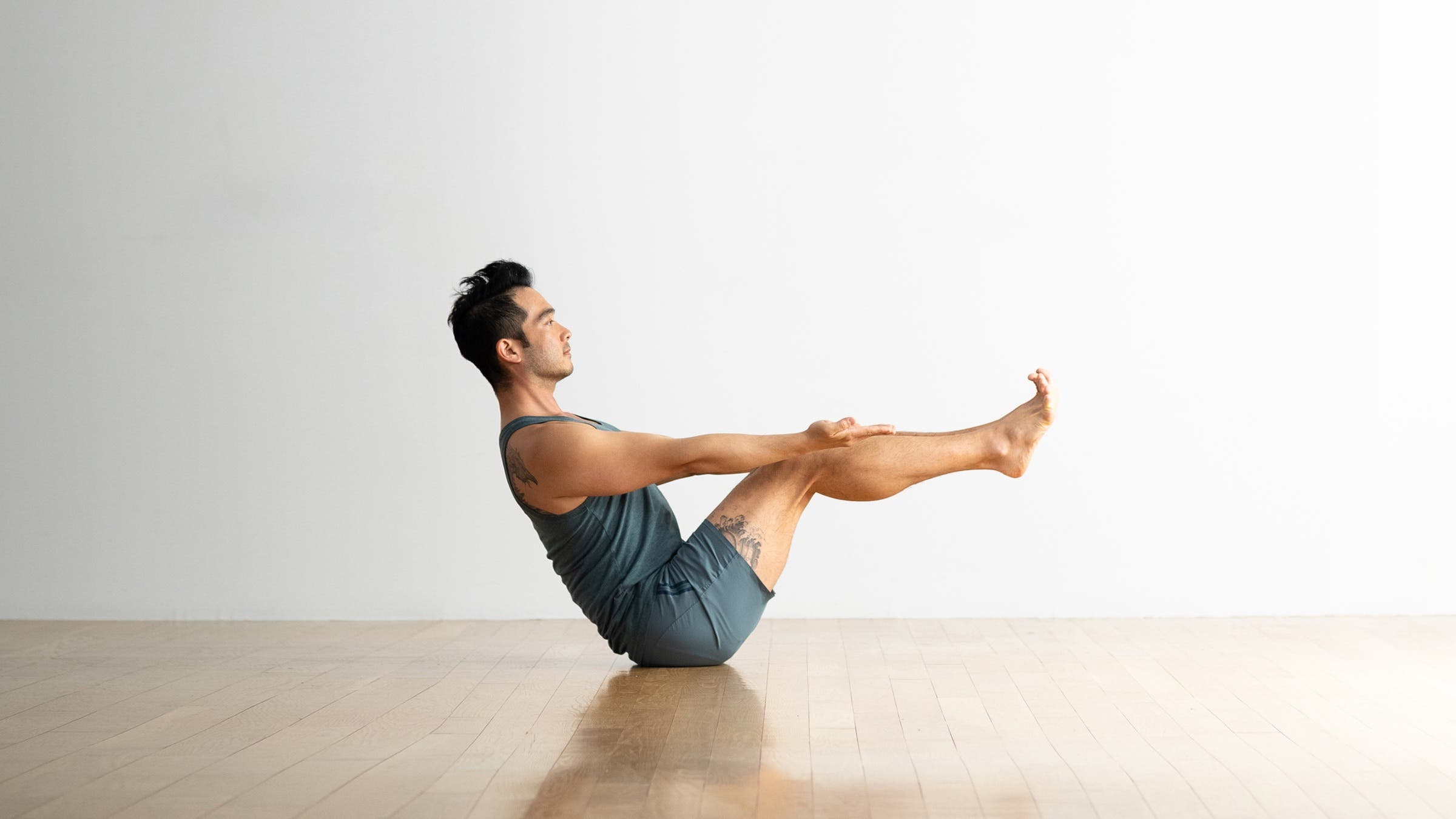
Try with your knees bent to lessen the effort and take pressure off your low back. Keep your arms extended in front of you, bring your palms to the backs of your thighs, or place your hands behind you on the floor for support.
Half Boat Pose
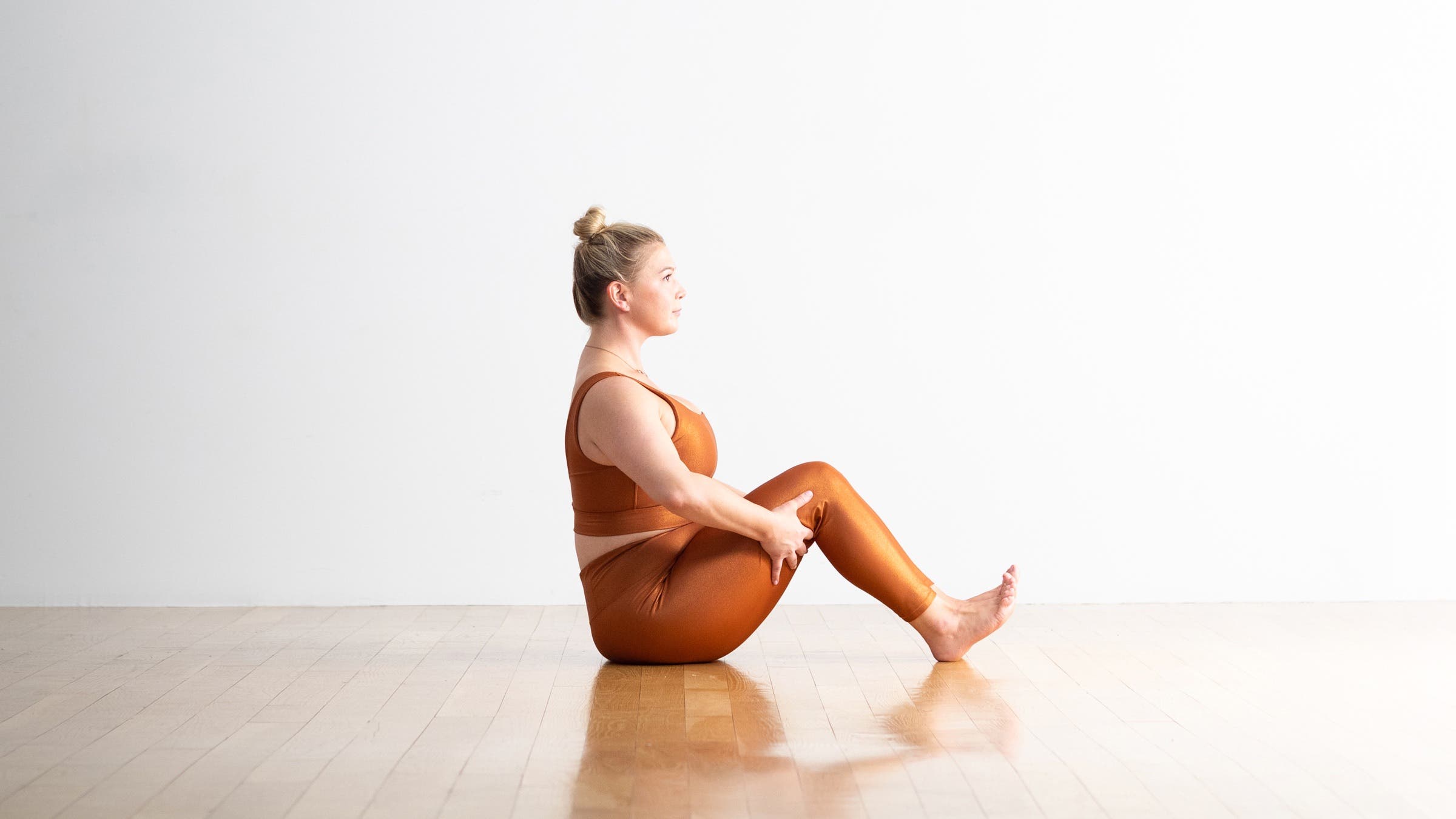
Prepare to come into the pose but keep your feet on the ground. If you like, lift one leg at a time. You can keep the lifted leg bent or straighten it. Hold onto the back of your thighs for extra support or bring your hands behind you on the floor. Try transitioning back and forth between legs with your breath, switching legs on an exhalation.
Boat Pose basics
Pose type: Seated
Targets: Core
Benefits: Boat Pose builds focus and body awareness. It can boost energy and fight fatigue, and can help build confidence and empowerment. It also improves posture and counteracts the effects of prolonged sitting and doing computer work by strengthening your core and thighs.
ADVERTISEMENT
Beginner tips
- Don’t let your back round. Instead, lengthen and lift through the front of your body.
- You can practice this pose throughout your day without even leaving your chair. Sit on the edge of a seat with your knees directly above your ankles. Grab onto the sides of the seat with your hands and lean slightly forward. Engage your arms and lift your buttocks slightly off the seat, then raise your heels (but not the balls of your feet) slightly off the floor. Lift the top of your sternum forward and up.
Be mindful!
- Avoid strong core engagement like in this pose if you are pregnant, particularly in the second and third trimesters. Consider modifying to a gentler version held for a shorter amount of time.
- Use caution if you have a hernia, or any back pain, injuries, or surgeries.
Deepen the pose
- You can intensify the pose by lowering both your legs and your upper back closer to the mat.
Why we love this pose
“I do Boat Pose incrementally with bent knees, holding the back of my legs,” says Sarah LaVigne, Yoga Journal‘s contributing photo editor. “Once I find my balance and am past the wobbly phase, I slowly straighten my legs. This step-by-step approach focuses me on each stage. Once I reach the peak pose, I feel like I am floating.”
Teacher tips
These tips will help protect your students from injury and help them have the best experience of the pose:
- Practice this posture in the beginning of class to fire up your core for the rest of your practice.
- If students find it too hard to raise their arms, have them keep their hands on the floor beside their hips or hold on to the backs of their thighs.
- For students who find it difficult to straighten their raised legs, invite them to keep their knees bent and loop a strap around the soles of their feet. As they inhale, ask them to lean the torso back, then as they exhale and lift and straighten the legs, invite them to push their feet firmly against the strap.
Preparatory and counter poses
Before undertaking Boat Pose, you want to stretch and challenge your body in the same manner demanded by this challenging pose. That means stretching your hamstrings and low back, engaging your abdominals, and lifting your chest without overarching your low back.
ADVERTISEMENT
Preparatory poses
Adho Mukha Svanasana (Downward-Facing Dog Pose)
Uttanasana (Standing Forward Bend)
Padangusthasana (Big Toe Pose)
ADVERTISEMENT
Counter poses
Baddha Konasana (Bound Angle Pose)
Bharadvajasana (Bharadvaja’s Twist)
Anatomy
Navasana is, technically, a forward fold since it flexes your body at the trunk. However, as anyone who has ever attempted Navasana knows, this pose is more of an isolated strengthening of your core and less a focused stretch. Unlike most forward bends, it requires constant muscular effort to maintain.
ADVERTISEMENT
In the drawings below, pink muscles are stretching and blue muscles are contracting. The shade of the color represents the force of the stretch and the force of contraction. Darker = stronger.
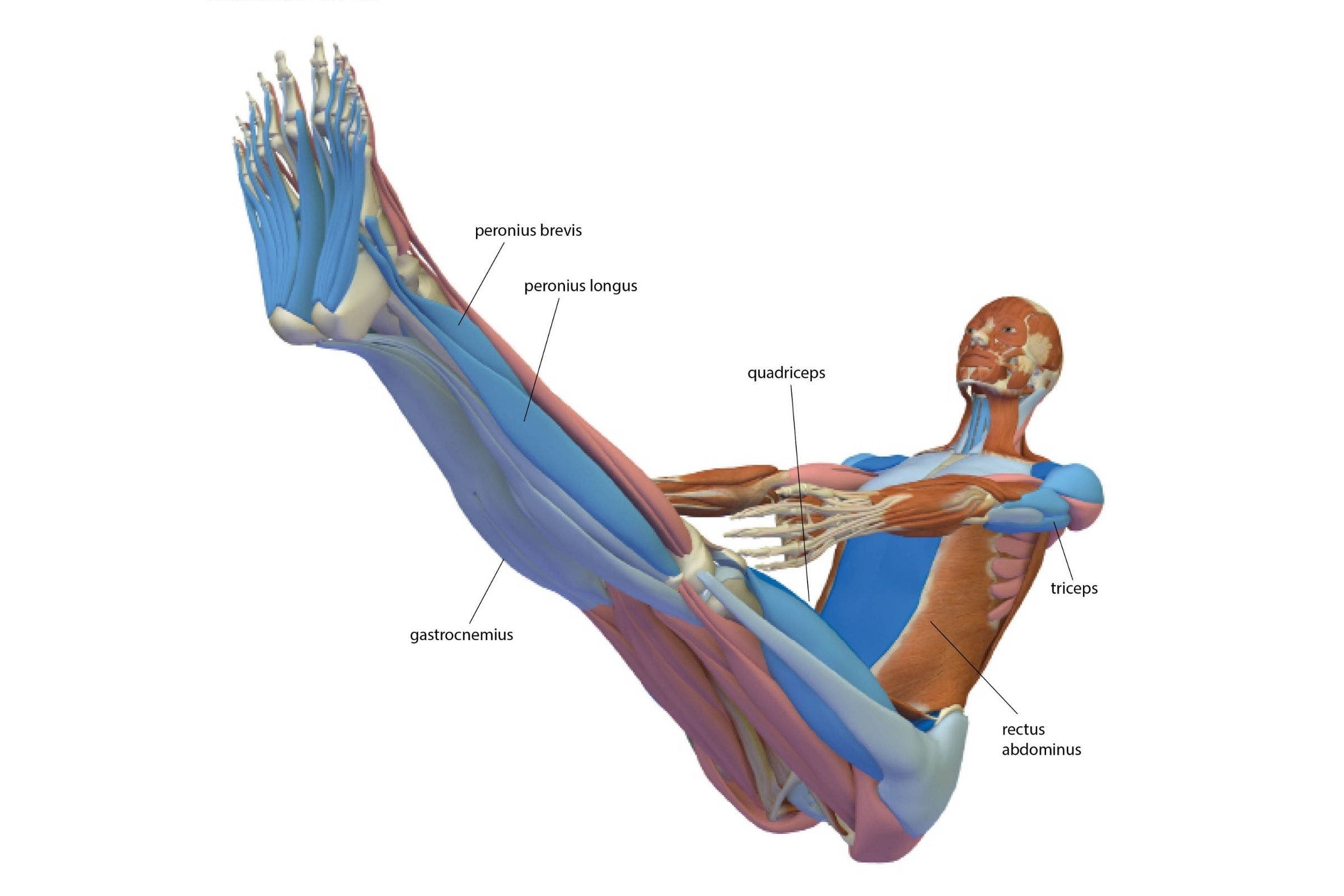
When you contract the rectus abdominis at the front of your abdomen, you activate all the layers of the abdominals, including the transverse abdominis and the oblique abdominals. They work to flex your hips. But you also need to activate the psoas and its synergist hip flexors. The psoas, pectineus, sartorius, and rectus femoris muscles bend your hips and flex your trunk to lift your legs.
When your back rounds in Navasana, it means you are relying entirely on the abdominals and need to engage the hip flexors to tilt your pelvis forward. All of these actions are required to attain optimal alignment in this challenging pose.
To feel the psoas engage, bend your knees with your feet on the ground and place your hands on your thighs. Resist with the hands while you attempt to draw your knees toward your chest. Look for this same feeling while in the full expression of the pose. Or simply stay here and, as you gain strength, work toward the classic expression of the pose.
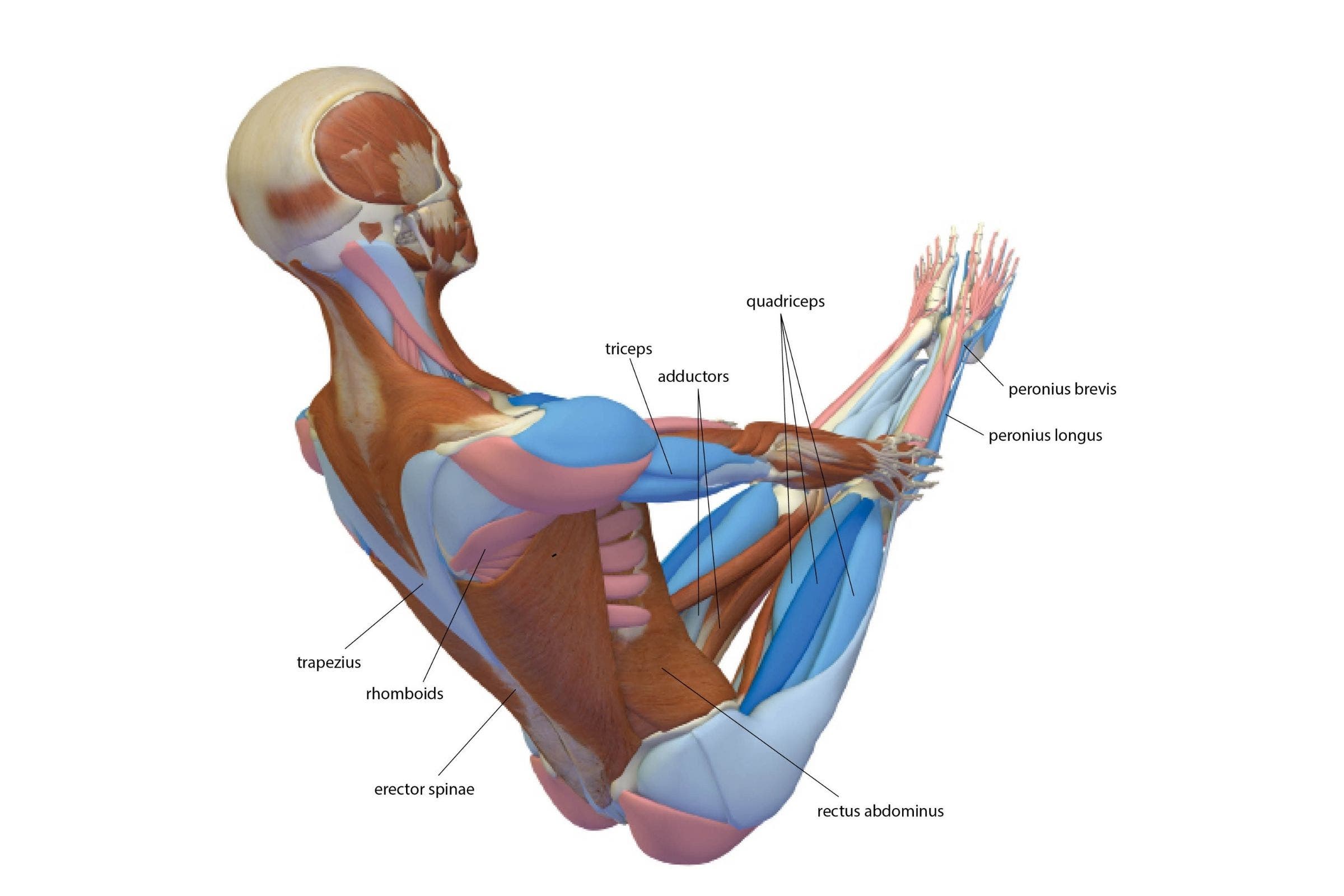
The trapezius muscles combine with the rhomboids (which connect the shoulder blade to the spine) to draw your shoulders back and down toward the midline of your body to open your chest. Once your scapulae are constrained in this fashion, you can contract the pectoralis minor, located under the pectoralis major on your chest, to lift and expand your rib cage and open your chest.
A cue for engaging these muscles is to hold the shoulder blades back and then attempt to roll the shoulders forward. The shoulders won’t move but the contractile force of the pectoralis minor and serratus anterior will be transmuted to your ribcage, lifting it upward.
The erector spinae and quadratus lumborum lift and slightly arch the back. The quadratus lumborum acts synergistically with the psoas major to support the lumbar spine.
Squeeze your knees toward one another to engage the adductors in your legs. Plantar flex the ankles and point your toes to stretch the tibialis anterior muscles and toe extensors. This activates the gastrocnemius and soleus muscles in the calf, which are attached to the heel by the Achilles tendon. The peroneus longus and brevis slightly evert your ankles and turn your feet slightly outward, opening the soles of your feet.
Excerpted and adapted with permission from The Key Poses of Yoga and Anatomy for Vinyasa Flow and Standing Poses by Ray Long MD.
ADVERTISEMENT
Put Boat Pose into practice
This is a great pose to build heat. Include it during the heat-building portion of class or as a respite from intense standing poses. Practice this posture in the beginning of class to fire up your core for the rest of your practice. Counter core work with gentle twists or backbends.
How to Build a Strong Core Without Sit-ups
7 Poses to Work Those Easily Overlooked Lower Abs
ADVERTISEMENT
About our contributors
Teacher and model Natasha Rizopoulos is a senior teacher at Down Under Yoga in Boston, where she offers classes and leads 200- and 300-hour teacher trainings. A dedicated Ashtanga practitioner for many years, she became equally as captivated by the precision of the Iyengar system. These two traditions inform her teaching and her dynamic, anatomy-based vinyasa system Align Your Flow. For more information, visit natasharizopoulos.com.
Ray Long is an orthopedic surgeon and the founder of Bandha Yoga, a popular series of yoga anatomy books, and the Daily Bandha, which provides tips and techniques for teaching and practicing safe alignment. Ray graduated from the University of Michigan Medical School and pursued post-graduate training at Cornell University, McGill University, the University of Montreal, and the Florida Orthopedic Institute. He has studied hatha yoga for over 20 years, training extensively with B.K.S. Iyengar and other leading yoga masters, and teaches anatomy workshops at yoga studios around the country.
Sanskrit
Paripurna Navasana (par-ee-POOR-nah nah-VAHS-anna)
Boat Pose basics
Pose type: Seated
Targets: Core
Benefits: Boat Pose builds focus and body awareness. It can boost energy and fight fatigue, and can help build confidence and empowerment. It also improves posture and counteracts the effects of prolonged sitting and doing computer work by strengthening your core and thighs.
How to
- Sit on the floor with your legs straight in front of you. Press your hands on the floor a little behind your hips.
- Lift through the top of the sternum and lean back slightly, making sure your back doesn’t round. Balance your weight on the tripod of your sitting bones and tailbone.
- Exhale and bend your knees, then lift your thighs so they are angled about 45 degrees above the floor, with your knees still bent.
- If possible, slowly straighten your knees, raising the tips of your toes slightly above the level of your eyes. If that is not possible, keep your knees bent, your shins parallel to the floor.
- Keeping your heart open and your spine long, draw your shoulders back and extend both arms forward alongside the legs, parallel to the floor, with your palms facing in. Try to keep your lower belly flat and firm, but not hard and thick.
- Point your toes or flex through your heels, and breathe. Try to stay in the pose for 10 to 20 seconds, slowly increasing your time to a minute.
Beginner tips
- Don’t let your back round. Instead, lengthen and lift through the front of your body.
- You can practice this pose throughout your day without even leaving your chair. Sit on the edge of a seat with your knees directly above your ankles. Grab onto the sides of the seat with your hands and lean slightly forward. Engage your arms and lift your buttocks slightly off the seat, then raise your heels (but not the balls of your feet) slightly off the floor. Lift the top of your sternum forward and up.
Be mindful!
- Avoid strong core engagement like in this pose if you are pregnant, particularly in the second and third trimesters. Consider modifying to a gentler version held for a shorter amount of time.
- Use caution if you have a hernia, or any back pain, injuries, or surgeries.
Deepen the pose
- You can intensify the pose by lowering both your legs and your upper back closer to the mat.
Teacher tips
These tips will help protect your students from injury and help them have the best experience of the pose:
- Practice this posture in the beginning of class to fire up your core for the rest of your practice.
- If students find it too hard to raise their arms, have them keep their hands on the floor beside their hips or hold on to the backs of their thighs.
- For students who find it difficult to straighten their raised legs, invite them to keep their knees bent and loop a strap around the soles of their feet. As they inhale, ask them to lean the torso back, then as they exhale and lift and straighten the legs, invite them to push their feet firmly against the strap.
Variations

Bent-Knee Boat Pose
Try with your knees bent to lessen the effort and take pressure off your low back. Keep your arms extended in front of you, bring your palms to the backs of your thighs, or place your hands behind you on the floor for support.

Half Boat Pose
Prepare to come into the pose but keep your feet on the ground. If you like, lift one leg at a time. You can keep the lifted leg bent or straighten it. Hold onto the back of your thighs for extra support or bring your hands behind you on the floor. Try transitioning back and forth between legs with your breath, switching legs on an exhalation.
Why we love this pose
“I do Boat Pose incrementally with bent knees, holding the back of my legs,” says Sarah LaVigne, Yoga Journal‘s contributing photo editor. “Once I find my balance and am past the wobbly phase, I slowly straighten my legs. This step-by-step approach focuses me on each stage. Once I reach the peak pose, I feel like I am floating.”
Preparatory and counter poses
Before undertaking Boat Pose, you want to stretch and challenge your body in the same manner demanded by this challenging pose. That means stretching your hamstrings and low back, engaging your abdominals, and lifting your chest without overarching your low back.
Preparatory poses
Adho Mukha Svanasana (Downward-Facing Dog Pose)
Uttanasana (Standing Forward Bend)
Padangusthasana (Big Toe Pose)
ADVERTISEMENT
Counter poses
Baddha Konasana (Bound Angle Pose)
Bharadvajasana (Bharadvaja’s Twist)
Anatomy
Navasana is, technically, a forward fold since it flexes your body at the trunk. However, as anyone who has ever attempted Navasana knows, this pose is more of an isolated strengthening of your core and less a focused stretch. Unlike most forward bends, it requires constant muscular effort to maintain.
In the drawings below, pink muscles are stretching and blue muscles are contracting. The shade of the color represents the force of the stretch and the force of contraction. Darker = stronger.
When you contract the rectus abdominis at the front of your abdomen, you activate all the layers of the abdominals, including the transverse abdominis and the oblique abdominals. They work to flex your hips. But you also need to activate the psoas and its synergist hip flexors. The psoas, pectineus, sartorius, and rectus femoris muscles bend your hips and flex your trunk to lift your legs.
When your back rounds in Navasana, it means you are relying entirely on the abdominals and need to engage the hip flexors to tilt your pelvis forward. All of these actions are required to attain optimal alignment in this challenging pose.
To feel the psoas engage, bend your knees with your feet on the ground and place your hands on your thighs. Resist with the hands while you attempt to draw your knees toward your chest. Look for this same feeling while in the full expression of the pose. Or simply stay here and, as you gain strength, work toward the classic expression of the pose.
The trapezius muscles combine with the rhomboids (which connect the shoulder blade to the spine) to draw your shoulders back and down toward the midline of your body to open your chest. Once your scapulae are constrained in this fashion, you can contract the pectoralis minor, located under the pectoralis major on your chest, to lift and expand your rib cage and open your chest.
A cue for engaging these muscles is to hold the shoulder blades back and then attempt to roll the shoulders forward. The shoulders won’t move but the contractile force of the pectoralis minor and serratus anterior will be transmuted to your ribcage, lifting it upward.
The erector spinae and quadratus lumborum lift and slightly arch the back. The quadratus lumborum acts synergistically with the psoas major to support the lumbar spine.
Squeeze your knees toward one another to engage the adductors in your legs. Plantar flex the ankles and point your toes to stretch the tibialis anterior muscles and toe extensors. This activates the gastrocnemius and soleus muscles in the calf, which are attached to the heel by the Achilles tendon. The peroneus longus and brevis slightly evert your ankles and turn your feet slightly outward, opening the soles of your feet.
Excerpted and adapted with permission from The Key Poses of Yoga and Anatomy for Vinyasa Flow and Standing Poses by Ray Long MD.
ADVERTISEMENT
Put Boat Pose into practice
This is a great pose to build heat. Include it during the heat-building portion of class or as a respite from intense standing poses. Practice this posture in the beginning of class to fire up your core for the rest of your practice. Counter core work with gentle twists or backbends.
ADVERTISEMENT
How to Build a Strong Core Without Sit-ups
7 Poses to Work Those Easily Overlooked Lower Abs
ADVERTISEMENT
About our contributors
Teacher and model Natasha Rizopoulos is a senior teacher at Down Under Yoga in Boston, where she offers classes and leads 200- and 300-hour teacher trainings. A dedicated Ashtanga practitioner for many years, she became equally as captivated by the precision of the Iyengar system. These two traditions inform her teaching and her dynamic, anatomy-based vinyasa system Align Your Flow. For more information, visit natasharizopoulos.com.
Ray Long is an orthopedic surgeon and the founder of Bandha Yoga, a popular series of yoga anatomy books, and the Daily Bandha, which provides tips and techniques for teaching and practicing safe alignment. Ray graduated from the University of Michigan Medical School and pursued post-graduate training at Cornell University, McGill University, the University of Montreal, and the Florida Orthopedic Institute. He has studied hatha yoga for over 20 years, training extensively with B.K.S. Iyengar and other leading yoga masters, and teaches anatomy workshops at yoga studios around the country.
