Updated March 27, 2025 02:31PM
If you buy through our links, we may earn an affiliate commission. This supports our mission to get more people active and outside.Learn about Outside Online's affiliate link policy
Mountain Pose
It seems so simple as to hardly be a pose. But this basic posture contains the secrets of how to hold yourself in countless other poses.

(Photo: Andrew Clark)
The interplay of effort and ease is something that you experience in almost every yoga pose. Mountain Pose allows you to practice the foundational principles of balance, alignment, and selective effort and ease, preparing you to draw on these same principles in other poses.
“On the outside, Mountain Pose in yoga looks extremely simple,” says Stephany McMillan, founder of Rise and Flow Yoga in Greensboro, North Carolina. “But internally, the muscles are active, strong, and working hard.”
Sanskrit
Tadasana (tah-DAHS-ah-nah)
tada = mountain
asana = seat; posture
ADVERTISEMENT
How to do Mountain Pose
- Stand with your big toes touching and your heels slightly apart.
- Lift and spread your toes and then lower them back to the mat.
- Stack your shoulders, hips, knees, and ankles in a straight line.
- Let your arms fall at your sides, palms facing forward.
- Gaze straight ahead. Breathe.
Mountain Pose Variations
Mountain Pose With Feet Apart
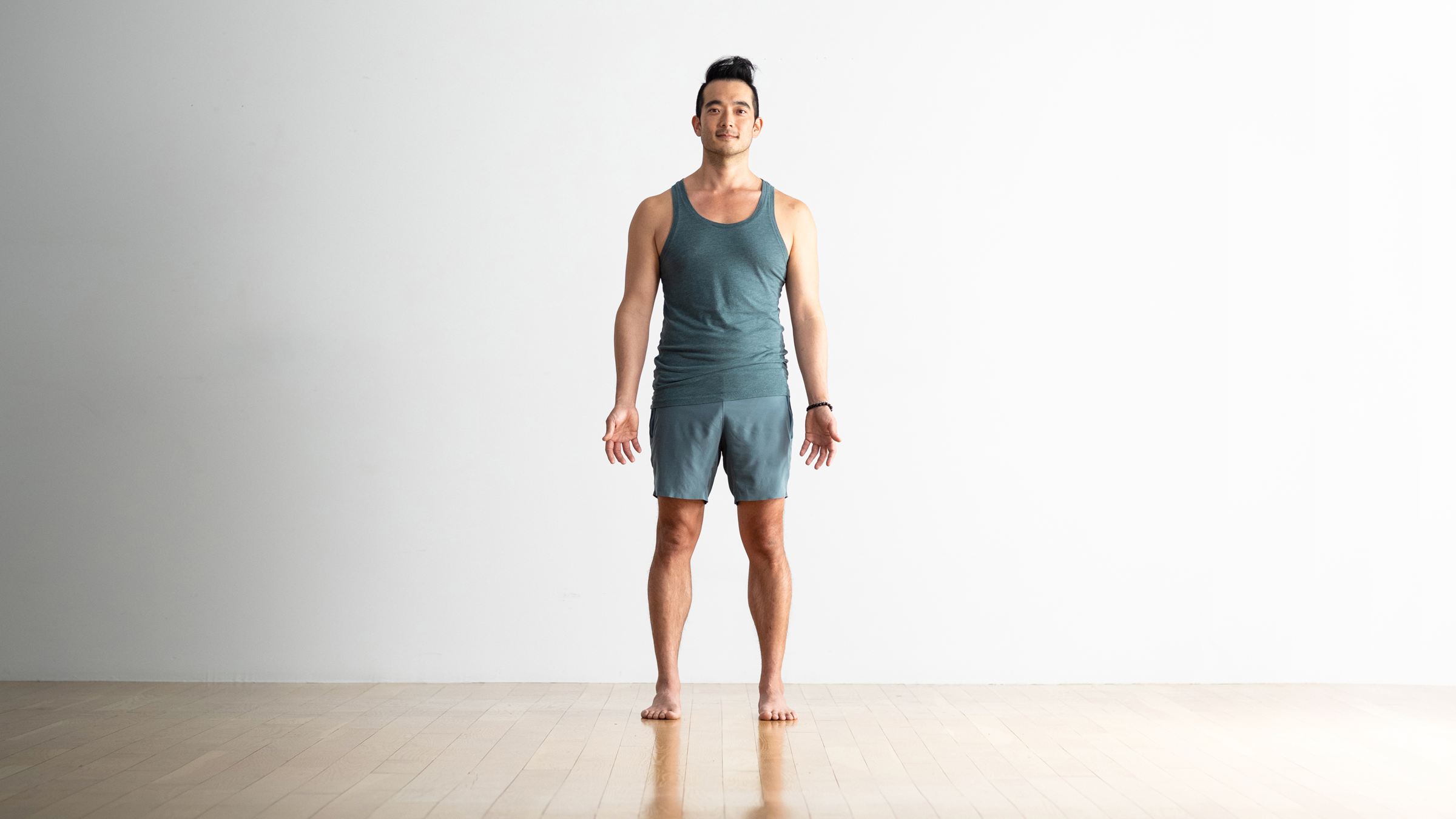
Taking your feet hip-distance apart allows for a more stable base and is helpful for anyone who experiences back pain or finds it challenging to stay balanced.
Mountain Pose Against a Wall
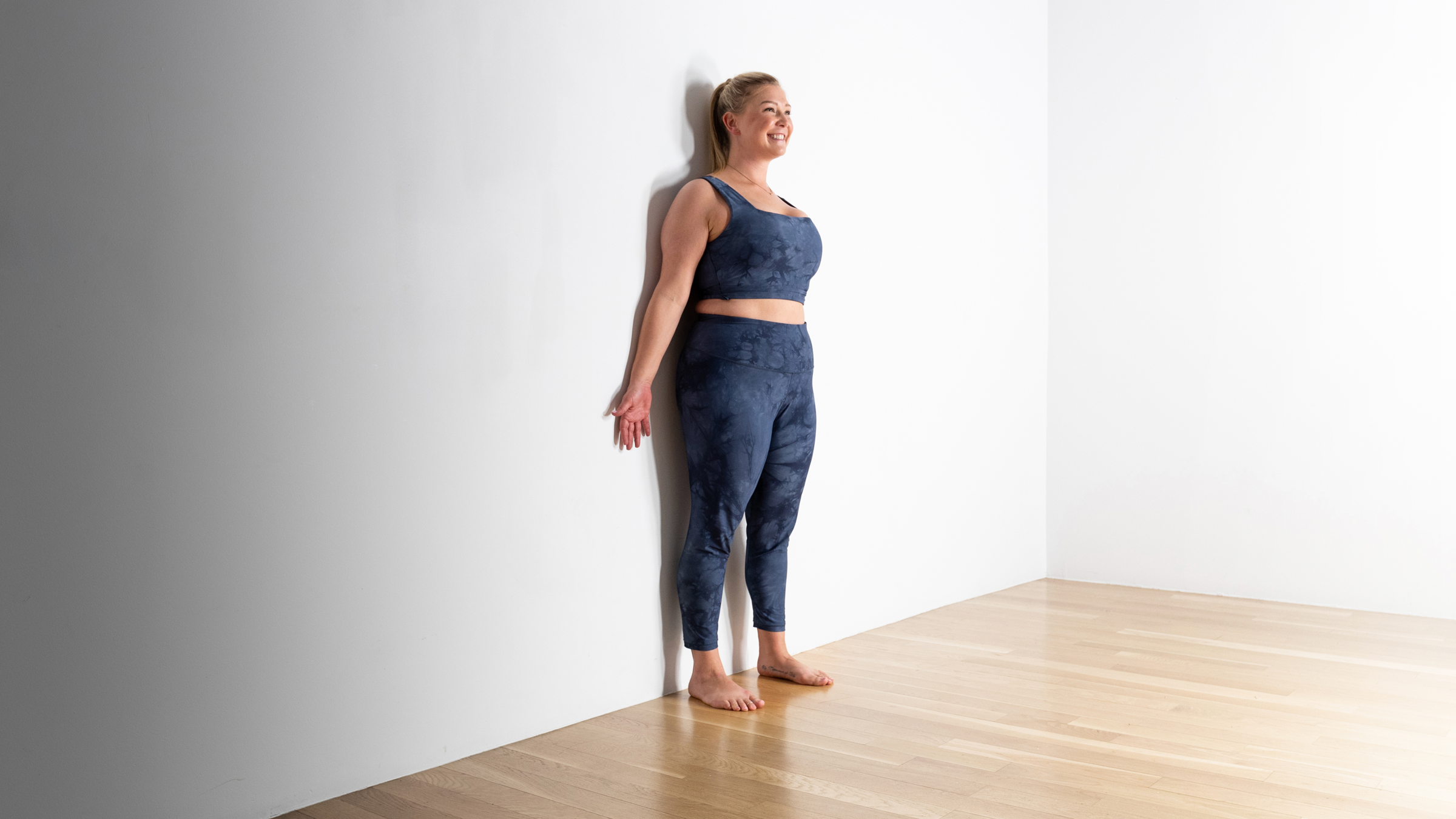
Bring the back side of your body, from your heels to your shoulder blades, against the wall. It’s okay if not all parts of your body touch the wall.
ADVERTISEMENT
Mountain Pose in a Chair
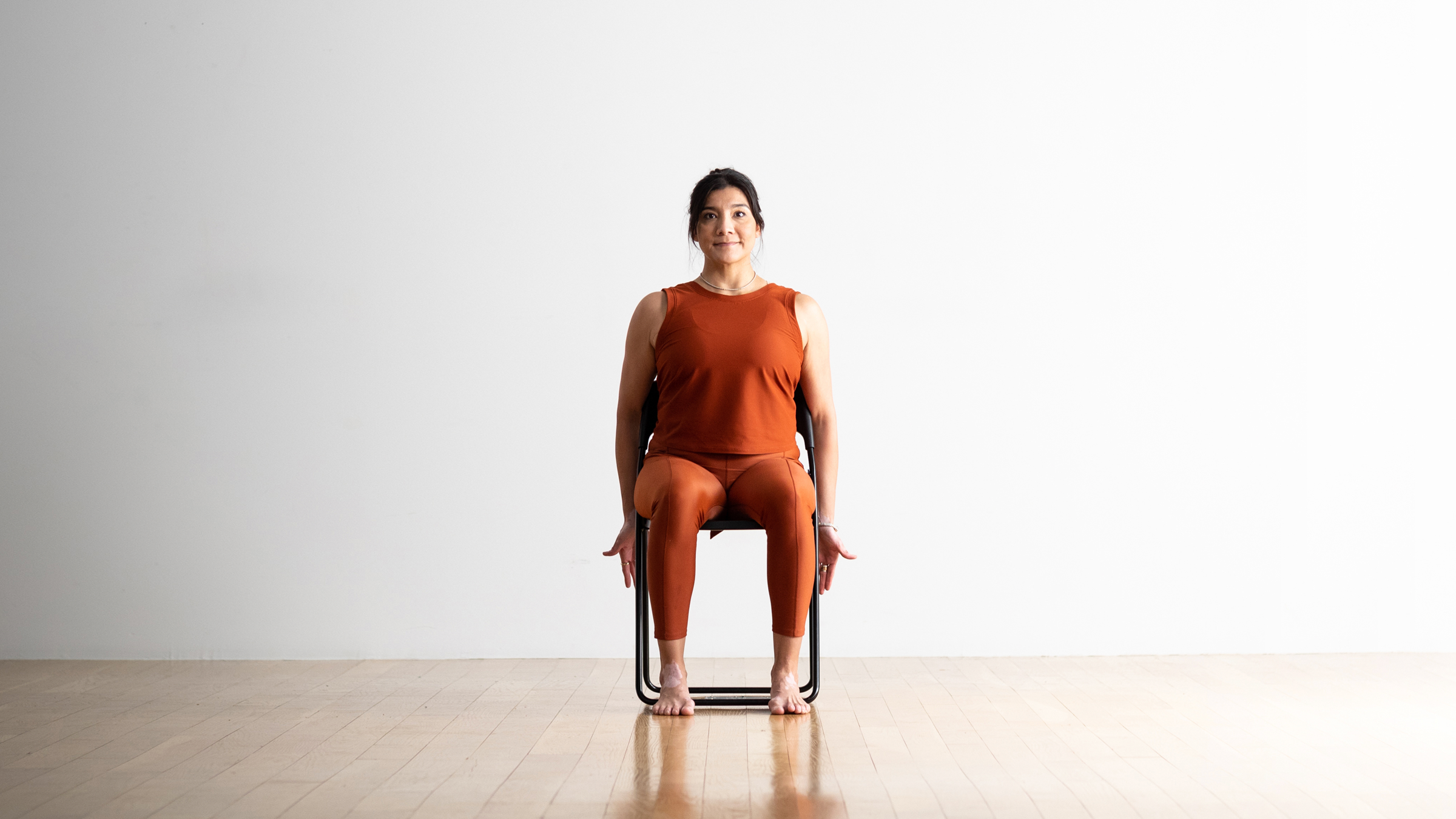
Find a comfortable seated position in a chair with your feet directly underneath your knees. Lengthen the top of your head toward the ceiling to achieve a neutral spine. Avoid slouching.
Ideally your hips will be in line with your knees. If you are shorter, try placing blocks under your feet and a pillow behind your back for support. If you are taller, consider sitting on a folded blanket.
Mountain Pose Basics
Pose type: Standing posture
Targets: Full body
Benefits: Mountain Pose improves your postural and body awareness by stacking your shoulders, hips, knees, and ankles. It can counter the effects of prolonged sitting at a computer by reminding you what it feels like to release your shoulders away from your ears.
ADVERTISEMENT
Beginner Tips for Mountain Pose
- Take your feet hip-distance apart to find better balance and ease muscle tension in your lower back.
- Rock back and forth and side to side on your feet. Slowly reduce the sway and come to a standstill with your weight balanced evenly across your feet. Root down through all edges of your feet. Feel the energy draw from your feet up through your core.
- Ask a teacher to check whether your ears, shoulder joints, hips, and ankles are in a straight line.
- Elongate from your pelvis through the top of your head. You’ll notice where your body is tugging from stress or lack of movement, explains McMillan.
Common Misalignments in Mountain Pose
- Notice if your shoulders are tense and lifting toward your ears. Draw your shoulder blades down.
- There can be an unconscious tendency to round the shoulders forward. Lift the top of your head toward the ceiling and pull your shoulder blades toward your spine.
- Yoga teacher Alexandria Crow advises you to avoid the common cue “tuck your tailbone” in Tadasana. This flattens your lumbar spinal curve and pushes your hips forward, which prevents you from forming a long line from your feet through the crown of your head.
- Crow also suggests not to roll onto the outer edges of your feet or distribute your weight unevenly as it interferes with the structural stability of every joint above your feet.
- Your mental state affects your posture and vice-versa. “If you feel fatigued, defeated, or depressed, you might stand in Tadasana with slumped shoulders and a collapsed chest,” explains Ray Long, MD, in Anatomy for Vinyasa Flow and Standing Poses. “Conversely, the form that you create with Tadasana influences your mental state. Draw your shoulders back and down to open your chest. This relaxed yet open position counteracts a defeated and slumped posture in both body and mind.”
Why We Love Mountain Pose
“What had once been a simple beginning stance became, for me, a physical embodiment of inner stability, peace, and intentionality in my yoga practice and my life.”—Yoga Journal contributing editor Gina Tomaine
Teaching Mountain Pose
- Watch students for pronation (the feet rolling in toward the arch) or supination (the feet rolling toward the outer edge of the foot). Remind them to ground down through all corners of the feet.
- Encourage students to notice if they’re hyperextending, or locking, their knees. Remind them to take a slight bend in their knees.
Preparatory and Counter Poses
Tadasana essentially prepares you for any standing asana. To prepare for this pose bring attention to breath, grounding, and alignment.
Counter Poses
Uttanasana (Standing Forward Bend)
Utkatasana (Chair Pose)
Savasana (Corpse Pose)
ADVERTISEMENT
Anatomy
Tadasana is the cornerstone of the standing poses. It is used in between standing poses as a physical barometer, a place of return where you can quietly assess how the body feels after a preceding asana.
In the drawings below, pink muscles are stretching and blue muscles are contracting. The shade of the color represents the force of the stretch and the force of contraction. Darker = stronger.
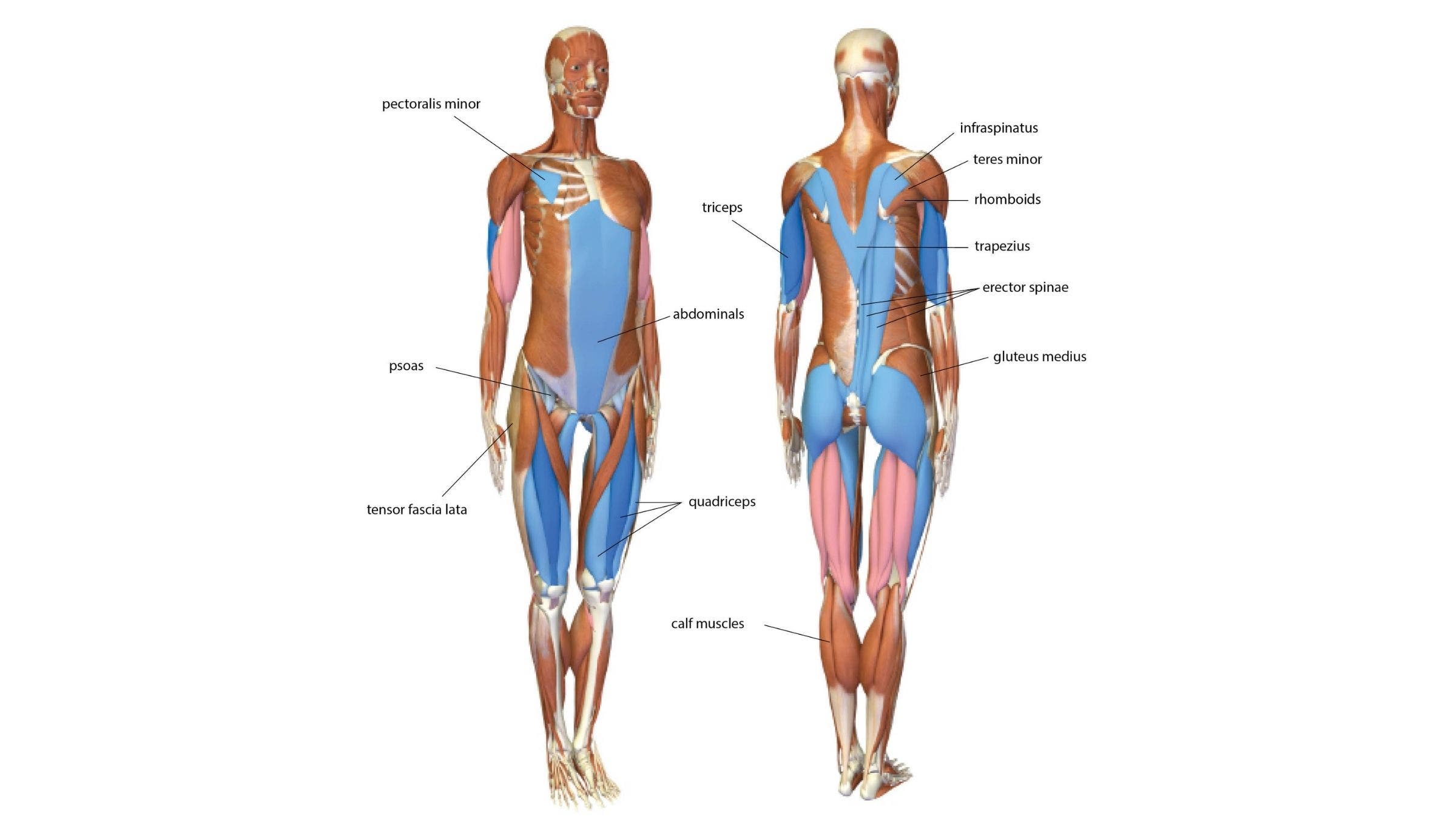
The erector spinae are deep back muscles that extend from the skull to the base of the spine. They work with the muscles in the small of your back to lift the spine and hold you upright. The abdominal muscles running down the front of your body work with these back muscles to support and balance your torso. Together they draw your ribs downward.
The lower part of the trapezius, which spans your back, draws your shoulders down and away from your ears and lifts your chest. The rhomboids, which connect the shoulder blades to the spine, work with the mid-portion of the trapezius and draw the shoulder blades toward the midline of your body, which opens the front of your chest.
The muscles that keep the pelvis upright are located on both the front and back of the body. At the front of the pelvis is the psoas, and at the back are the glutei or the buttocks muscles. These two muscles balance one another.
The quadriceps muscles contract and straighten your knees. Meanwhile, the calf muscles are working quietly to balance your ankles on your feet, which are the foundation of the pose. All this time, the muscles on the top and bottom of the feet balance each other, grounding the pose.
If your legs tend to turn outward, the tensor fascia lata and the gluteus medius muscles at the front and highest points of the hip bones work to turn them inward.
Excerpted with permission from The Key Poses of Yoga and Anatomy for Vinyasa Flow and Standing Poses by Ray Long.
ADVERTISEMENT
Mountain Pose in Practice
Mountain Pose is the basis of all yoga postures, so spend time grounding and aligning this posture from the ground up, and try to maintain the elements of engagement and alignment of Mountain Pose in all of your poses throughout your flow. Here are a few sequences to try:
About Our Contributors
Teacher and model Natasha Rizopoulos is a senior teacher at Down Under Yoga in Boston, where she offers classes and leads 200- and 300-hour teacher trainings. A dedicated Ashtanga practitioner for many years, she became equally as captivated by the precision of the Iyengar system. These two traditions inform her teaching and her dynamic, anatomy-based vinyasa system Align Your Flow. For more information, visit natasharizopoulos.com.
Ray Long is an orthopedic surgeon and the founder of Bandha Yoga, a popular series of yoga anatomy books, and the Daily Bandha, which provides tips and techniques for teaching and practicing safe alignment. Ray graduated from the University of Michigan Medical School and pursued post-graduate training at Cornell University, McGill University, the University of Montreal, and the Florida Orthopedic Institute. He has studied hatha yoga for over 20 years, training extensively with B.K.S. Iyengar and other leading yoga masters, and teaches anatomy workshops at yoga studios around the country.
