Updated February 27, 2025 05:44PM
If you buy through our links, we may earn an affiliate commission. This supports our mission to get more people active and outside.Learn about Outside Online's affiliate link policy
Half Lord of the Fishes Pose
Also called Seated Twist Pose or Ardha Matsyendrasana in Sanskrit, this pose energizes the spine and stimulate proper digestion while improving postural and body awareness.

(Photo: Andrew Clark)
Ardha Matsyendrasana (Half Lord of the Fishes Pose/Seated Twist Pose) is a deep, restorative twist that is both strengthening and rejuvenating. Your entire torso twists in the pose, which improves circulation, helps with digestion, and improves spinal mobility.
“I look forward to doing Ardha Matsyendrasana toward the end of my practice,” says Yoga Journal contributing editor Gina Tomaine. “It allows me to feel like my whole body is being wrung out, after I’ve been energized and warmed up from previous poses. When I was younger—before I even knew what yoga was—I used to practice this pose after running all over the field during soccer practice. It’s one that’s been an asset to me all my life.”
Sanskrit
Ardha Matsyendrasana (ARD-ah Mats-yun-DRAHS-uh-nah)
ardha = half
matsya = fish
indra = king
ADVERTISEMENT
How to
- Begin seated in Sukhasana. Cross your right knee on top or your left, bringing your feet alongside your hips.
- Lift your right knee up to place the soul of your right foot on the mat outside of your left knee.
- Place your right hand to the floor outside of your right hip for support. Make sure you are sitting evening on both sitting bones.
- Inhale and raise your left hand to the ceiling. Exhale and bring your left elbow down to the outside of your right knee. Press your knee and elbow together to create some resistance.
- Turn your head to the right, looking past your right shoulder. Make sure you don’t strain your neck.
- Breath as you hold the pose, lengthening on each inhale and gently twisting a bit more with each exhale.
- To exit the pose, inhale to reach the right arm up and unwind the body. Exhale to release back to center. Repeat on the other side.
Variations
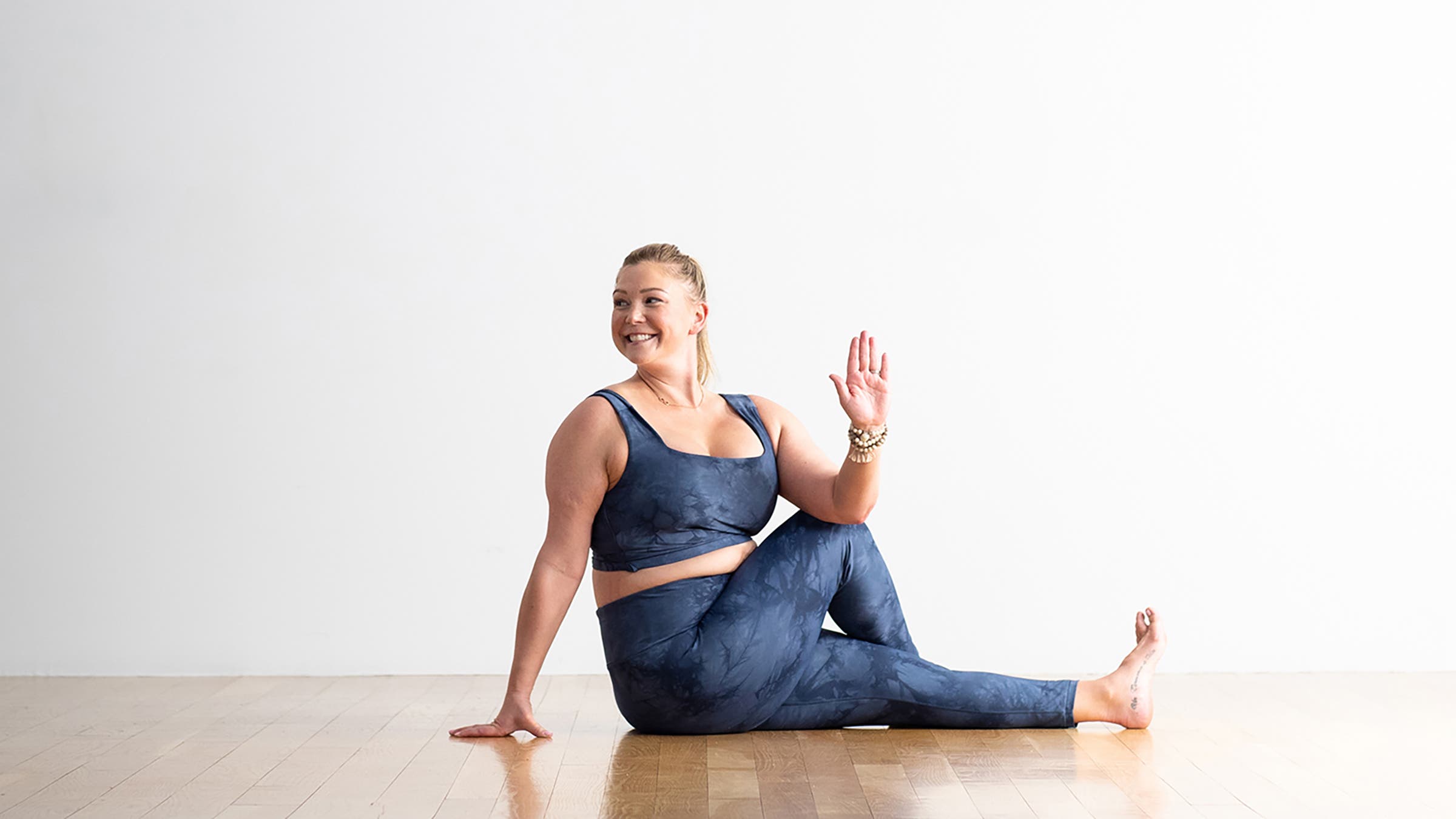
Half Lord of the Fishes Pose with relaxed arms
Instead of bringing your left elbow to your right thigh, wrap your left forearm around your right shin, bringing your knee inside your elbow.
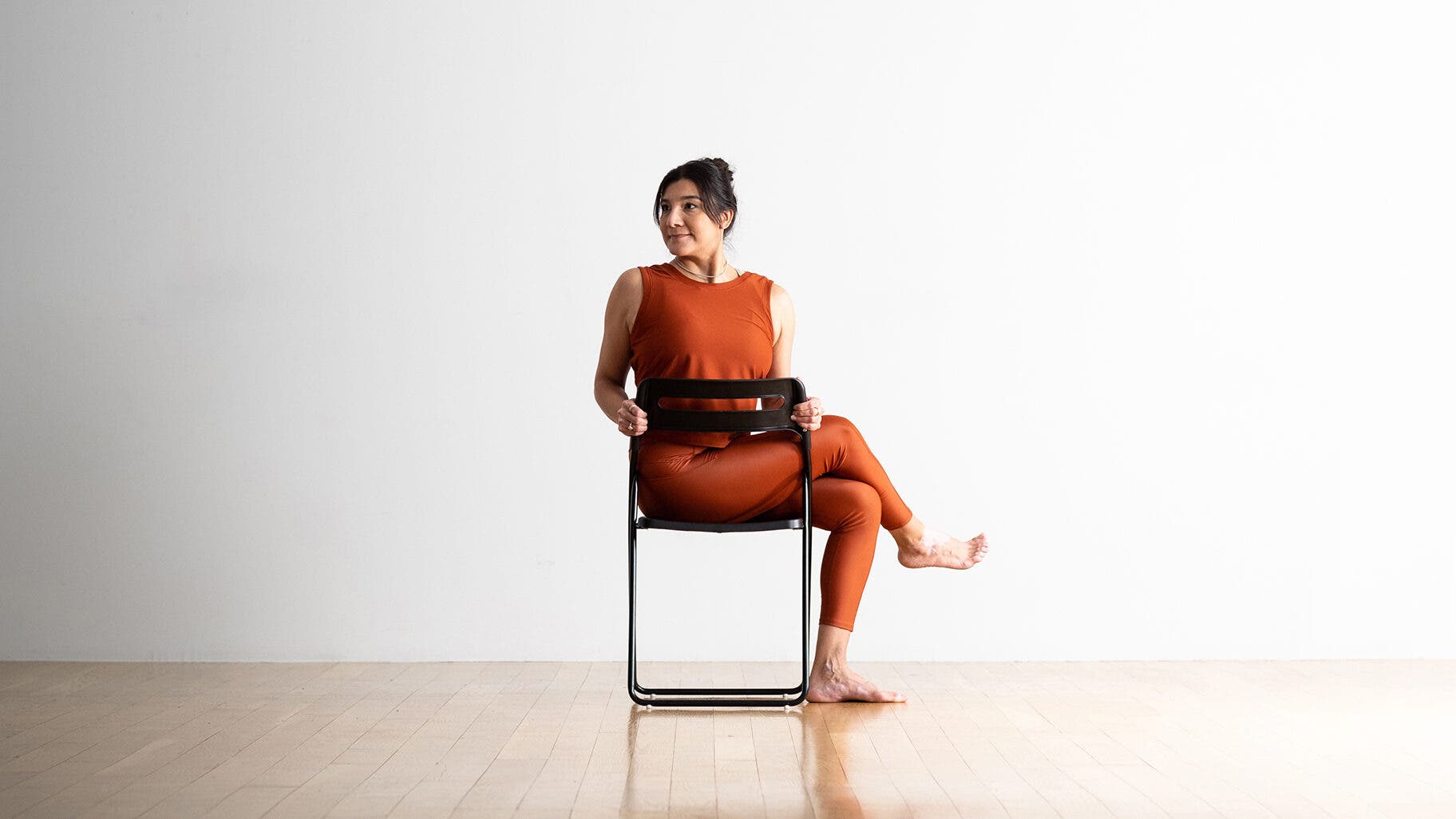
Half Lord of the Fishes on a chair
Sit on a chair with your legs crossed. Lengthen your spine and twist toward your top leg. Hold onto the sides of the seat, the armrest, or the back of the chair.
Half Lord of the Fishes basics
Pose type: Twist
Targets: Core, flexibility
Benefits: “[Ardha Matsyendrasana] increases spinal rotation, boosts blood flow to the disks, and builds strength and flexibility in the erector spinae muscles, the tiny muscles that support the spine,” says Carol Krucoff. Half Lord of the Fishes is good for stretching your outer hips and thighs, opening your shoulders and chest, building strength in your upper back, lengthening your spine, and stretching the front of your thighs.
It can also help stimulate digestion. In Ardha Matsyendrasana, everything within the torso is getting a little squeeze—the stomach, intestines, and kidneys—which can encourage digestion and elimination. Bonus: your shoulders, hips, and neck also receive a deep and welcome stretch.
ADVERTISEMENT
Other Half Lord of the Fishes perks:
- Improves posture and counteracts the effects of sitting
- May help relieve constipation by moving and stimulating your lower abdominal area
Beginner tips
- If your shoulders are tight, instead of pressing your elbow against your lifted knee, hold your knee with your hand or wrap your arm around the raised leg and hug the thigh to your torso.
- If you are struggling to breathe deeply, back out of the twist a bit and slow your breath down.
- Avoid or modify this pose if you have knee, hip, or back pain, or injuries in these areas.
- For support, sit on a blanket.
Explore the pose
Take this pose—and any spinal twist—slowly and carefully. To avoid compression and injury, yoga teacher Carol Krucoff says it’s important that you create length in the spine before and during the twist. Press down with your sitting bones and stretch up, extending the length of your spine. If it helps, picture a central axis running through your torso from your pelvic floor to the top of your head.
If you want a deeper shoulder opener, twist until your right shoulder is in front of your left knee. Bring your right arm down, under the knee, and reach through toward your back. Bring the left hand and arm behind your back, and clasp your hands together.
Why we love this pose
“This pose always offers me a new perspective during my class. I spend so much time during yoga classes focused on the front of the room…thinking about my legs, my arms and my breath,” says Yoga Journal staff writer Ellen O’Brien. “This pose asks me to engage with my core—and the back of the room—offering me a new perspective. When I turn my gaze toward the back of the room, I often think about turning my attention away from any stress or anxieties I’m holding onto. This pose always gives me the reset I need.”
ADVERTISEMENT
Teacher tips
These cues will help protect your students from injury and help them have the best experience of the pose:
- With every inhalation, lift a little more through the sternum, pushing the fingers against the floor to help. Twist a little more with every exhalation.
- Before you attempt any twisting pose, warm up properly. Prepare with some gentle asanas that bring blood into the muscles that flex and extend the spine, such as Cat-Cow.
- Distribute the twist evenly throughout the entire length of your spine; don’t concentrate it in the lower back.
Preparatory and counter poses
Stretch your hips and practice twists before practicing Half Lord of the Fishes Pose.
Preparatory poses
Bharadvajasana I (Bharadvaja’s Twist)
Marichyasana III (Pose dedicated to the Sage Marichi III/Sage’s Pose)
Janu Sirsasana (Head-to-Knee Forward Bend)
ADVERTISEMENT
Counter poses
Paschimottanasana (Seated Forward Bend)
Baddha Konasana (Bound Angle Pose)
ADVERTISEMENT
Anatomy
Ardha Matsyendrasana creates the shape of a fish’s tail, with the bottom knee flexing and the hip externally rotating, reminiscent of a salmon twisting as it swims upstream, explains Ray Long, MD, a board-certified orthopedic surgeon and yoga teacher. The main effort of this pose involves turning the tail in the opposite direction of the upper body.
In the drawings below, pink muscles are stretching and blue muscles are contracting. The shade of the color represents the force of the stretch and the force of contraction. Darker = stronger.
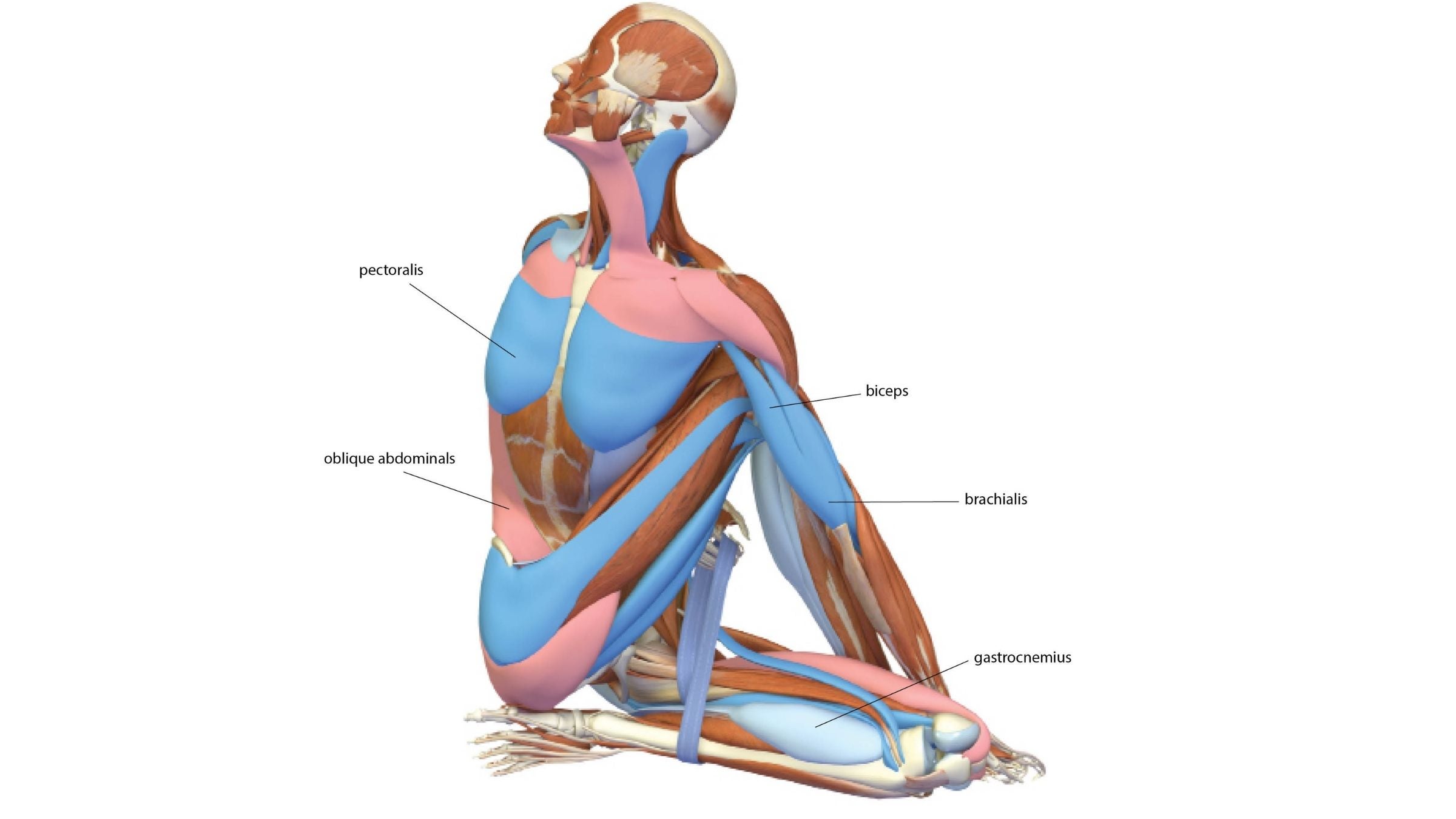
The trunk flexes and rotates as you plantar flex the foot (press it into the floor). This action is a result of the contraction of the gastrocnemius and soleus complex. The shoulder of the arm that holds the foot abducts and externally rotates. This will draw the arm further forward and turn the body deeper into the twist.
The shoulder of the arm behind the back extends and internally rotates. Roll the shoulder forward to internally rotate the arm behind the back. Lift the hand off the back to engage the muscles that produce this action. This causes the lower part of the pectoralis major, the latissimus dorsi, the teres major, the front part of the deltoid, and the subscapularis muscles to contract. Attempt to straighten the elbow by engaging the triceps. Note that as the elbow extends, the body turns deeper into the pose.
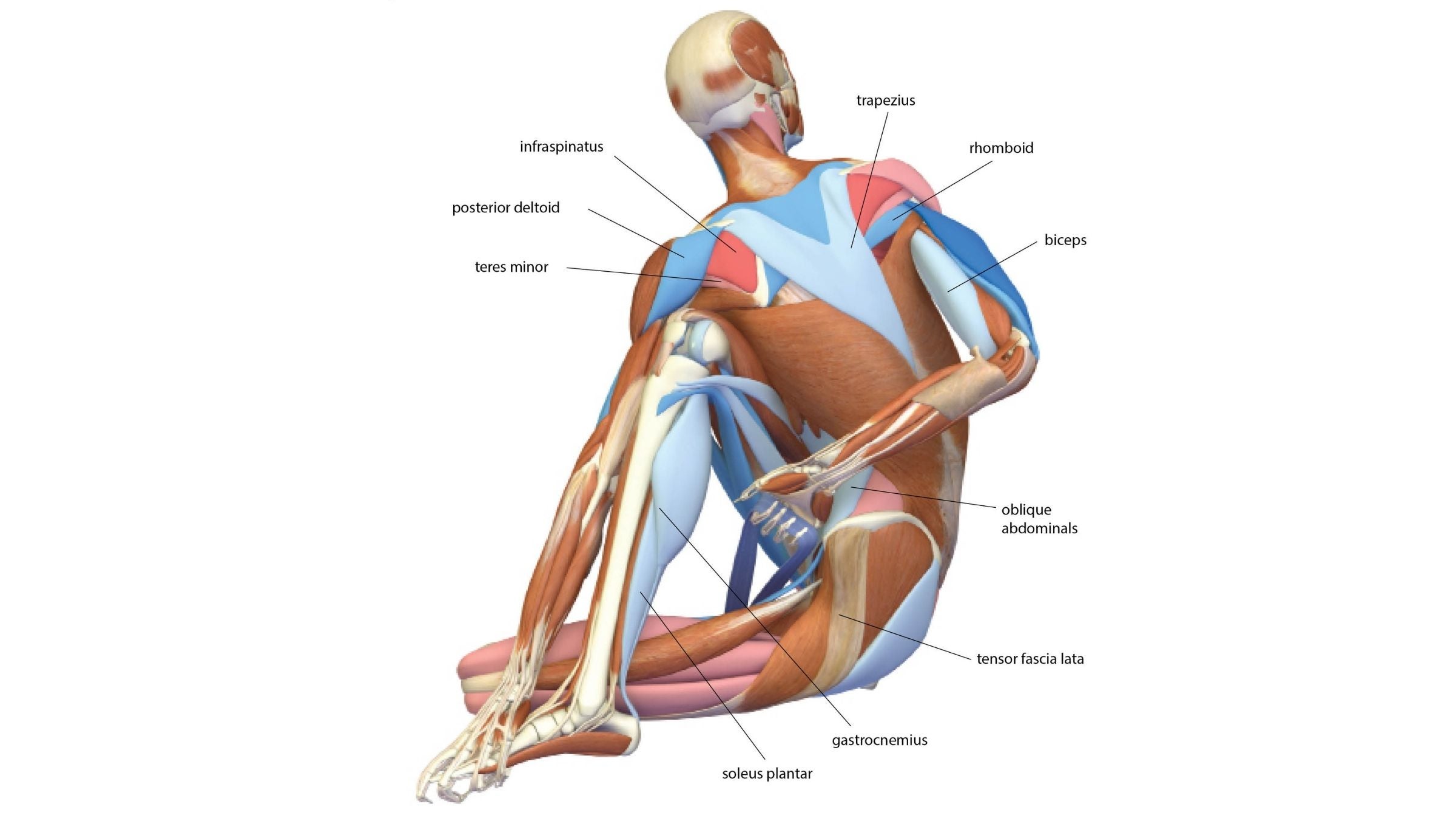
The top leg knee is adducting, or moving across the midline. This means the abductor muscles (those that move the leg away from the midline) lengthen and stretch, which allow the knee to be drawn closer to the midline and thus turn the body deeper into the twist. Additionally, internally rotating the thigh stretches the deep external rotators of the hip. Ardha Matsyendrasana is one of the most effective poses for isolating these hard-to-access muscles.
Press the side of the bottom thigh into the mat to engage the tensor fascia lata and gluteus medius muscles. Tuck the tailbone down and under to activate the gluteus maximus and deep external rotators to roll the thigh outward.
Excerpted with permission from The Key Poses of Yoga and Anatomy for Backbends and Twists.
Put Half Lord of the Fishes into practice:
Ready to put this twisting posture into practice? Here are a few flows to try:
10 Grounding Poses to Balance Your Vata Dosha This Fall
12 Poses to Relax Your Tight Hips and Low Back
ADVERTISEMENT
About our contributors
Teacher and model Natasha Rizopoulos is a senior teacher at Down Under Yoga in Boston, where she offers classes and leads 200- and 300-hour teacher trainings. A dedicated Ashtanga practitioner for many years, she became equally as captivated by the precision of the Iyengar system. These two traditions inform her teaching and her dynamic, anatomy-based vinyasa system Align Your Flow. For more information, visit natasharizopoulos.com.
Ray Long is an orthopedic surgeon and the founder of Bandha Yoga, a popular series of yoga anatomy books, and the Daily Bandha, which provides tips and techniques for teaching and practicing safe alignment. Ray graduated from the University of Michigan Medical School and pursued post-graduate training at Cornell University, McGill University, the University of Montreal, and the Florida Orthopedic Institute. He has studied hatha yoga for over 20 years, training extensively with B.K.S. Iyengar and other leading yoga masters, and teaches anatomy workshops at yoga studios around the country.
