Updated February 28, 2025 12:19PM
If you buy through our links, we may earn an affiliate commission. This supports our mission to get more people active and outside.Learn about Outside Online's affiliate link policy
Warrior 3 Pose
A standing posture centered around balance, Virabhadrasana III will strengthen your legs, ankles, and core.

(Photo: Andrew Clark)
Virabhadrasana III (Warrior Pose 3) requires concentration and stamina to maintain a thoughtful calibration between push and pull—gathering energy in, and extending it out.
“Virabhadrasana III asks us to stand grounded on one leg, rooted down into the earth, yet at the same time to lift the other leg and stretch horizontally from the tips of our toes to our fingertips, like a radiant star expanding into space,” says Power Yoga creator Beryl Bender Birch. “But if we expand outward too much, we lose our power and balance.”
Focus on contracting, pulling in, and connecting with gravity, says Bender Birch. But don’t contract too much; if you hang on too tightly, you will lose expansion—and likely your balance, too. Alternate between expansion and contraction, and treat both with equal importance.
Sanskrit
Virabhadrasana III (veer-ah-bah-DRAHS-anna)
virabhadra = the name of a fierce warrior, an incarnation of Shiva, described as having a thousand heads, a thousand eyes, and a thousand feet; wielding a thousand clubs; and wearing a tiger’s skin.
ADVERTISEMENT
How to
- Begin in Virabhadrasana I (Warrior Pose I) with your right foot forward.
- Root down firmly with your right heel to lift your lower belly, drawing the abdominals in and up and releasing your tailbone down.
- Firm your right outer hip into your midline as you straighten your left leg.
- Energize your arms to draw more length into your side body.
- Turn your left inner thigh toward the ceiling to roll your left outer hip forward, then pivot onto your back toes so your back leg is in a neutral position.
- Inhale to lengthen your spine.
- Exhale and tilt your torso forward, and reach your arms out ahead.
- Shift your weight into your front foot, and move forward as you lift your left leg until it is parallel to the floor.
- Your upper arms frame your ears, and your head, torso, pelvis, and lifted leg to form a straight line.
- Continue to turn your left inner thigh to the ceiling so your leg remains neutral and your pelvis is level.
- Continue to engage your right outer hip to provide stability for your standing leg.
- Push back with your left heel while extending forward with your arms, the crown of your head, and your sternum.
- Tone your lower belly, and direct your tailbone toward your left heel to provide support for your lower back.
- Hold for 5–10 breaths, then carefully bend your right knee and step back with your left foot, returning to Virabhadrasana I.
- Exit, and repeat on the other side.
Variations
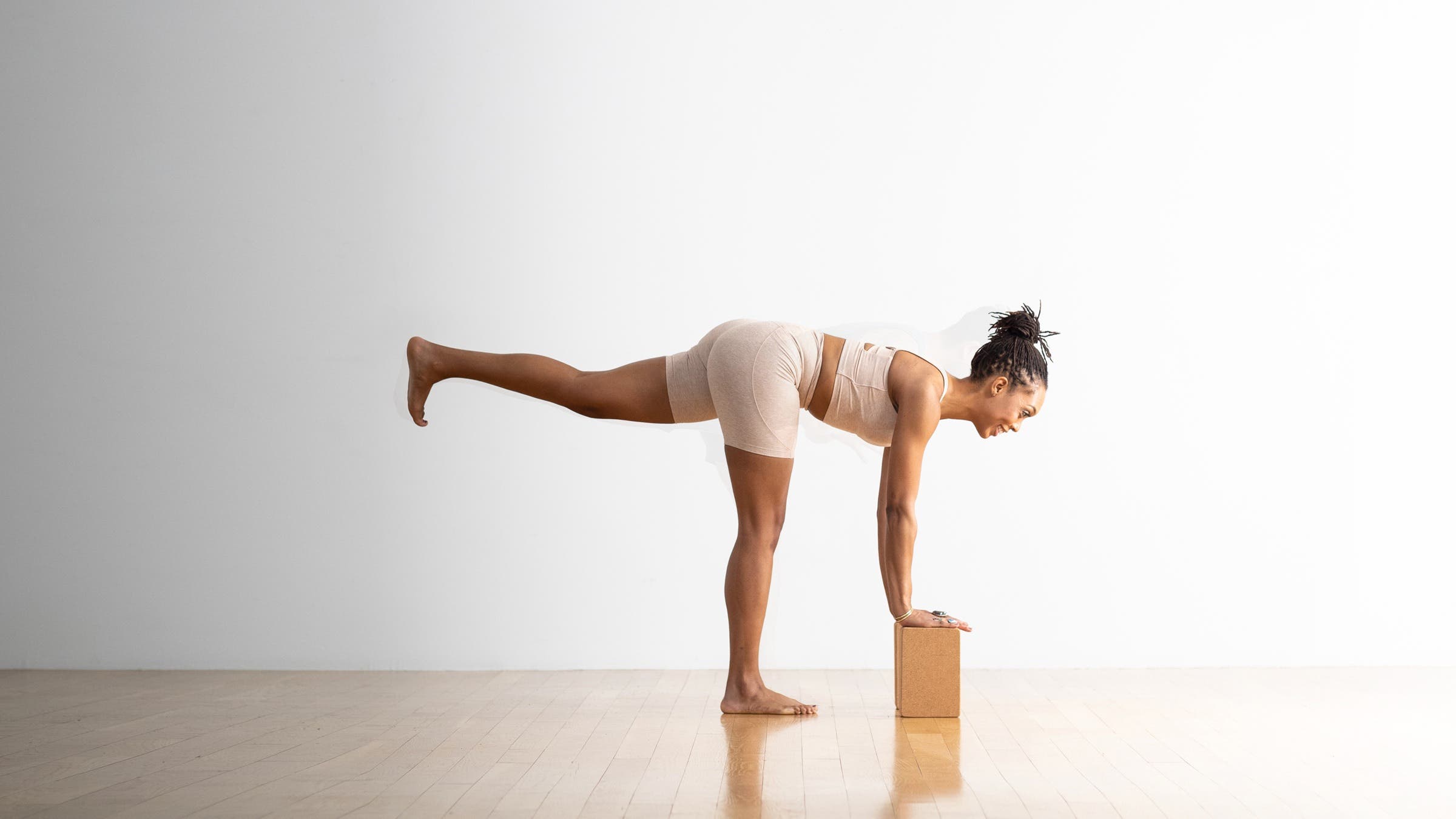
Warrior III with blocks
For added stability, bring your hands to blocks at any height rather than the floor.
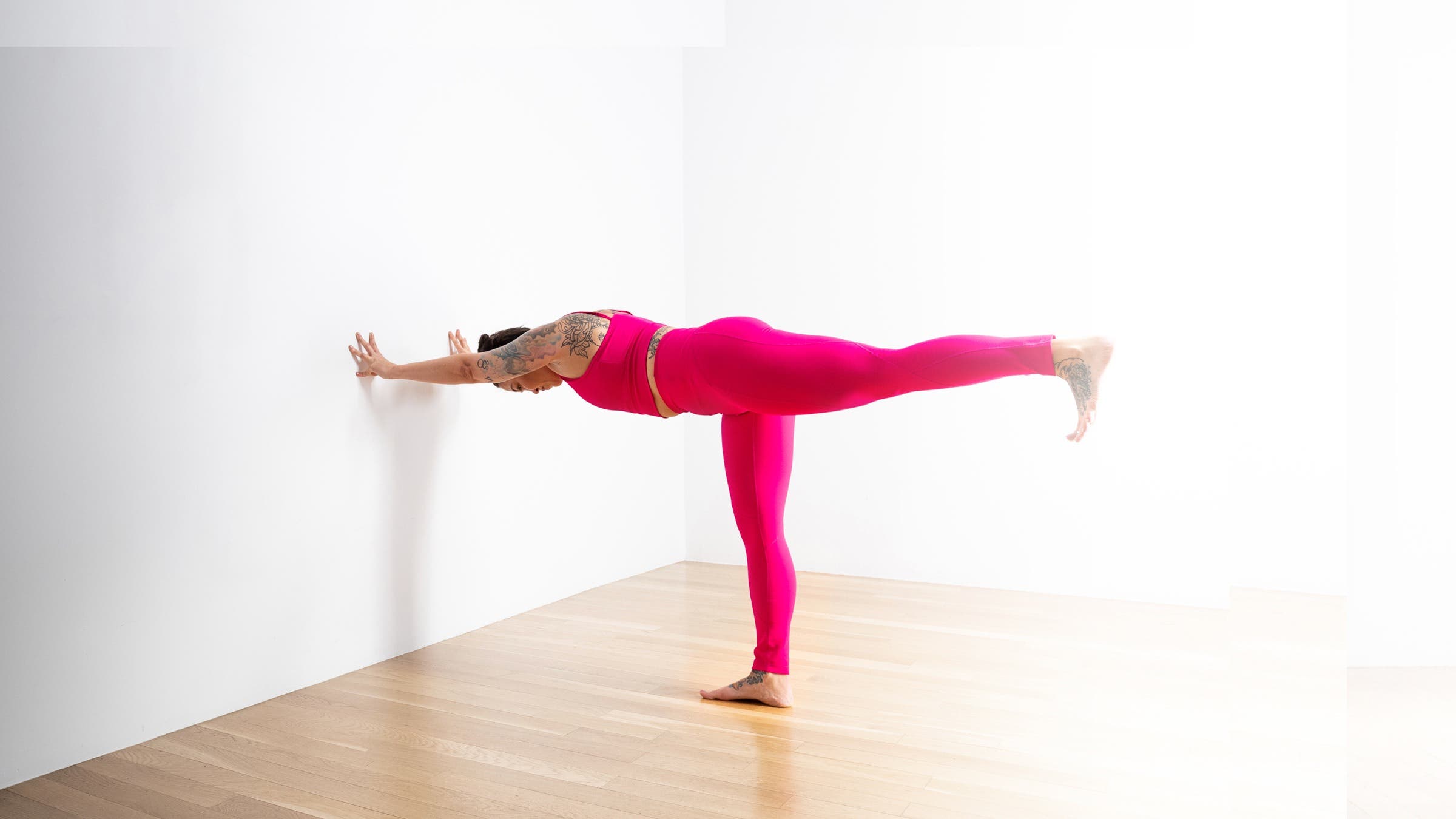
Warrior III with hands against a wall
If balance is elusive, stand facing a wall as you come into Warrior III and place your palms on the wall, using it to help support you. Your leg may or may not be lifted high, and that is OK.
ADVERTISEMENT
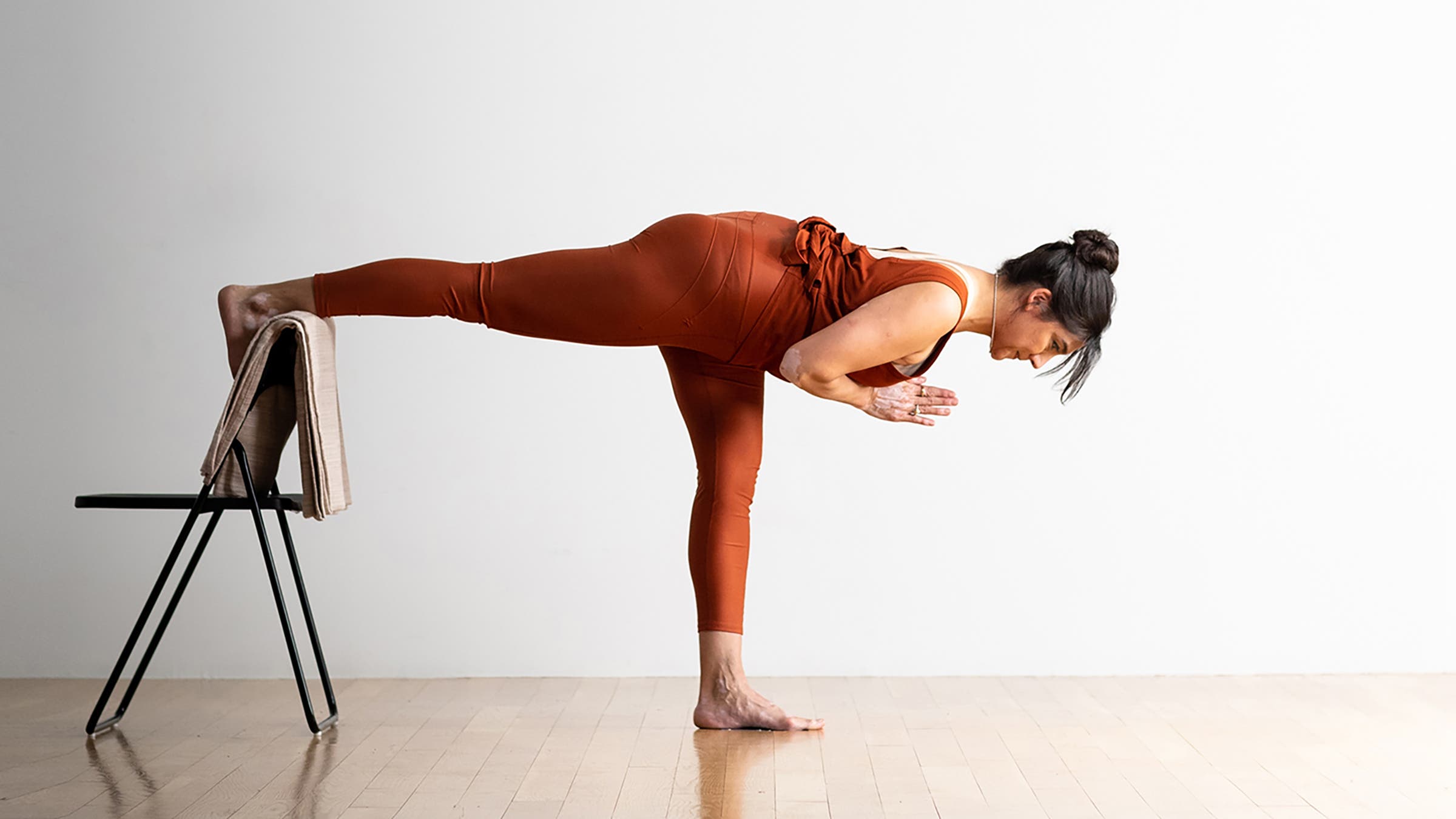
Warrior III with a chair
Come into Warrior III facing a chair and rest your hands on the seat or the back of the chair as you lift one leg behind you.
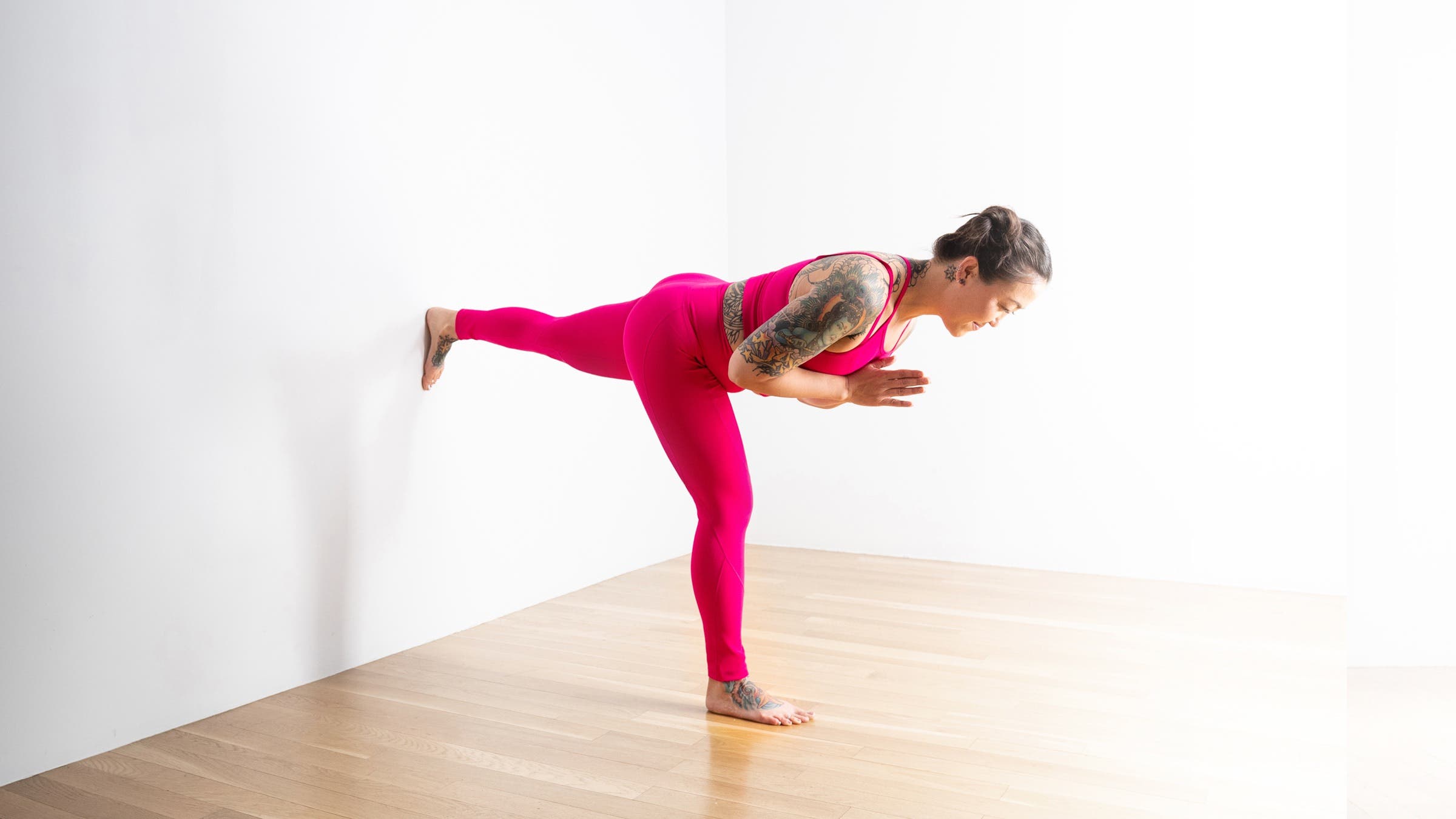
Warrior III with foot against a wall
Stand facing away from a wall as you come into Warrior III and place the bottom of your lifted foot on the wall. Press into your heel. Your leg may or may not be lifted high, and that is OK.
Warrior III basics
Pose type: Standing posture
Targets: Full-body strength
ADVERTISEMENT
Benefits
Warrior III improves your balance and strengthens your core. On your standing leg, this pose stretches the back of your thigh (hamstring) and buttock (glute) while strengthening the front of your thigh (quadriceps) and ankle. On your lifted leg, this pose stretches the front of your hip (hip flexor), including the psoas, and strengthens the back of your thigh (hamstring) and buttock (glute).
Other Warrior III perks:
- Helps counteract the effects of sitting too much
- Can be helpful for recovery after sports
Beginner tips
- If the hip bone of your lifted leg raises during the pose, release that hip toward the floor until both hip points are even and parallel to the floor. Energize your back leg and extend it strongly toward the wall behind you as you reach just as actively forward with your arms.
- When you straighten the front knee, imagine that the front calf is resisting forward against the shin; this will prevent the knee from locking or hyperextending.
Explore the pose
There’s a common tendency in Warrior III to roll your torso slightly over to your standing-leg side, or to drop your shoulder, arm, and hand on that side. Work to internally rotate the thigh and the whole torso to be parallel to and directly facing the floor.
ADVERTISEMENT
To straighten your back leg, bend your standing knee slightly to create one long line of energy from your head to your back foot. Keep your foot flexed to engage your quadriceps.
When you straighten the standing knee by pushing the head of the thighbone back, imagine that the same-leg calf is resisting forward against the shin. These two opposing movements prevent the knee from locking or hyperextending and further stabilize the position.
Be mindful!
- Don’t lock (hyperextend) your standing knee. If you feel strain around your standing knee, slightly bend it. The stretching sensations are safest felt in the centers (bellies) of the hamstrings/backs of thighs rather than in the joints.
- Avoid overarching your low back, a common mistake with beginning practitioners. Protect your low back and practice extending from your back leg to your crown.
- If you are new to this pose or your lower back hurts, bring your palms together at the center of your heart, instead of extending your arms in front of you.
Why we love this pose
“Warrior 3 allows you so many entry points—from Warrior 1, from Tree, from a lunge, from Chair. And, oh, the places you can go: Standing splits. Half Moon. The challenge of Warrior 3 is to keep the hips parallel to the floor, but when you do, you can really feel the strength of your standing leg.” —Yoga Journal senior editor Tamara Jeffries
Teacher tips
These cues will help protect your students from injury and help them have the best experience of the pose:
- Focus on expansion. Expand through the torso and your raised back leg, moving your shoulders away from your ears. Work to maintain length and openness throughout your upper body.
- Stay mindful of cultivating an easy and slow transition as you come out of the pose. A hallmark of an advanced practice is the ability to transition mindfully between poses.
- Invite softness into the posture. Focus on extending through your raised back leg. Carefully bend your lower knee to invite some softness even as you stand firm.
ADVERTISEMENT
Preparatory and counter poses
Stretch your hips, your entire back body, and your shoulders prior to coming into Warrior III.
Preparatory poses
Supta Padangusthasana (Reclining Hand-to-Big-Toe Pose)
Urdhva Hastasana (Upward Salute)
Urdhva Prasarita Eka Padasana (Standing Splits)
Parsovottanasana (Intense Side Stretch)
ADVERTISEMENT
Counter poses
Uttanasana (Standing Forward Bend)
ADVERTISEMENT
Anatomy
Warrior III converts the potential energy stored in Warrior I into movement, projecting your body forward into balancing on your front leg, explains Ray Long, MD, a board-certified orthopedic surgeon and yoga teacher.
The main story of the pose is the rotation of your pelvis forward and flexion of your torso over your standing leg. The back story in Warrior III is the balancing act. As with all balancing poses, become aware of your center of gravity and use it to your advantage. Bend your standing leg and/or lower your lifted leg to descend the center of gravity and make the pose more stable.
ADVERTISEMENT
In the drawings below, pink muscles are stretching and blue muscles are contracting. The shade of the color represents the force of the stretch and the force of contraction. Darker = stronger.
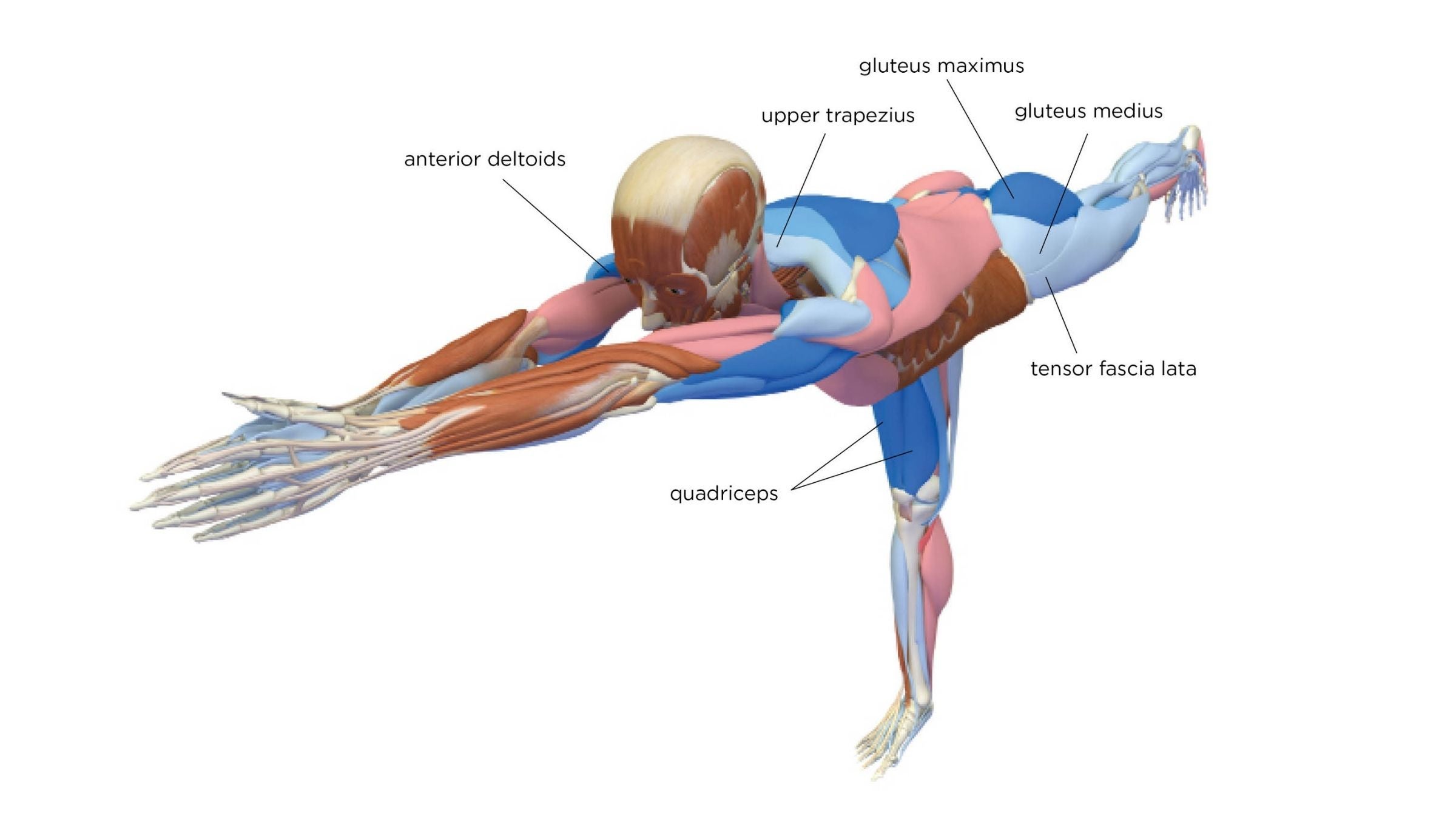
Central to the balancing act is the quadriceps of your standing leg. You can use it to lift your torso by straightening your knee. Press the ball of that foot into the floor and turn your thigh inward. This activates the peronei on the side of your lower leg and the tensor fascia lata and gluteus medius of your standing-leg hip.
Remember that stability originates from the large muscles of the pelvic core—the psoas and the gluteals. The gluteus maximus, synergized by the adductor magnus, extends the raised hip and tilts the pelvis backward. Engage the gluteus maximus and adductor magnus by contracting the buttocks. Activating the gluteus maximus also externally rotates your leg; counter this by engaging the tensor fascia lata and gluteus medius muscles to internally rotate your hip.
Note the interrelations among the erector spinae, trapezius, and deltoids. Observe how these muscles can be used in combination to lift your chest and raise your arms while drawing your shoulders away from your neck. Straighten your elbows to engage the triceps. Bring an external rotation of your shoulders by engaging the infraspinatus and teres minor muscles of the rotator cuff.
Excerpted with permission from The Key Poses of Yoga and Anatomy for Vinyasa Flow and Standing Poses by Ray Long.
ADVERTISEMENT
Put Warrior III into practice:
Ready to put this standing posture into practice? Here are a few flows to try:
Boost Your Motivation and Willpower with This Sequence
Try This Lower-Body Strength Yoga Sequence for Stable Legs
ADVERTISEMENT
About our contributors
Teacher and model Natasha Rizopoulos is a senior teacher at Down Under Yoga in Boston, where she offers classes and leads 200- and 300-hour teacher trainings. A dedicated Ashtanga practitioner for many years, she became equally as captivated by the precision of the Iyengar system. These two traditions inform her teaching and her dynamic, anatomy-based vinyasa system Align Your Flow. For more information, visit natasharizopoulos.com.
Ray Long is an orthopedic surgeon and the founder of Bandha Yoga, a popular series of yoga anatomy books, and the Daily Bandha, which provides tips and techniques for teaching and practicing safe alignment. Ray graduated from the University of Michigan Medical School and pursued post-graduate training at Cornell University, McGill University, the University of Montreal, and the Florida Orthopedic Institute. He has studied hatha yoga for over 20 years, training extensively with B.K.S. Iyengar and other leading yoga masters, and teaches anatomy workshops at yoga studios around the country.
