Updated July 1, 2025 08:36AM
What Is Pranayama?
Exploring the ancient practice of breath control in yoga.
(Photo: iStock/MmeEmil)
In yoga, as in life, breathing can be taken for granted. It’s something we do automatically, involuntarily, and unconsciously. But since ancient times, practitioners of yoga have understood that breath is life. This awareness is expressed in the Sanskrit term pranayama, which is commonly translated as “breath control.”
Pranayama is the fourth of the eight limbs of yoga, which are ethical and moral principles written by the yogic sage Pantanjali. Asana, which refers to physical postures, is the third of the eight limbs; however, each limb is equally important.
It has long been taught that pranayama has the power to bring awareness to the body and elevate the mind and spirit. Contemporary science supports what ancient tradition has taught for centuries: Awareness of the breath can directly affect your health and quality of life.
What Is Pranayama?
While we often simplify the term pranayama to mean “breathwork,” the yogic meaning of pranayama is more nuanced.
In Sanskrit, “prana” means “life force,” and literally describes the energy that is believed to sustain the life of the body. “Ayama” translates as “to extend, expand, or draw out,” although some say that the word is actually dervied from “yama,” meaning “control.”
ADVERTISEMENT
In her book Yoga: Ancient Heritage, Tomorrow’s Vision, Indu Arora breaks it down even further. “Pra means ‘primary, first, innate.’ Ana, from anu, means ‘the tiniest, smallest, indestructible unit of energy,’” according to Arora.
With either translation, you arrive at the same concept: Pranayama is a practice that involves the management or control of the breath. As implied by the literal translation of the term, yogis believe that this practice not only rejuvenates the body but actually extends life itself.
Pranayama consists of different breathwork techniques designed to gain mastery over the respiratory process while recognizing the connection among breath, mind, and emotions.
Pranayama is an integral part of the yogic tradition, but not always an easy one to grasp.
ADVERTISEMENT
Benefits of Pranayama
Ancient yoga philosophy maintains that pranayama practice is a powerful tool for healing and enhancing clarity and vitality. Modern scientific research has begun to support this traditional wisdom.
Reduces Stress and Anxiety
Research has found that intentional breathing such as that practiced in pranayama may help reduce symptoms of arousal, anxiety, and depression.
ADVERTISEMENT
Slowing down your breathing in any form activates relaxation in the body, which prevents us from going into our stress response (also known as “fight or flight”).
Improves Sleep
In one study, older adults who regularly practiced yoga—asana and pranayama—experienced less sleep disturbance and overall better sleep quality when compared to those who did not practice yoga.
Lowers Blood Pressure
An engaged breath practice can help lower your heart rate and blood pressure, as well as relieve fatigue, according to research. When you practice pranayama, you may notice a change in your energy levels, the temperature of your body, or even your emotional state.
Improves Respiratory Function
One study found that a regular pranayama practice can help improve pulmonary function by training the muscles of the diaphragm and abdomen, as well as clearing the respiratory passages to allow for better airflow.
Pranayama may improve breathing and quality of life for people with respiratory illnesses such as bronchial asthma and chronic obstructive pulmonary disease (COPD).
ADVERTISEMENT
Enhances Cognitive Function
After practicing pranayama for 35 minutes, three times per week, for 12 weeks, individuals participating in a medical study experienced improved cognitive functions.
How to Practice Pranayama
You will find that yoga instructors teach a wide range of pranayama techniques. Styles vary according to the discipline in which it is taught.
ADVERTISEMENT
You can do pranayama as a stand-alone practice and sit or lie quietly as you experiment with the various breathing exercises. Or you can incorporate pranayama into your physical yoga practice, coordinating your breath with your movements.
You can also introduce pranayama into your daily activities–during physical exercise or exertion, in stressful situations, or when you’re having trouble sleeping.
There are potential risks of engaging in pranayama. Some people who engage in breathwork are prone to hyperventilating, particularly if the breathwork is done quickly. In addition, it’s best to return to your normal breathing if you experience shortness of breath, chest pain, or light-headedness during pranayama.
It may help to speak to a doctor or other health practitioner prior to starting breathwork, particularly if you have health conditions affecting your airways (such as asthma) or heart (such as low blood pressure or cardiovascular disease).
ADVERTISEMENT
Types of Pranayama Exercises
Below are some of the most common breathwork exercises that you might encounter in a yoga class.
Ujjayi Pranayama (Victorious Breath)
One of the most common breathwork techniques taught in asana practice, ujjayi pranayama is practiced by gently constricting the throat to create some resistance to the passage of air.
“Gently pulling the breath in on inhalation and gently pushing the breath out on exhalation against this resistance creates a well-modulated and soothing sound—something like the sound of ocean waves rolling in and out,” explains Ashtanga teacher Tim Miller. This is why you may also hear it called “ocean breath.”
ADVERTISEMENT
Ujjayi can be incorporated into any physical practice whenever you inhale and exhale. It can also be part of your meditation practice as you sit quietly and focus on the breath.
- Exhale with your mouth slightly open, as if you are trying to fog up a mirror.
- Feel the breath move across your throat and hear that “ocean” sound.
- Once you are accustomed to the feeling in your throat, practice inhaling and exhaling through a closed mouth.
- Repeat this cycle for 10 breaths or more.
RELATED: 11 Ujjayi Breath Cues You’ve Probably Never Heard Before
Sama Vritti Pranayama (Box Breathing)
Another powerful breathwork tool that can help clear your mind, sama vritti pranayama can relax your body and allow you to focus.
- Sit in a comfortable seat with your back supported and feet on the floor.
- Close your eyes. Breathe in through your nose, slowly counting to 4. Focus on feeling the air fill your lungs.
- Hold your breath as you slowly count to 4 again. Try not to clamp your mouth shut as you avoid inhaling or exhaling for 4 counts.
- Slowly exhale to the count of 4.
- Pause at the end of your exhalation for another 4 counts.
- Repeat this cycle for 10 breaths or until you feel calm and centered.
Dirgha Pranayama (Three-Part Breath)
This technique involves briefly interrupting your inhalations and/or exhalations with pauses. Dirgha pranayama raises your awareness of your lung capacity and the structure of your torso.
- Lie in a reclined position–either flat on your back or propped up by bolsters, blocks, blankets or a combination of these.
- Inhale to a third of your lungs’ capacity, then pause for two to three seconds.
- Inhale another third, pause again, and inhale until the lungs are filled.
- Pause, then repeat the pattern on the exhale–exhaling the breath in thirds.
- Repeat a cycle of inhalations for 5 rounds and a cycle of exhalations for 5 rounds, or until you feel comfortable.
You may also practice pausing only on the inhalation, then releasing the full breath on one exhalation, or vice versa by taking in one deep breath and then exhaling in three parts.
ADVERTISEMENT
Nadi Shodhana Pranayama (Alternate Nostril Breath)
Also known as channel-cleaning breath, nadi shodhana pranayama is practiced to help calm the body and mind.
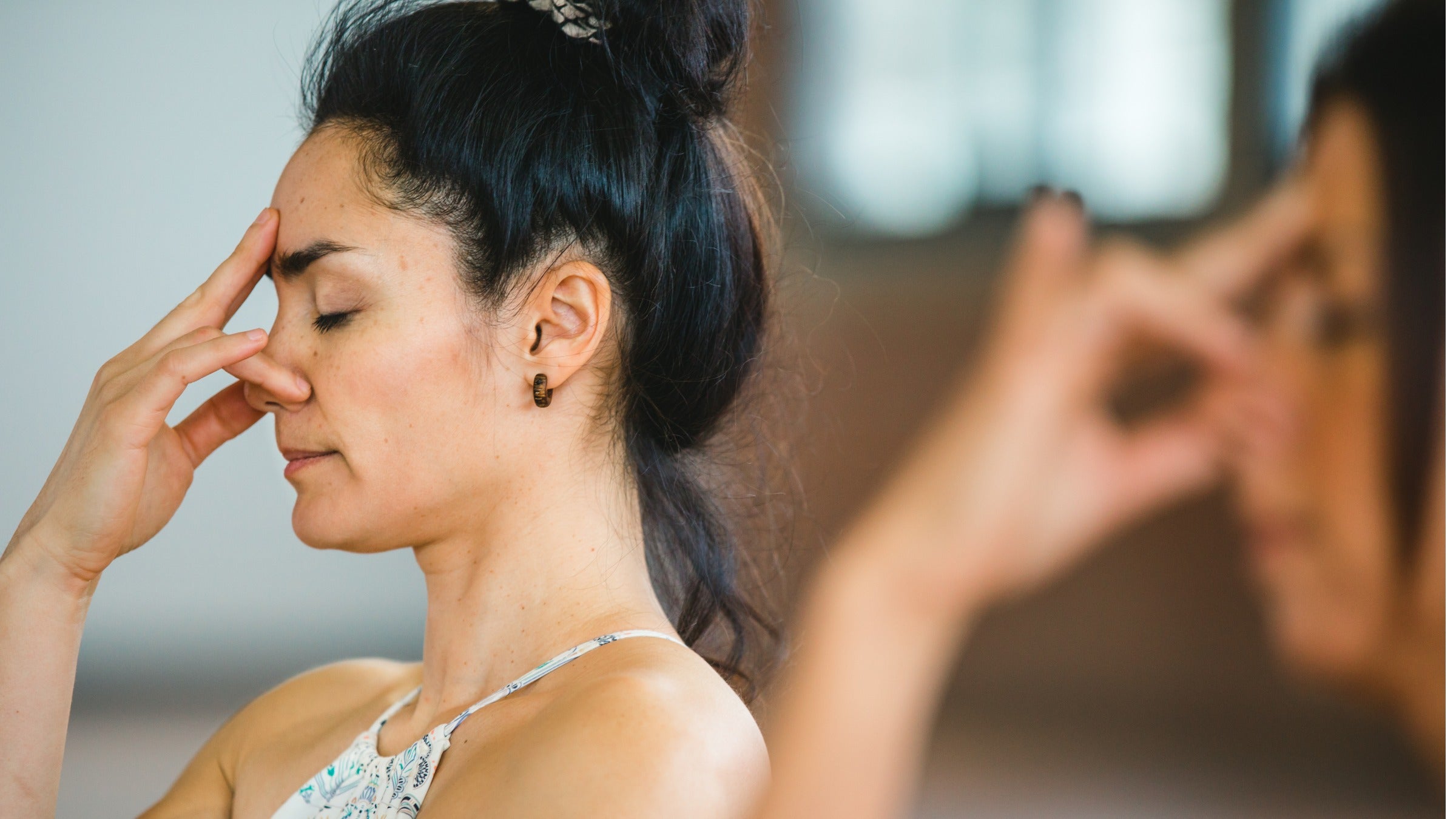
- Sit in a comfortable position and make Vishnu Mudra by folding your right index and middle finger folded in to meet the base of your thumb and the other fingers extended. Your left hand can rest on your left thigh or in your lap. It can also be used to support your right elbow.
- Gently close your right nostril with your right thumb. Inhale through your left nostril, then close it with your ring finger and pinky. After a very brief pause, open and exhale slowly through the right nostril.
- Keep the right nostril open, inhale, then close it, and open and exhale slowly through the left. This is one cycle. Repeat 3 to 5 times, then release the hand mudra and go back to normal breathing.
Kapalabhati Pranayama (Skull Brightener or Skull-Shining Breath)
This technique consists of alternating short, explosive exhalations and slightly longer, passive inhalations.
ADVERTISEMENT
Exhalations are generated by powerful contractions of the lower abdominal muscles (between the pubis and navel), which push air out of the lungs. Inhalations are in response to the release of this contraction, which sucks air back into the lungs.
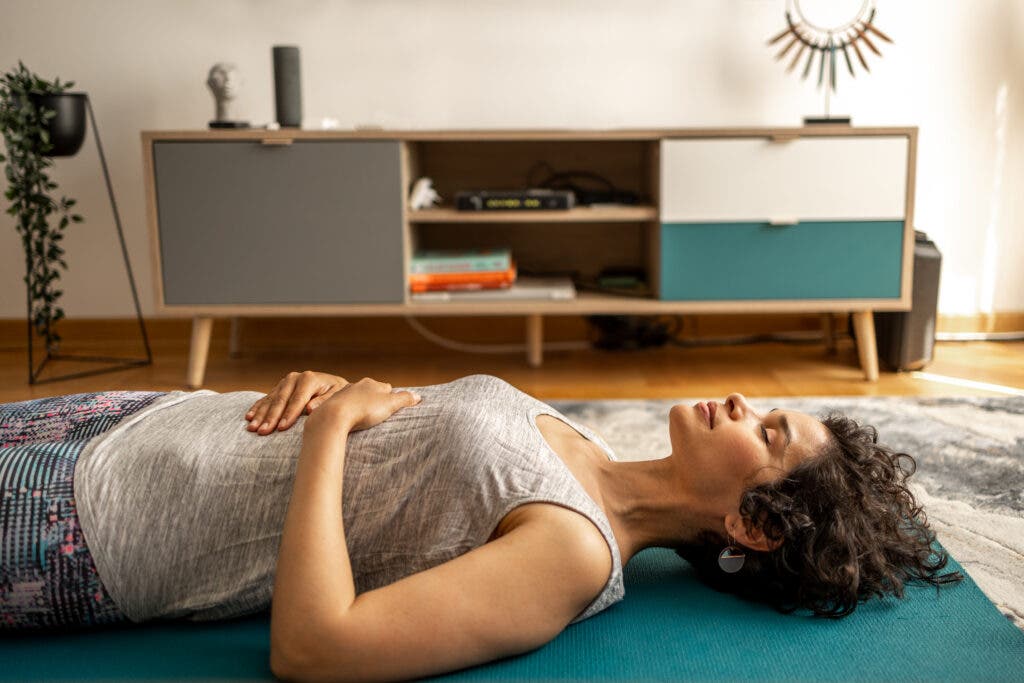
You can begin to practice kapalabhati in a seated position or a reclined position with your fingers placed lightly on your belly.
- Focus on your lower belly. If needed, cup one hand lightly in the other and press them gently against your lower belly. (With practice you will have more abdominal control and hands may not be necessary.)
- Now quickly contract your lower belly, pushing a burst of air out of your lungs. Then quickly release the contraction (or your hands), so the belly “rebounds” to suck air into your lungs. Pace yourself slowly at first.
- Repeat 8 to 10 times at about one exhale-inhale cycle every second or two. As you become more adept at contracting/releasing your lower belly, you can increase your pace to about two exhale-inhale cycles every second. Imagine the exhalation sweeping out or “brightening” the inner lining of your skull.
- Do 25 to 30 cycles at first. Gradually increase the number of cycles you do each practice to 100 or more.
Key Takeaways
If you’re new to practicing pranayama, it may feel uncomfortable at first—and that’s okay! It takes time to understand and execute these techniques; and it may be a while before you start to experience the calming effects and lifestyle benefits that pranayama may offer.
