Updated January 27, 2025 06:55PM
If you buy through our links, we may earn an affiliate commission. This supports our mission to get more people active and outside.Learn about Outside Online's affiliate link policy
Camel Pose: The Complete Guide
Lift your heart—and your energy—by bending back into Ustrasana. This pose counteracts slouching and relieves lower back pain with a generous, upward stretch.

Clothing: Calia (Photo: Andrew Clark)
Table of Contents
Camel Pose basics
Sanskrit: Ustrasana (oosh-TRAH-sah-nah)
ustra = camel
Pose Type: Backbend
Targets: Core
ADVERTISEMENT
Step-by-step instructions
- Begin kneeling with your knees and feet hip-distance apart and your thighs perpendicular to the floor.
- Extend your big toes straight back, pressing down with all 10 toes. Without moving, energetically try to draw your ankles toward one another.
- Turn your inner thighs toward one another and gently release your tailbone toward the backs of your knees. Your pelvis should be neutral, neither tipped forward nor back.
- Bring your palms together in front of your sternum, and drop your chin toward your chest.
- Inhale to emphasize the lift of your chest and the length of your spine.
- With the next exhalation, begin to arch your upper back and open your shoulders. Let both arms fall back at the same time and reach your fingers toward your heels. If you can’t reach your heels, tuck your toes to lift your heels higher. (Do not reach back with one arm first and then the other; twisting into this pose can cause injury.)
- Press your shoulder blades forward and up to lift your chest even more if it’s comfortable.
- Having created more space/extension in your upper back, keep a slight tuck of your chin as you let your head fall drop back further.
- Continue pressing down with your feet and lower legs to lift up with your thoracic spine and chest.
- Remain in the pose for 5–10 breaths. Then, leading with your sternum, use an inhalation to come up, allowing your head to come up last.
Explore the pose
Beginner’s tips
- Don’t crunch the lower back by squeezing the butt, placing the knees wider than hip-width apart, or pushing the belly out.
- Keep the shoulders open and away from the ears.
- If your neck feels strained, perform the pose with your toes turned under against a wall. When you arch back, rest the crown of your head against the wall.
- To practice keeping the hips stacked over the knees, face the wall, press your thighs into it for support, then lengthen up and into the backbend.
- Take care not to rotate the body during this movement (i.e., reaching for one foot and then the other). Rotational movements while extending the spine can result in back or neck strain or other injury.
Sequencing tip
- Ensure that you prep for this pose by warming up your back body and psoas. Practice gentle heart openers first to prevent injury.
- When you’re done with backbending in your sequence, counter with gentle forward bends.
Be mindful!
- Avoid or modify this pose if you have shoulder or back pain or spinal injuries.
- If you have a neck injury or are at risk for stroke, don’t drop your head back; instead, lift your chin slightly and use your neck muscles to stabilize your head.
Teaching Ustrasana
- Advise your students to open their chests and lift their rib cages up, arching into the backbend. Tell them not to worry about whether or not their hands can reach for their feet. A backbend doesn’t require contortions to be effective.
- Tell students to engage their quads in order to keep their thighs at a right angle at their knees on the floor. It’s common to feel their thigh bones move forward so they should focus on activating the muscles to resist this tendency.
- Remind students to point the tailbone toward the floor before leaning back, and then to slightly, gently push the pelvis forward.
Camel Pose variations
Powerful and exhilarating, Camel Pose (Ustrasana) is a backbend that works on multiple levels to strengthen your back, open your shoulders, and stretch your belly, hip flexors, and quadriceps. By creating space in your abdomen and chest, it can help improve digestion and breathing. It also energizes you mentally.
“Camel Pose is one of my favorite backbends,” says Natasha Rizopoulos, a senior teacher with Down Under School of Yoga. “It has the potential to help us find tremendous openness in the thoracic spine—the upper back—where many of us are relatively tight. Most people tend to be more mobile in their cervical spine (neck) and lumbar spine (lower back).”
Finding that opening in the thoracic spine is incredibly valuable, specifically because many of us spend a lot of time with our spines rounding forward. “Most of life’s activities round you forward: picking up your children, washing dishes, working on a computer,” says Carol Krucoff, yoga teacher and author of the book Healing Moves. “When you consider how much time you spend doing these repetitive tasks, it’s no wonder so many people walk around with collapsed chests and round shoulders, not to mention the accompanying aches and pains.”
Unintentionally moving through life bent forward weakens your abdominal muscles and can make you prone to lower back injuries. Then there’s the effect that poor posture can have on your emotions. The next time you find yourself slouching, notice how you feel—tired? achy? down? Now, think of how you move when you’re full of energy and vitality—in all likelihood your chest is lifted and your shoulders are back. That’s because the way you hold your body affects the way you feel, and vice versa, explains Krucoff.
ADVERTISEMENT
Ustrasana, when performed safely, is just one way to help counter these symptoms—and open your heart.
Camel Pose with hands on sacrum
If you feel tightness or compression in your low back, place the heels of your hands at the tops of your buttocks with your fingers facing downward and your elbows pointing back. Engage your inner thighs and pelvic floor by pulling your lower belly in and up. Focus on creating space between your vertebrae, opening your chest and shoulders. Lengthen with each inhalation and on each exhalation keep the space that you’ve created while engaging the core more. Tuck your chin slightly toward your chest. You may wish to place a blanket under your knees for extra cushioning.
Camel Pose with blocks
Place blocks at any height (or stacked) next to your ankles as support for your hands.
Preparatory and counter poses
Preparatory poses
Urdhva Mukha Svanasana (Upward-Facing Dog Pose)
Setu Bandha Sarvangasana (Bridge Pose)
Purvottanasana (Reverse Plank Pose)
ADVERTISEMENT
Counter poses
Paschimottanasana (Seated Forward Bend)
Ananda Balasana (Happy Baby Pose)
Supta Padangusthasana (Reclining Hand-to-Big-Toe Pose)
ADVERTISEMENT
Benefits
Camel Pose can help build a sense of confidence and empowerment, improve posture, and counteract the effects of prolonged sitting, such as slouching and kyphosis (abnormal curvature of the spine). It may help relieve back pain.
Additional Camel Pose perks:
- Strengthens your back muscles, the back of your thighs, and buttocks (glutes).
- Stretches your abdomen, chest, shoulders, front of your hips (hip flexors), and front of your thighs (quadriceps).
Your body in Camel Pose | Anatomy
Ustrasana extends the back of the body to stretch the front, explains Ray Long, MD, a board-certified orthopedic surgeon and yoga instructor. It is essentially a backbend in which the shoulders extend behind as in Purvottanasana (Upward or Reverse Plank Pose) and at the same time the hands and feet connect the upper and lower appendicular skeletons as in Danurasana (Upward Bow Pose).
ADVERTISEMENT
In the drawings below, pink muscles are stretching and blue muscles are contracting. The shade of the color represents the force of the stretch and the force of contraction. Darker = stronger.
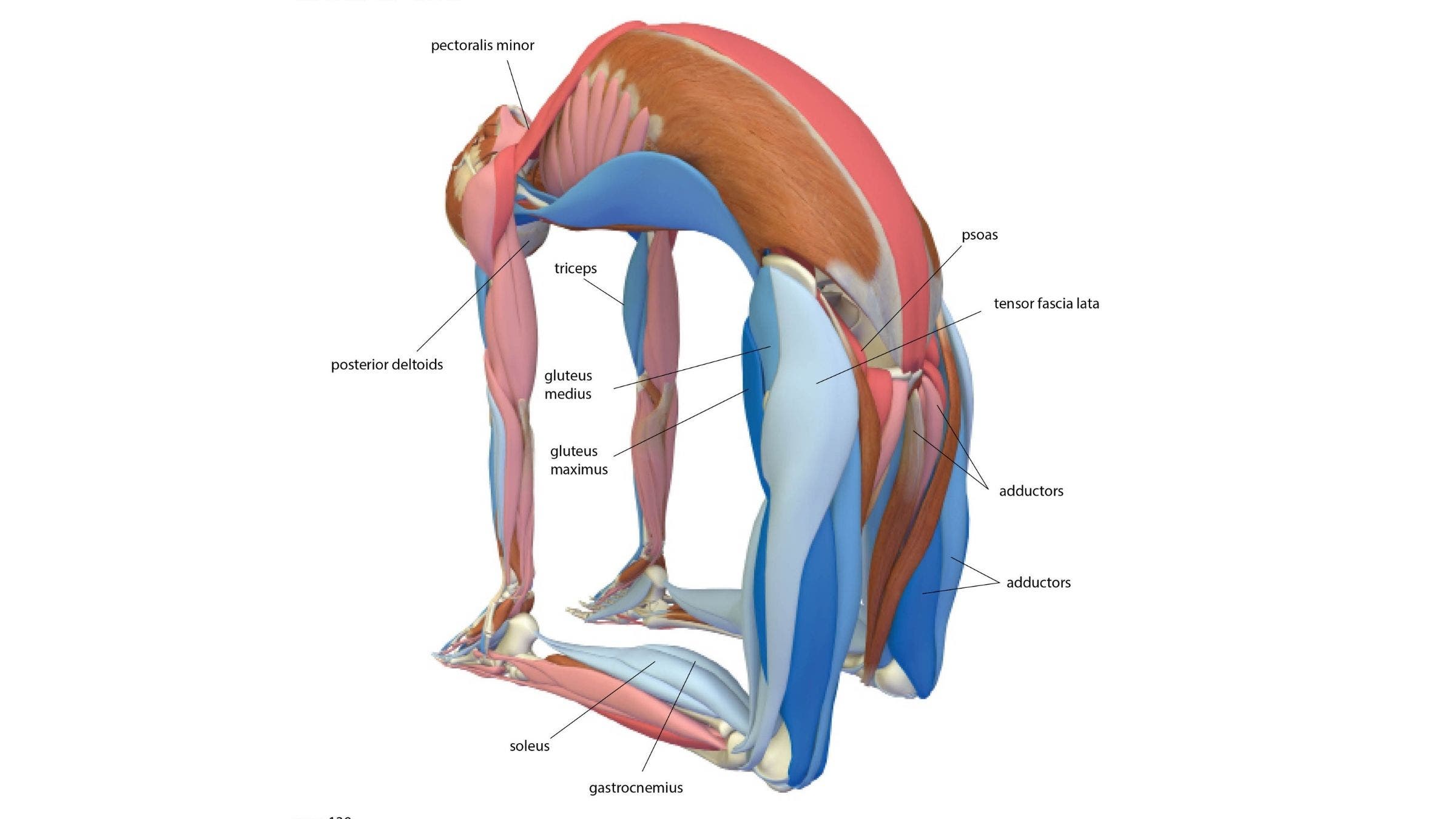
The rhomboids, connecting the spine and the shoulder blades, work with the lower and middle trapezius to draw the shoulders back and down. The pectoralis minor in the upper chest lifts the rib cage.
The gluteus maximus in the buttocks and the hamstrings straighten the hips. The adductors in the inner thigh press the hips straighter.
The thighs tend to drift backward in Ustrasana, decreasing the angle between the upper and lower legs. Most people’s instinct is to engage the buttocks to push it forward. This can actually draw the pelvis back more. Instead, contract the quadriceps to bring the thighs perpendicular to the floor and deepen the backbend.
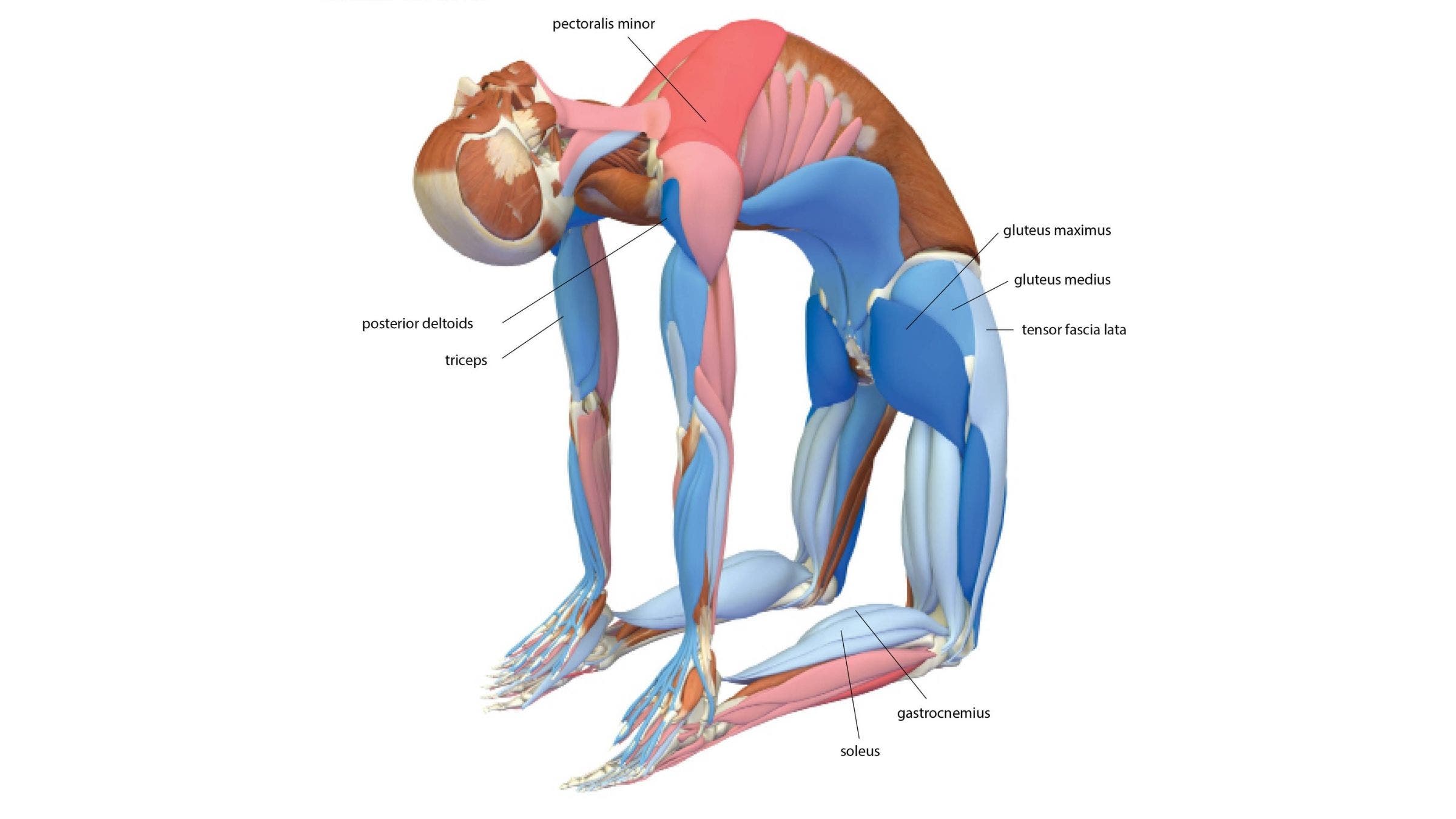
The tensor fascia lata and the gluteus medius along the side of the thigh turn the thigh bones inward. This action counters the turning out of the thighs created by the gluteus maximus.
Excerpted with permission from The Key Poses of Yoga and Anatomy for Backbends and Twists by Ray Long.
ADVERTISEMENT
Camel Pose in a chair
Drape a blanket over the back of a chair. Sit with your feet hip-distance apart and reach your arms back and loosely grasp the back legs of the chair. Lift your sternum as you slowly slide your hands down the back of the chair and lean your upper shoulder blades against the back of the chair to create an arch in your back. Tuck your chin slightly toward your chest.
Put Camel Pose into practice
- 10 Yin Yoga Poses to Help You Overcome Fear
- Open Your Heart Chakra with These 9 Poses
- 6 Yoga Poses to Stretch Tight Hip Flexors
About our contributors
Teacher and model Natasha Rizopoulos is a senior teacher at Down Under Yoga in Boston, where she offers classes and leads 200- and 300-hour teacher trainings. A dedicated Ashtanga practitioner for many years, she became equally as captivated by the precision of the Iyengar system. These two traditions inform her teaching and her dynamic, anatomy-based vinyasa system Align Your Flow. For more information, visit natasharizopoulos.com.
Ray Long is an orthopedic surgeon and the founder of Bandha Yoga, a popular series of yoga anatomy books, and the Daily Bandha, which provides tips and techniques for teaching and practicing safe alignment. Ray graduated from the University of Michigan Medical School and pursued post-graduate training at Cornell University, McGill University, the University of Montreal, and the Florida Orthopedic Institute. He has studied hatha yoga for over 20 years, training extensively with B.K.S. Iyengar and other leading yoga masters, and teaches anatomy workshops at yoga studios around the country.
Powerful and exhilarating, Camel Pose (Ustrasana) is a backbend that works on multiple levels to strengthen your back, open your shoulders, and stretch your belly, hip flexors, and quadriceps. By creating space in your abdomen and chest, it can help improve digestion and breathing. It also energizes you mentally.
“Camel Pose is one of my favorite backbends,” says Natasha Rizopoulos, a senior teacher with Down Under School of Yoga. “It has the potential to help us find tremendous openness in the thoracic spine—the upper back—where many of us are relatively tight. Most people tend to be more mobile in their cervical spine (neck) and lumbar spine (lower back).”
Finding that opening in the thoracic spine is incredibly valuable, specifically because many of us spend a lot of time with our spines rounding forward. “Most of life’s activities round you forward: picking up your children, washing dishes, working on a computer,” says Carol Krucoff, yoga teacher and author of the book Healing Moves. “When you consider how much time you spend doing these repetitive tasks, it’s no wonder so many people walk around with collapsed chests and round shoulders, not to mention the accompanying aches and pains.”
Unintentionally moving through life bent forward weakens your abdominal muscles and can make you prone to lower back injuries. Then there’s the effect that poor posture can have on your emotions. The next time you find yourself slouching, notice how you feel—tired? achy? down? Now, think of how you move when you’re full of energy and vitality—in all likelihood your chest is lifted and your shoulders are back. That’s because the way you hold your body affects the way you feel, and vice versa, explains Krucoff.
ADVERTISEMENT
Ustrasana, when performed safely, is just one way to help counter these symptoms—and open your heart.
Camel Pose basics
Sanskrit: Ustrasana (oosh-TRAH-sah-nah)
ustra = camel
Pose Type: Backbend
Targets: Core
Benefits
Camel Pose can help build a sense of confidence and empowerment, improve posture, and counteract the effects of prolonged sitting, such as slouching and kyphosis (abnormal curvature of the spine). It may help relieve back pain.
Additional Camel Pose perks:
- Strengthens your back muscles, the back of your thighs, and buttocks (glutes).
- Stretches your abdomen, chest, shoulders, front of your hips (hip flexors), and front of your thighs (quadriceps).
Step-by-step instructions
- Begin kneeling with your knees and feet hip-distance apart and your thighs perpendicular to the floor.
- Extend your big toes straight back, pressing down with all 10 toes. Without moving, energetically try to draw your ankles toward one another.
- Turn your inner thighs toward one another and gently release your tailbone toward the backs of your knees. Your pelvis should be neutral, neither tipped forward nor back.
- Bring your palms together in front of your sternum, and drop your chin toward your chest.
- Inhale to emphasize the lift of your chest and the length of your spine.
- With the next exhalation, begin to arch your upper back and open your shoulders. Let both arms fall back at the same time and reach your fingers toward your heels. If you can’t reach your heels, tuck your toes to lift your heels higher. (Do not reach back with one arm first and then the other; twisting into this pose can cause injury.)
- Press your shoulder blades forward and up to lift your chest even more if it’s comfortable.
- Having created more space/extension in your upper back, keep a slight tuck of your chin as you let your head fall drop back further.
- Continue pressing down with your feet and lower legs to lift up with your thoracic spine and chest.
- Remain in the pose for 5–10 breaths. Then, leading with your sternum, use an inhalation to come up, allowing your head to come up last.
Explore the pose
Beginner’s tips
- Don’t crunch the lower back by squeezing the butt, placing the knees wider than hip-width apart, or pushing the belly out.
- Keep the shoulders open and away from the ears.
- If your neck feels strained, perform the pose with your toes turned under against a wall. When you arch back, rest the crown of your head against the wall.
- To practice keeping the hips stacked over the knees, face the wall, press your thighs into it for support, then lengthen up and into the backbend.
- Take care not to rotate the body during this movement (i.e., reaching for one foot and then the other). Rotational movements while extending the spine can result in back or neck strain or other injury.
Sequencing tip
- Ensure that you prep for this pose by warming up your back body and psoas. Practice gentle heart openers first to prevent injury.
- When you’re done with backbending in your sequence, counter with gentle forward bends.
Be mindful!
- Avoid or modify this pose if you have shoulder or back pain or spinal injuries.
- If you have a neck injury or are at risk for stroke, don’t drop your head back; instead, lift your chin slightly and use your neck muscles to stabilize your head.
Teaching Ustrasana
- Advise your students to open their chests and lift their rib cages up, arching into the backbend. Tell them not to worry about whether or not their hands can reach for their feet. A backbend doesn’t require contortions to be effective.
- Tell students to engage their quads in order to keep their thighs at a right angle at their knees on the floor. It’s common to feel their thigh bones move forward so they should focus on activating the muscles to resist this tendency.
- Remind students to point the tailbone toward the floor before leaning back, and then to slightly, gently push the pelvis forward.
Camel Pose variations
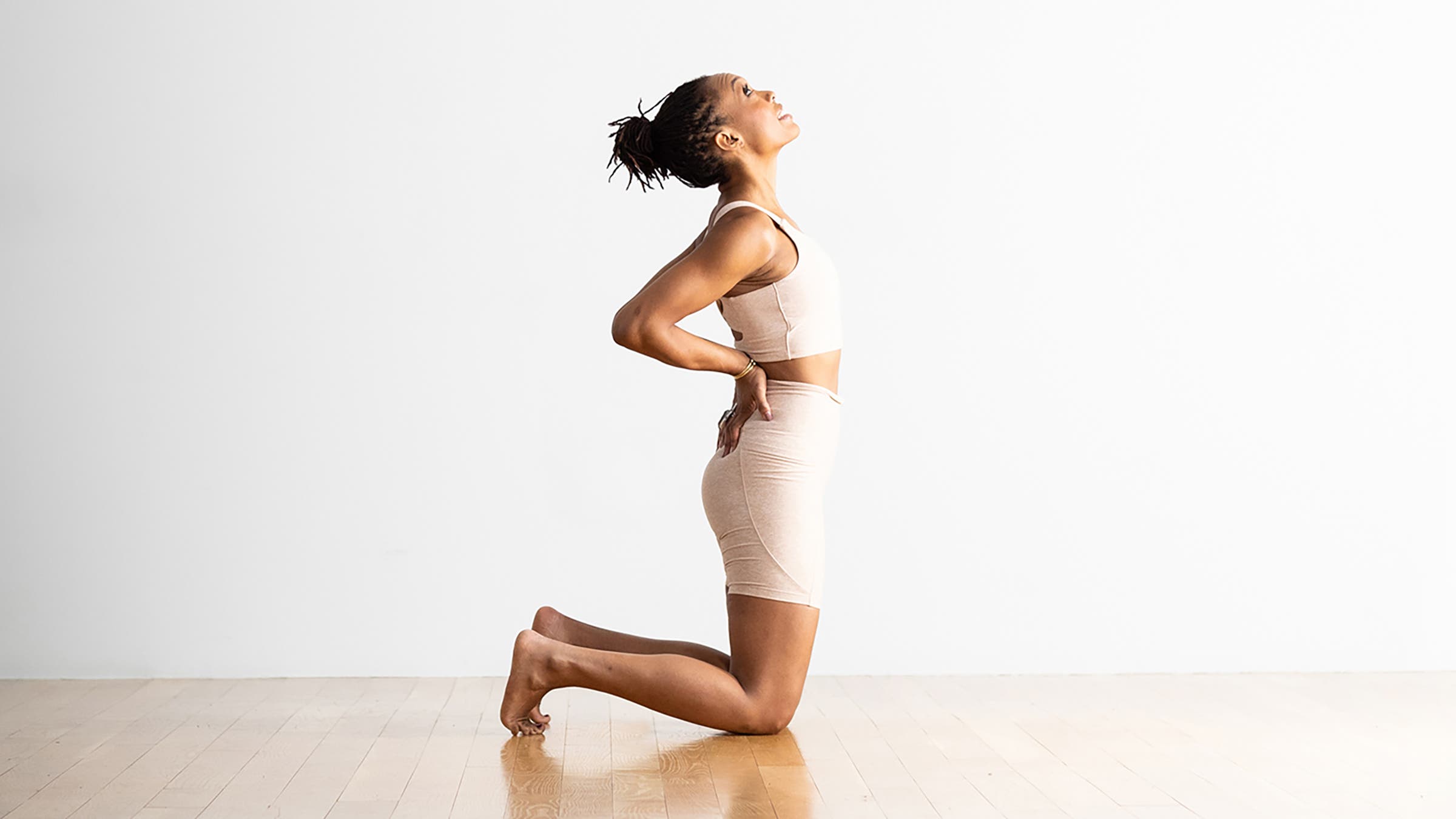
Camel Pose with hands on sacrum
If you feel tightness or compression in your low back, place the heels of your hands at the tops of your buttocks with your fingers facing downward and your elbows pointing back. Engage your inner thighs and pelvic floor by pulling your lower belly in and up. Focus on creating space between your vertebrae, opening your chest and shoulders. Lengthen with each inhalation and on each exhalation keep the space that you’ve created while engaging the core more. Tuck your chin slightly toward your chest. You may wish to place a blanket under your knees for extra cushioning.
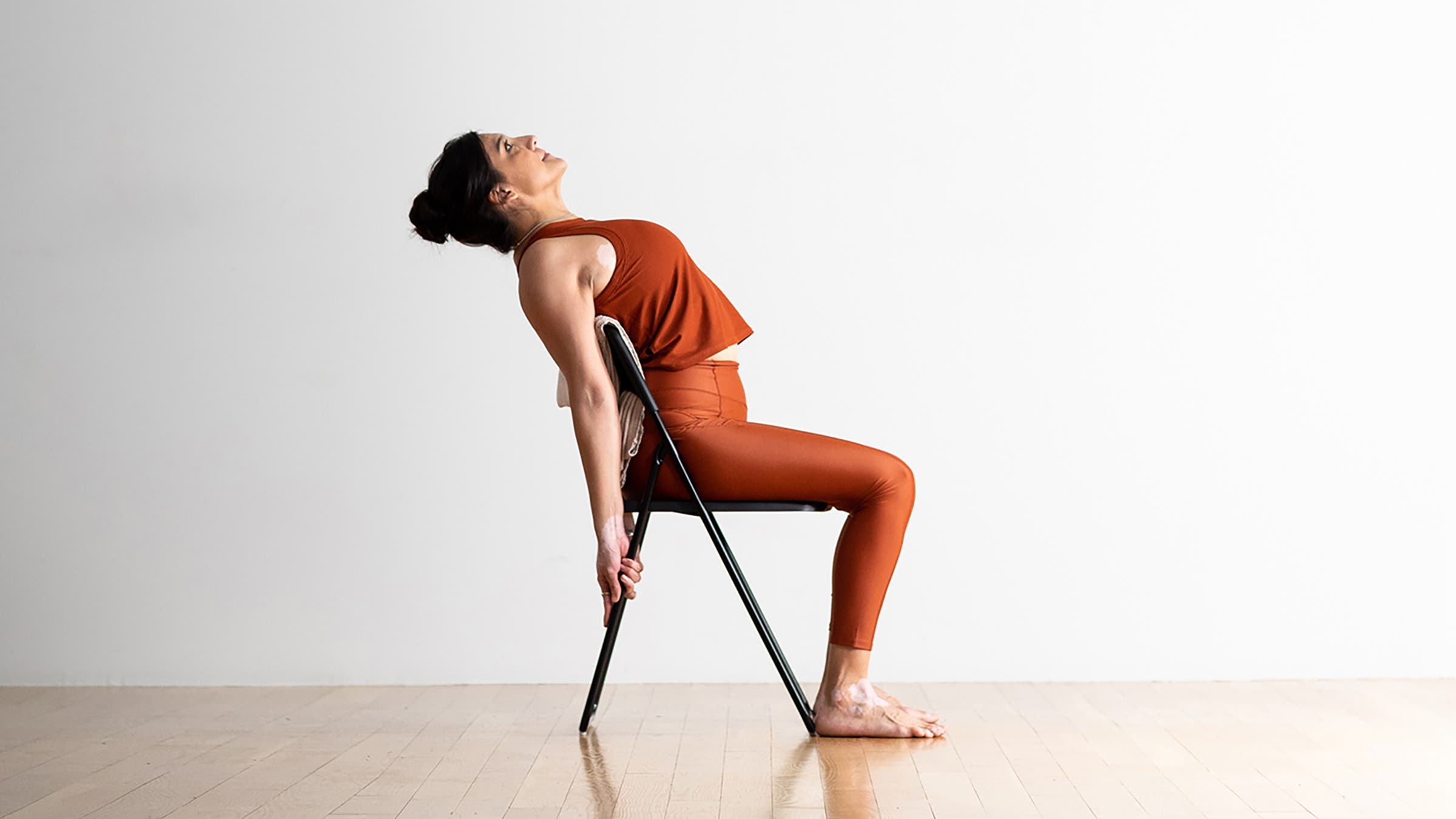
Camel Pose in a chair
Drape a blanket over the back of a chair. Sit with your feet hip-distance apart and reach your arms back and loosely grasp the back legs of the chair. Lift your sternum as you slowly slide your hands down the back of the chair and lean your upper shoulder blades against the back of the chair to create an arch in your back. Tuck your chin slightly toward your chest.
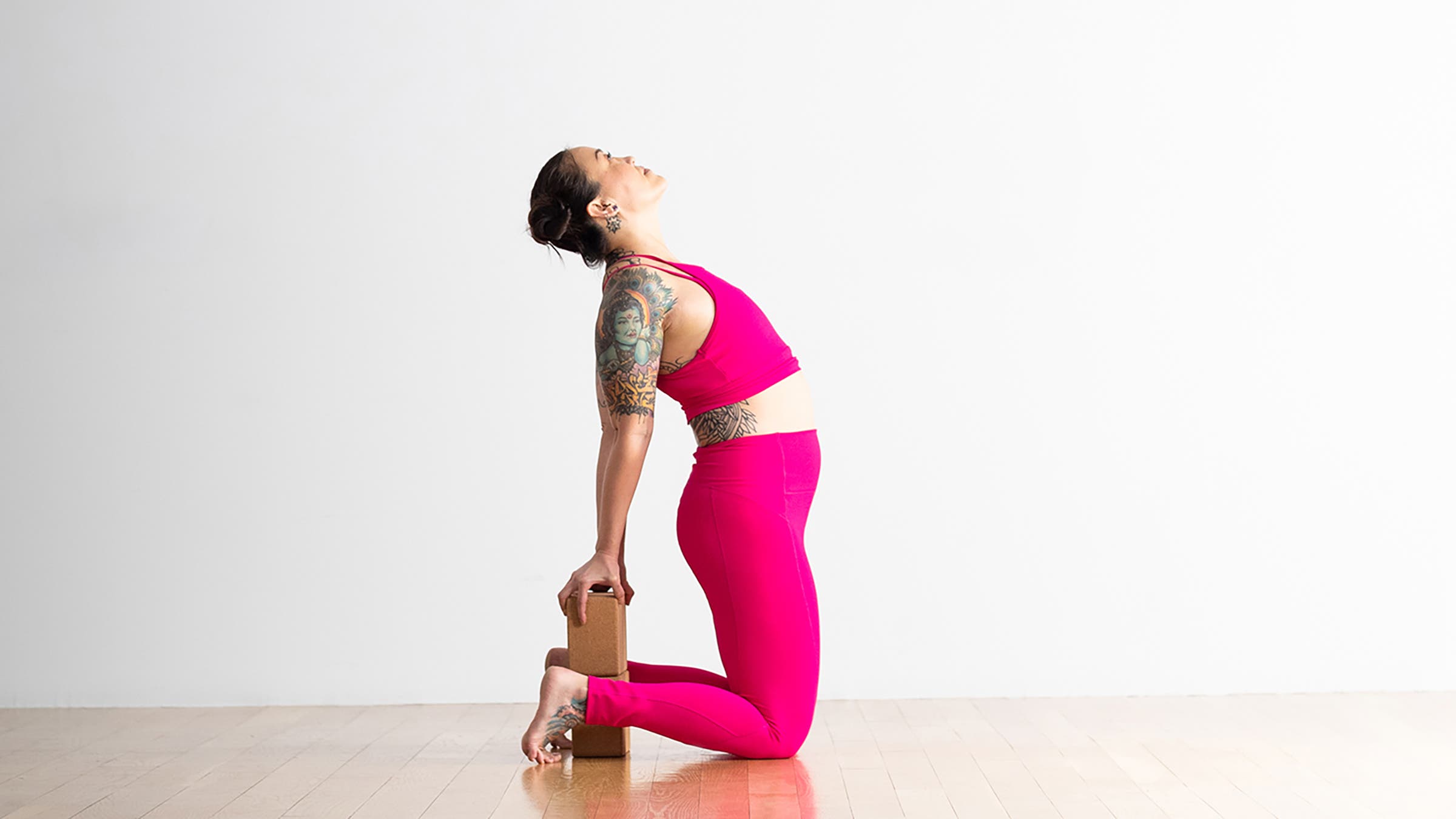
Camel Pose with blocks
Place blocks at any height (or stacked) next to your ankles as support for your hands.
Preparatory and counter poses
Preparatory poses
Urdhva Mukha Svanasana (Upward-Facing Dog Pose)
Setu Bandha Sarvangasana (Bridge Pose)
Purvottanasana (Reverse Plank Pose)
ADVERTISEMENT
Counter poses
Paschimottanasana (Seated Forward Bend)
Ananda Balasana (Happy Baby Pose)
Supta Padangusthasana (Reclining Hand-to-Big-Toe Pose)
Your body in Camel Pose | Anatomy
Ustrasana extends the back of the body to stretch the front, explains Ray Long, MD, a board-certified orthopedic surgeon and yoga instructor. It is essentially a backbend in which the shoulders extend behind as in Purvottanasana (Upward or Reverse Plank Pose) and at the same time the hands and feet connect the upper and lower appendicular skeletons as in Danurasana (Upward Bow Pose).
In the drawings below, pink muscles are stretching and blue muscles are contracting. The shade of the color represents the force of the stretch and the force of contraction. Darker = stronger.
The rhomboids, connecting the spine and the shoulder blades, work with the lower and middle trapezius to draw the shoulders back and down. The pectoralis minor in the upper chest lifts the rib cage.
The gluteus maximus in the buttocks and the hamstrings straighten the hips. The adductors in the inner thigh press the hips straighter.
The thighs tend to drift backward in Ustrasana, decreasing the angle between the upper and lower legs. Most people’s instinct is to engage the buttocks to push it forward. This can actually draw the pelvis back more. Instead, contract the quadriceps to bring the thighs perpendicular to the floor and deepen the backbend.
The tensor fascia lata and the gluteus medius along the side of the thigh turn the thigh bones inward. This action counters the turning out of the thighs created by the gluteus maximus.
Excerpted with permission from The Key Poses of Yoga and Anatomy for Backbends and Twists by Ray Long.
Put Camel Pose into practice
- 10 Yin Yoga Poses to Help You Overcome Fear
- Open Your Heart Chakra with These 9 Poses
- 6 Yoga Poses to Stretch Tight Hip Flexors
About our contributors
Teacher and model Natasha Rizopoulos is a senior teacher at Down Under Yoga in Boston, where she offers classes and leads 200- and 300-hour teacher trainings. A dedicated Ashtanga practitioner for many years, she became equally as captivated by the precision of the Iyengar system. These two traditions inform her teaching and her dynamic, anatomy-based vinyasa system Align Your Flow. For more information, visit natasharizopoulos.com.
Ray Long is an orthopedic surgeon and the founder of Bandha Yoga, a popular series of yoga anatomy books, and the Daily Bandha, which provides tips and techniques for teaching and practicing safe alignment. Ray graduated from the University of Michigan Medical School and pursued post-graduate training at Cornell University, McGill University, the University of Montreal, and the Florida Orthopedic Institute. He has studied hatha yoga for over 20 years, training extensively with B.K.S. Iyengar and other leading yoga masters, and teaches anatomy workshops at yoga studios around the country.
