Updated March 24, 2025 12:00AM
If you buy through our links, we may earn an affiliate commission. This supports our mission to get more people active and outside.Learn about Outside Online's affiliate link policy
Plow Pose
Plow Pose (Halasana) reduces backache and can help you get to sleep.
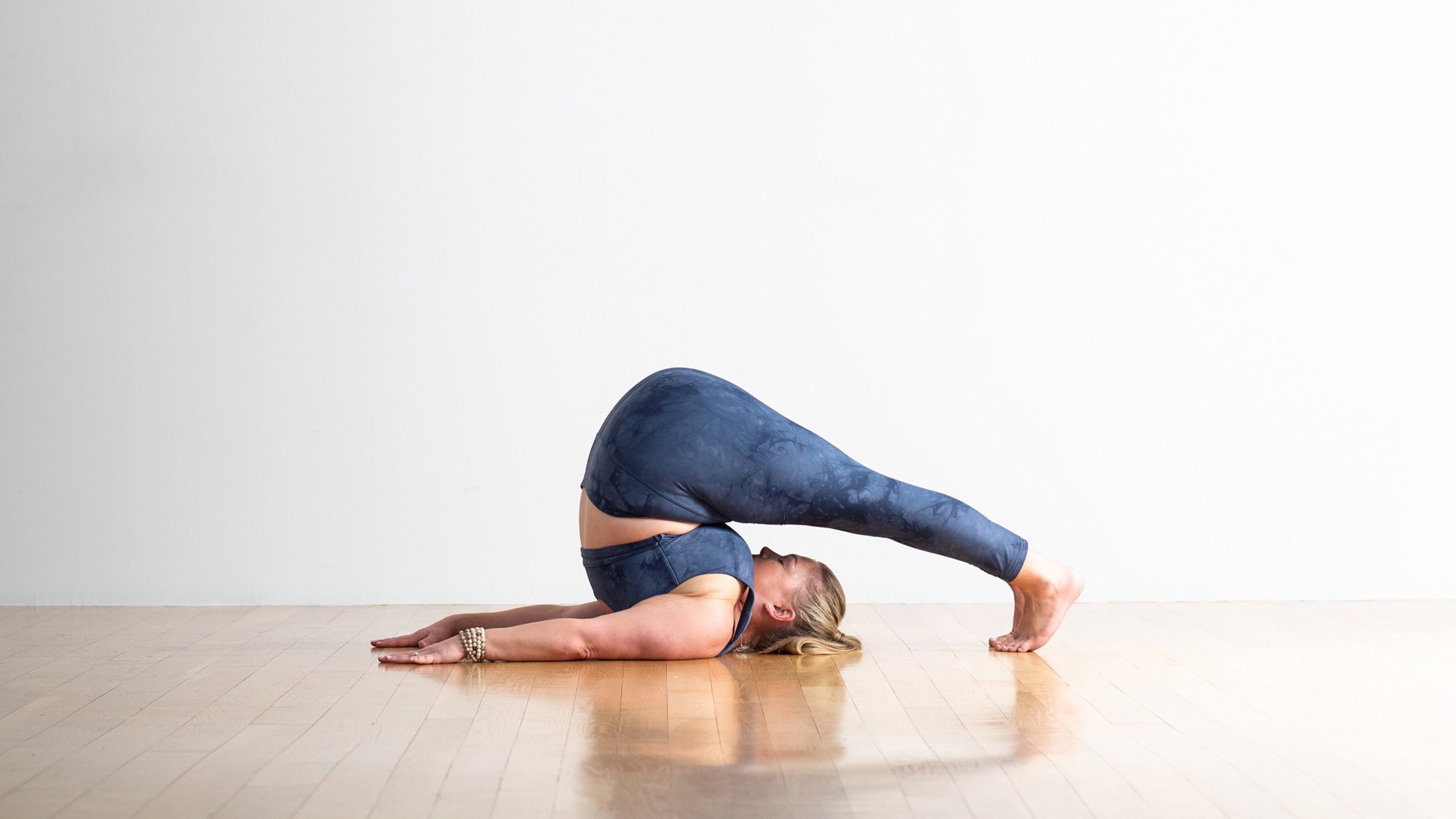
(Photo: Andrew Clark; Clothing: Calia)
Halasana (Plow Pose), a full-body stretch that positions your body upside down with your feet over your head, offers interesting new perspectives. Practice it before settling into meditation, pranayama, Savasana (Corpse Pose), or before going to sleep.
Regular practice of Halasana stretches the thoracic, lumbar, and cervical regions of the spine, increasing circulation and suppleness. This posture can relieve backache, stretch the shoulders, and lengthen the spine. It can also reduce phlegm or mucus in the sinuses and respiratory system, and gradually lengthens and regulates the breath.
Carefully done, Plow Pose can release tension in the neck and throat. But prep and practice with care to avoid neck strain or injury.
Sanskrit
Halasana (hah-LAHS-ah-nah)
hala = plow
ADVERTISEMENT
How to
- Stack three blankets so that their edges line up. Place the stack near the front of your mat so that their edges line up near the middle of the mat.
- Sit at the front end of your mat and lie back over the blankets so they support your torso. Adjust your position so that the tops of your shoulders are about an inch over the edge and the back your head rests on the floor. Lie face up so that the front of your neck is long and there’s space between the back of your neck and the floor.
- Bring your knees toward your chest, then straighten your legs toward the ceiling.
- Using the strength of your abs—and supporting yourself with both hands at your low or mid back—lift your hips off the floor and roll up until you are supported by your shoulders. Stack your hips above your shoulders.
- Slowly lower your legs backward over your head until your toes reach the ground behind you. Rest your toes on the ground, feet flexed.
- Release your hands and place your arms no the floor, palms down or with hands clasped. Press down with your outer upper arms and shoulders to create more lift along the spine.
- Hold for 5 breaths or more.
- To exit, unclasp your hands, press your arms and hands into the mat, and slowly roll down one vertebrae at a time.
- Take a few moments to allow the back to settle back into its normal curves.
Plow Pose variations
If your lower back aches or you have tight hamstrings, practice with a chair set near your head. When you bring your legs up and over, rest your thighs and knees on the seat of the chair for support and allow your feet to hang over.
You can also practice Plow with your knees bent, cantilevered over your face. Or try one of the creative variations below.
Half Plow Pose
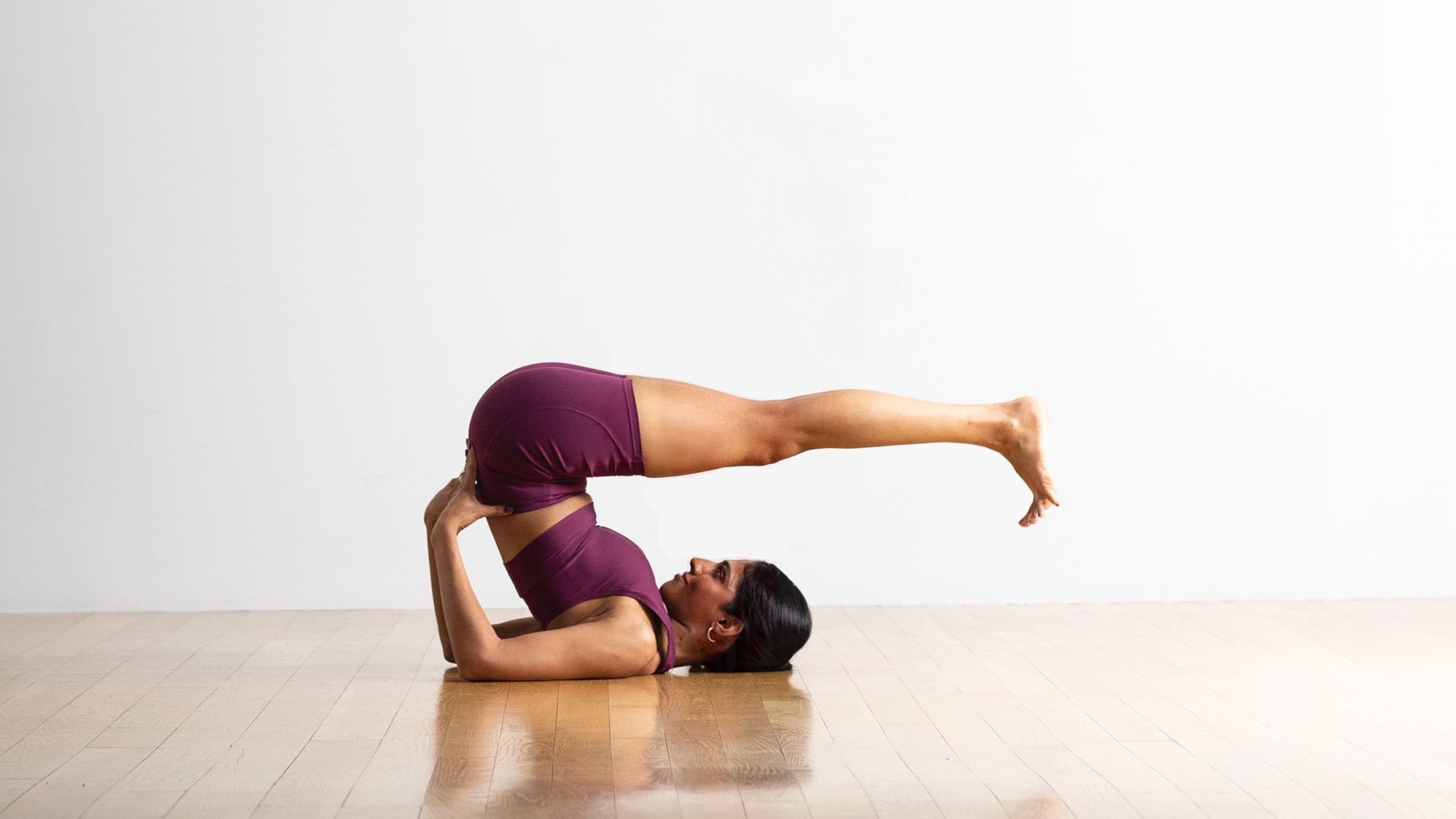
To put less pressure on your neck, don’t lift up or over all the way. In Half Plow, your hips are not stacked directly over the shoulders, but moving slightly away from the body. This allows you to keep some space between your chin and your chest, and avoid pressing the back of the neck into the mat. Stay a few breaths, then slowly lower down.
ADVERTISEMENT
Plow Pose against a wall
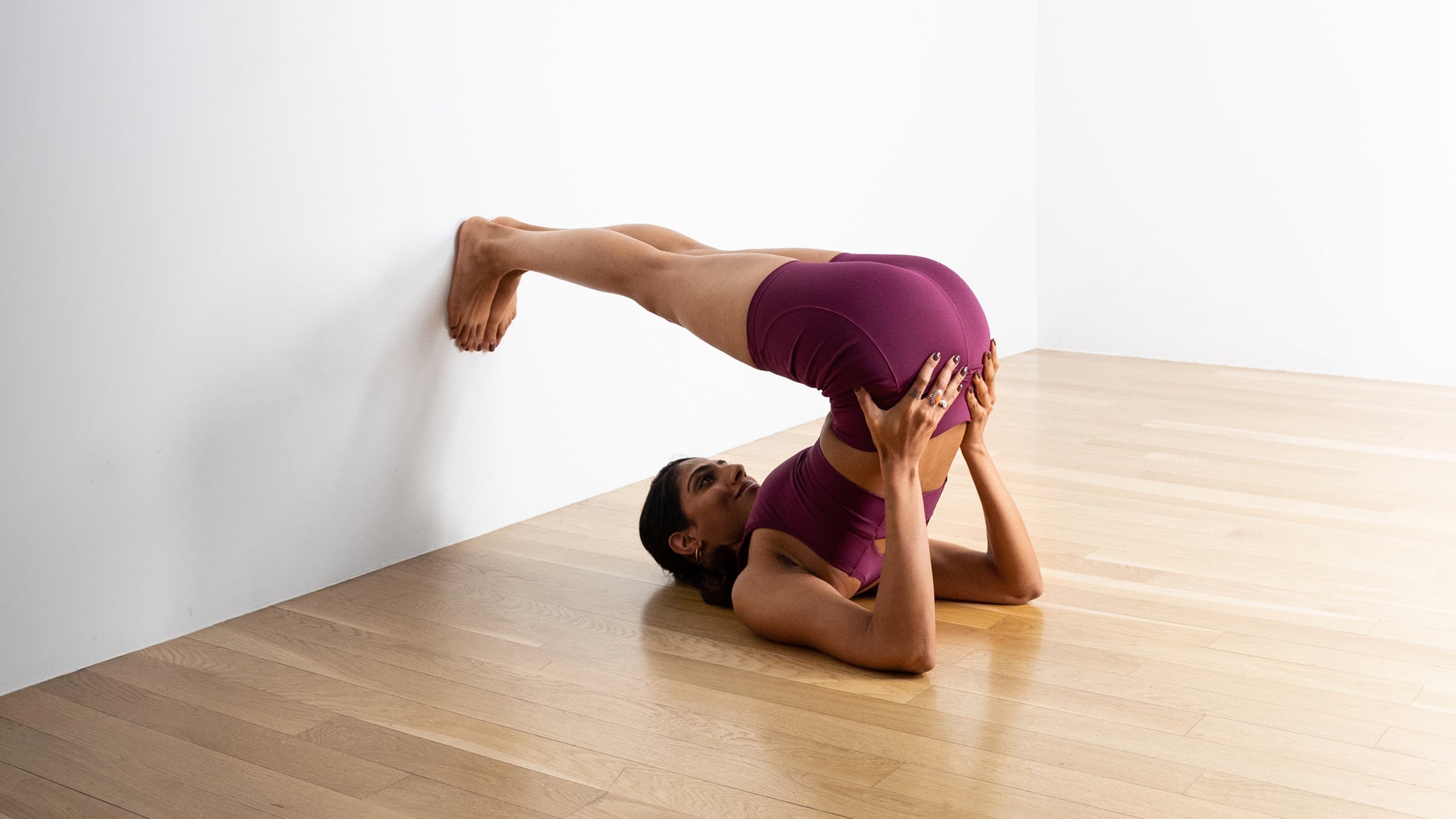
Lie down facing away from the wall with your head on the floor positioned about 2 feet from the wall. For added cushioning, you can set up 2 or 3 folded blankets near a wall. Allow enough space so that you can lie with your shoulders on the edge of the blankets and your head on the floor.
Slowly lift your legs up into Salamba Sarvangasana (Supported Shoulderstand) with your hands supporting your low back. Then lower your legs back until your feet meet the wall. Press your feet into the wall, straighten your legs, and lengthen your back.
You can keep holding your low back or bring your hands to interlace behind your back on the blanket. Stay for several deep breaths. To come out of the pose, slowly lower yourself onto your back and bring the feet down. Use your hands on your low back or bend your knees to slow the descent.
ADVERTISEMENT
Legs up with a block
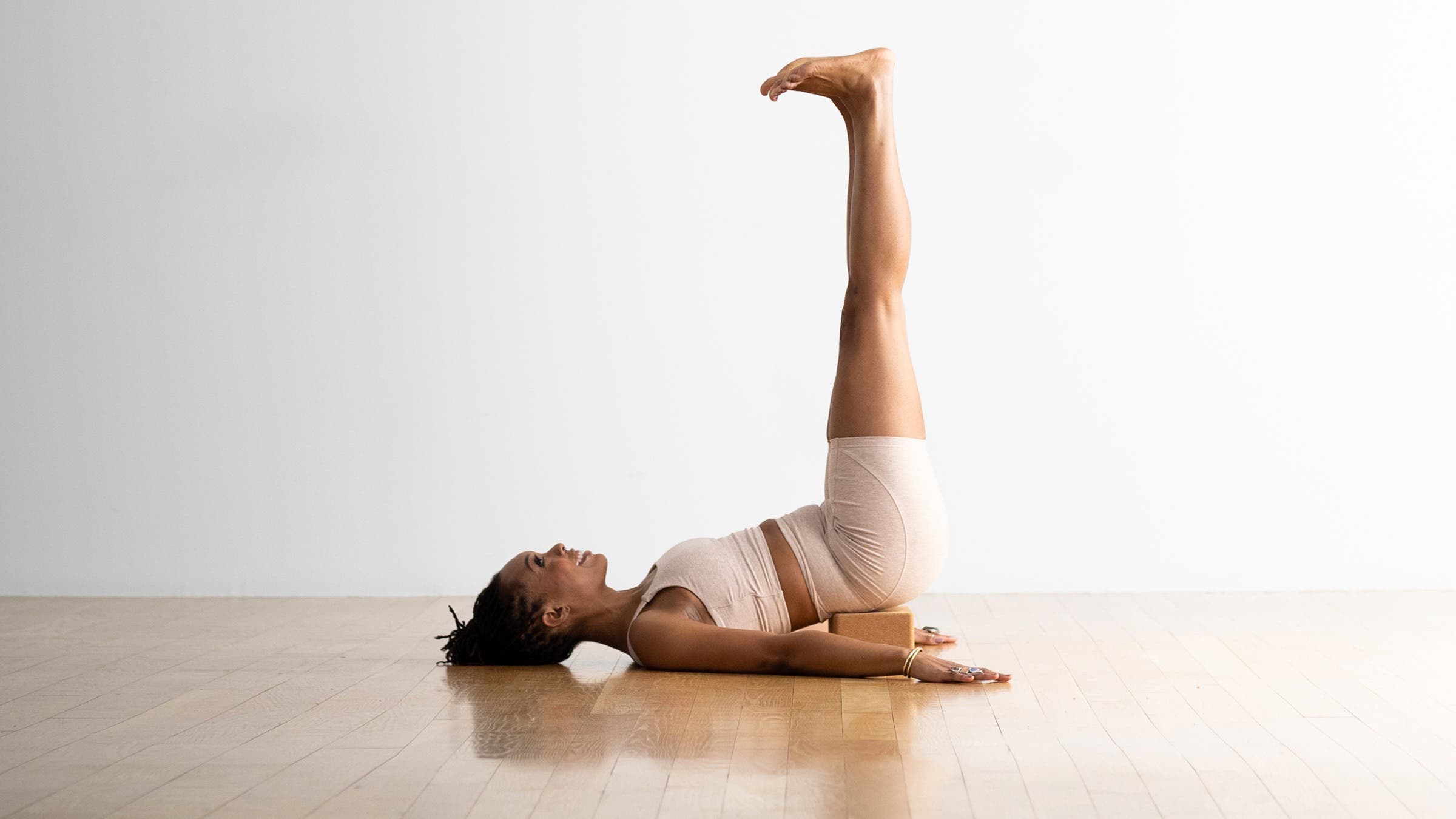
Start lying on your back with your knees bent and your feet flat on the floor. Lift your hips up as if you were coming into Setu Bandha Sarvangasana (Bridge Pose). Place a block on the low or medium height under your sacrum (the flat part of your low back). Lift your legs straight up, stacking your ankles and knees directly over your hips. Breathe and hold the pose as long as you would like. Then bend your knees and lower your legs to place your feet flat on the ground. Lift your hips slightly and remove the block. Slowly straighten and extend your legs onto the floor.
Plow Pose basics
Pose type: Inversion
Targets: Upper body, back
Benefits: This pose can create a relaxed and focused energy. Additionally, it stretches the entire back of your body, including the back of the thighs (hamstrings), buttocks (glutes), shoulders, and neck.
Additional Plow Pose perks:
- Strengthens your diaphragm
- Relieves backache
ADVERTISEMENT
Explore the pose
Keep your gaze steady, with your face lifted to the ceiling. Though it can be tempting to look around, do not turn your head or attempt to move your neck while in Plow Pose or any inversion to keep your cervical vertebrae safe. Instead, practice your drishti. Breathe. When the chest becomes compressed, the tendency is to hold your breath. Keep your breath as steady and slow as if you were seated at the beginning or end of class.
If you attempt the “flat” version of the pose without the blankets, take care not to overwork and possibly injure the vulnerable cervical vertebrae.
ADVERTISEMENT
Avoid this pose if you have back or neck pain or injuries, including bulging or herniated discs. If you have glaucoma, detached retina, diabetic retinopathy, or other eye conditions, ask your ophthalmologist if this inversion is safe to do.
Why we love this pose
“Plow Pose certainly gives you a new perspective on things. Almost every body part is doing something it doesn’t normally do: You’re looking up at your knees. Your hips are higher than anything else. Your feet are over your head,” says Yoga Journal senior editor Tamara Jeffries. “This is a pose that requires you to shift your thinking while you’re doing it. You begin in a restful reclined position, then have to use strength to lift the body up, flexibility to take the body over, and careful attention to assure that your neck is safe. I find that once I’m in the pose with my toes tucked overhead, it’s surprisingly restful.”
Teacher tips
These cues will help protect your students from injury and help them have the best experience of the pose:
- Always keep space between the back of the neck and the floor, to protect the cervical spine from injury.
- When coming into this pose, squeeze your shoulder blades together to help yourself lift up onto the tops of your shoulders. But once you are in the pose, broaden your shoulder blades across the back to open the sternum.
- You can overstretch your neck if you pull your shoulders too far away from your ears. While the tops of your shoulders should push down into the blankets, they should be lifted slightly toward your ears to keep the back of your neck and throat soft.
Preparatory and counter poses
You want to prepare for Plow Pose with stretches that lengthen your entire back body as well as bring to bring flexibility to your upper body. Because this pose technically a forward fold, it is commonly countered with the heart openers such as Matsyasana (Fish Pose), but you can come into any pose that lengthens your back and neutralizes the curvature that happens during Halasana.
ADVERTISEMENT
Preparatory poses
Paschimottanasana (Seated Forward Bend)
ADVERTISEMENT
Counter poses
Setu Bandha Sarvangasana (Bridge Pose)
Urdhva Mukha Svanasana (Upward-Facing Dog Pose)
ADVERTISEMENT
Anatomy
Halasana is a variation of Shoulderstand that combines opening the chest with stretching the back body. It is typically performed at the end of the practice, during the cool down leading to Savasana (Corpse Pose), and it shares many of the same potential benefits as other inverted postures.
In Plow Pose, your legs are taken over your head, flexing your hips. This position brings the center of gravity forward, so care must be taken to maintain most of the body weight on your shoulders and arms and to avoid hyperflexion of your neck. Using a blanket to support your shoulders keeps your neck out of hyperflexion and frees the cervical spine from excessive compression.
ADVERTISEMENT
In the drawings below, pink muscles are stretching and blue muscles are contracting. The shade of the color represents the force of the stretch and the force of contraction. Darker = stronger.
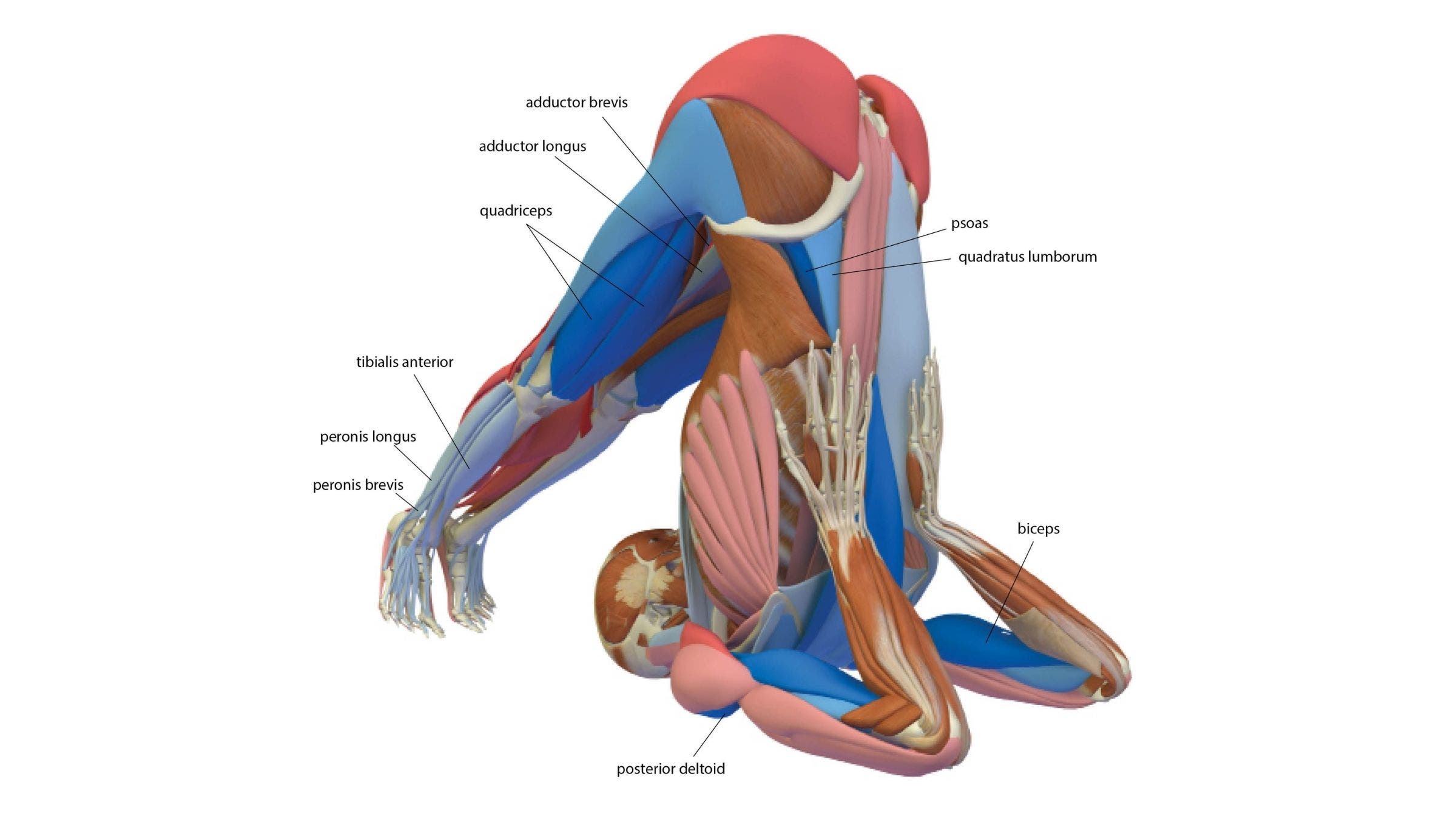
The entire back of the body opens, including the erector spinae, quadratus lumborum, gluteus maximus, hamstrings, and gastrocnemius and soleux complex. The bottoms of the feet also stretch. The chest opens as well, stretching the pectoralis major and minor and the anterior deltoids.
There is a tendency to compress the torso and to allow gravity do the work of bending your hips. Counteract this by actively engaging the hip flexors, including the psoas. Synergize this action by contracting the quadratus lumborum and lower back muscles to create a slight arch in the lumbar region.
Press the palms into your back by contracting the biceps and brachialis muscles. Press the backs of your elbows into the mat, which contracts the posterior deltoids. These muscles combine with the infraspinatus and teres minor muscles to externally rotate your shoulders and help to open your chest. Lean into your hands and press them into the back to expand your chest; this draws the center of gravity away from your neck, which helps to protect the cervical spine.
Excerpted and adapted with permission from The Key Poses of Yoga and Anatomy for Arm Balances and Inversions by Ray Long, MD.
ADVERTISEMENT
Put Plow Pose into practice
Ready to incorporate this inversion into your practice? Here are a few flows to try:
7 Yoga Poses for When You’re a Little…Blocked Up
Practicing at Home and Have No Yoga Props? No Problem
ADVERTISEMENT
About our contributors
Teacher and model Natasha Rizopoulos is a senior teacher at Down Under Yoga in Boston, where she offers classes and leads 200- and 300-hour teacher trainings. A dedicated Ashtanga practitioner for many years, she became equally as captivated by the precision of the Iyengar system. These two traditions inform her teaching and her dynamic, anatomy-based vinyasa system Align Your Flow. For more information, visit natasharizopoulos.com.
Ray Long is an orthopedic surgeon and the founder of Bandha Yoga, a popular series of yoga anatomy books, and the Daily Bandha, which provides tips and techniques for teaching and practicing safe alignment. Ray graduated from the University of Michigan Medical School and pursued post-graduate training at Cornell University, McGill University, the University of Montreal, and the Florida Orthopedic Institute. He has studied hatha yoga for over 20 years, training extensively with B.K.S. Iyengar and other leading yoga masters, and teaches anatomy workshops at yoga studios around the country.
