Published April 20, 2016 06:35PM
12 Yoga Poses to Help You Trust Your Intuition
Want to hone your intuition? Here's where to start.
(Photo: Beth Kessler; Design in Canva)
Learning to trust your intuition is a matter of inner quiet and confidence. Honing your intuition goes beyond the literal, the logical, and even our normal perception. It’s a feeling of being drawn to something that is in your best interest, even when your conscious mind wants to resist it.
According to yoga teacher and activist Seane Corn, your work in this lifetime is to awaken that inner knowing. By reconnecting with who you really are, she says, you can move forward, navigating the physical world with patience, kindness, and compassion. But it does take some practice.
“Intuition is a skill, not a gift,” she says, adding that the efforts put in are infinitely worthwhile. “Inner visioning—the commitment we make to ourselves to let go of limited beliefs that block our ability to see ourselves beyond the literal and logical realm—allows us to reclaim our power.”
ADVERTISEMENT
When your intuition is blocked, you may limit yourself and your abilities. By opening yourself up to your inner knowing, you are able to see the signs and symbols that show up along the way, guiding you toward your purpose and shedding light on the limiting beliefs and the voice of the ego that block us from clarity and influence our decisions.
And yoga can help.
This sequence from Corn, featuring yoga teacher Andrea Rice, emphasizes moving energy through the spine and shoulders to recharge the central nervous system and ground you. From that stability, says Corn, you are able to connect with and trust your intuition. This healing practice is both energetically clearing and energizing. It is specifically designed to prepare you to sit for a longer period of meditation afterward and set powerful intentions.
Yoga to Help You Trust Your Intuition
Turn your inner gaze to the third-eye (ajna) chakra. This is the energy center within the physical body that provides a gateway to collective consciousness. Corn reminds us that it’s here we expand our inner knowing and access our true teacher.
Before you begun, warm up with 1-3 rounds of Sun Salutation A, followed by 1-3 rounds of Sun Salutation B at your own pace, finishing in Downward-Facing Dog.
ADVERTISEMENT
Humble Warrior
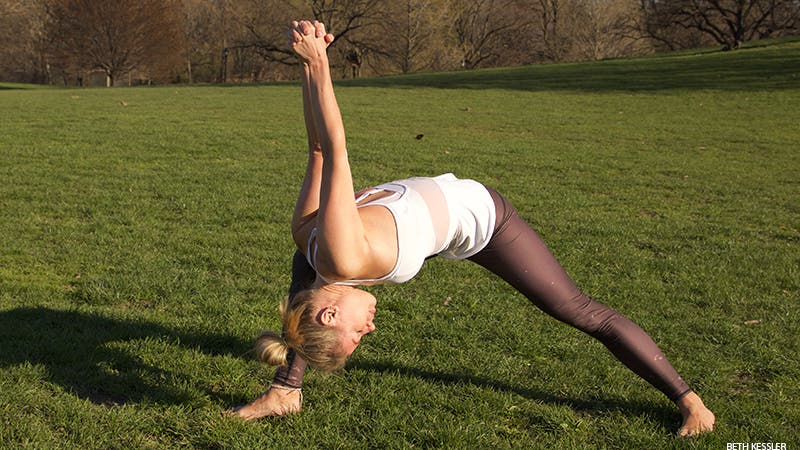
From Downward-Facing Dog, step your right foot forward and turn the back heel down. Inhale to come up to Warrior I. Interlace your fingers behind your back. Take a deep breath in, then exhale to bring your right shoulder inside of your right knee and draw the palms overhead. Relax your head, neck, and shoulders in Humble Warrior.
“For us to speak our truth, our head and our heart need to be congruent,” says Corn. “A lot of times when we experience conflict it lands in our hearts and shoulders and upper back—and blocks the flow of energy. Shoulder openers create a broad channel between head and heart.”
Wide-Legged Forward Bend with Hand Clasp
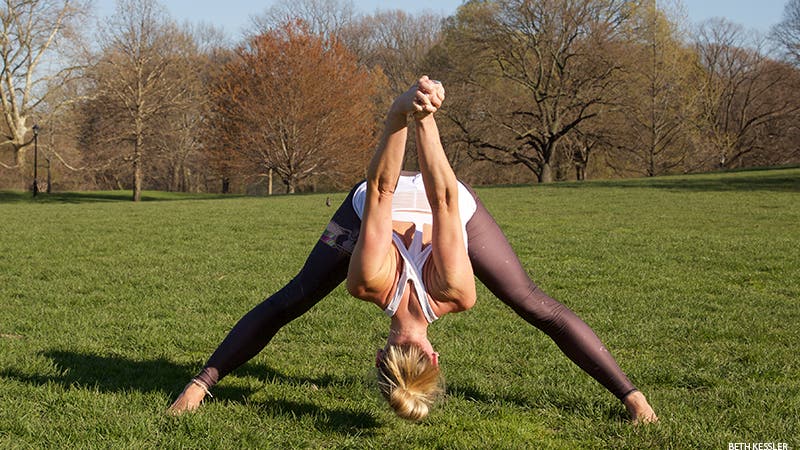
From Humble Warrior, inhale to lift your head and heart—keeping the fingers interlaced, and then straighten the front leg and parallel the feet to the left. Inhale to open up the chest, then exhale and fold forward—continuing to stretch through the arms.
ADVERTISEMENT
Take a deep breath in and exhale with a Lion’s Breath.
Here, Seane reminds us to observe any tension in the mouth and jaw.
Wide-Legged Forward Bend with Big Toe Grab
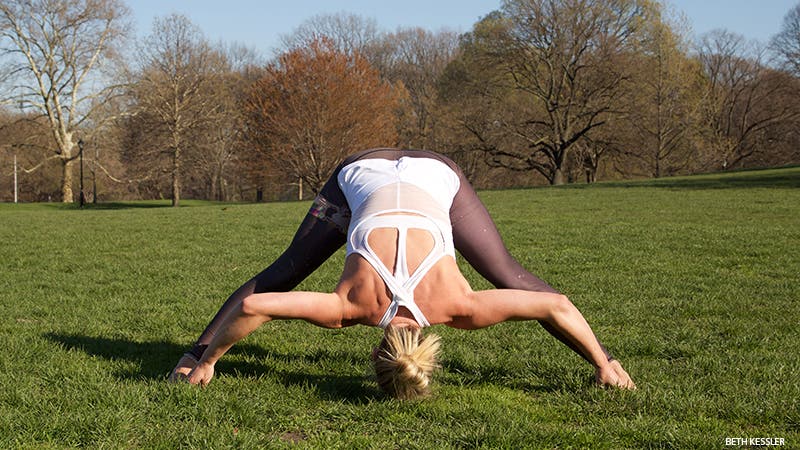
Release your hands from behind your back and yogi toe-lock your two big toes with the two peace fingers of each hand. Inhale to look forward and lengthen, then exhale to release your head and relax your neck. From here, place your hands on your hips and then inhale up to stand. Step forward to the front of the mat with your palms at your heart.
Inhale, arms reach overhead, exhale, and fold forward. Inhale, look up and lengthen, exhale to step or jump back to the top of a pushup and lower. Inhale to Upward-Facing Dog, then exhale back to Downward Dog. Repeat the first pose on the left side.
“Open energy in the third eye and crown chakra here by getting the hips above the head and heart to flush the pituitary and pineal glands,” Seane says. “This helps to ignite the heart and stimulate. Imagine your head getting filled and flushed with blood—the heaviness elongates the cervical spine.”
ADVERTISEMENT
Warrior I with Cow Face Arms
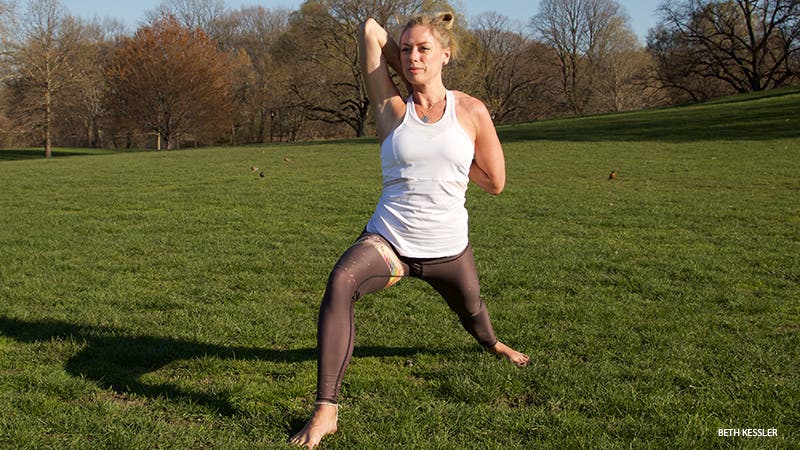
From Downward Dog, step your right foot forward and ground your back heel down. Inhale and come up to Warrior 1. Press your right hand into the nape of your neck and bring your left hand behind your back—and try to clasp. If you can’t clasp, don’t force it.
Take 4 deep breaths here and observe any sensation in the hips.
Wide-Legged Forward Bend with Cow Face Arms
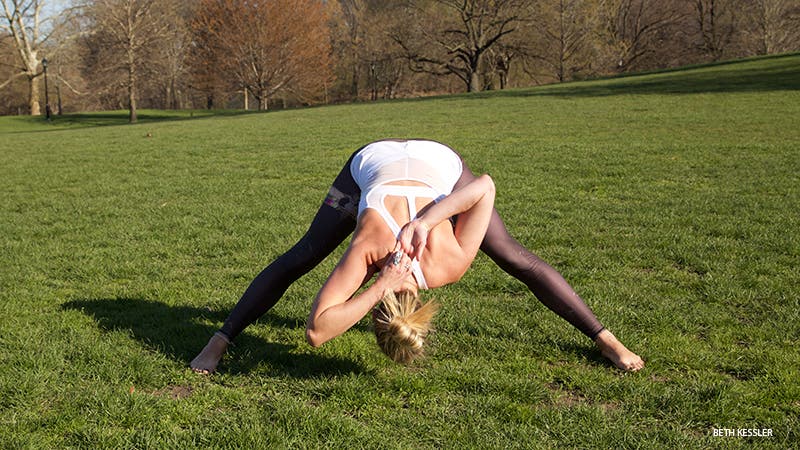
Inhale to straighten the front leg, then exhale to turn the right foot parallel and fold forward in Wide-Legged Standing Forward Bend with hands still clasping behind your back. Take a deep breath in and soften.
Inhale to stand up nice and slow, using your core and then release your arms, bringing them out to the sides. Step to the front of the mat and inhale, arms reaching overhead to open the chest, and exhale to fold all the way forward.
ADVERTISEMENT
Take a vinyasa and repeat the last two poses on the left side.
Wide-Legged Forward Bend with a Twist
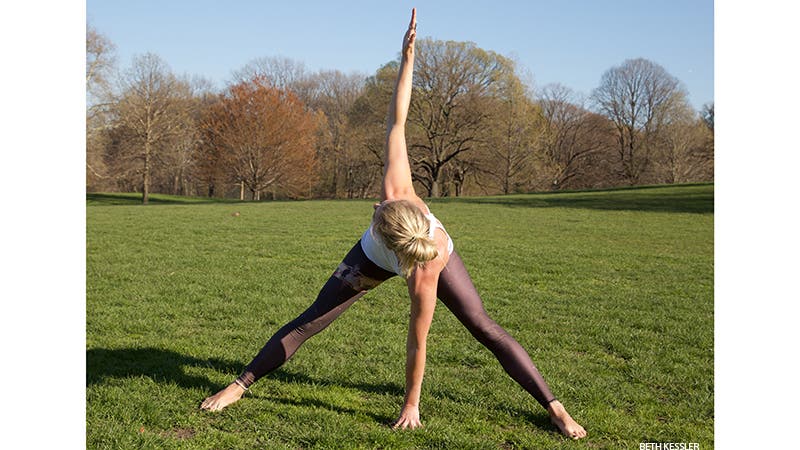
From a Wide-Legged Forward Bend, inhale to stand and release the arms out to the sides, then exhale with your hands on your hips and fold forward, bringing your fingertips to the ground. Bring the tips of your thumbs to touch and inhale to look up and lengthen, then bring your right arm to the ceiling and twist. Press down into the left hand and reach through the right. Lengthen the sternum away from the navel as you breathe. Switch hands and repeat.
Then with both hands down, deepen the forward fold by walking your hands between the legs. Release your head and neck, let the blood flow. On an inhale look up and lengthen, place your hands on your hips and come to stand. Step to the front of the mat with your palms at your heart. Inhale, arms reach overhead. Exhale, fold forward and take a vinyasa.
Revolved Lunge Pose
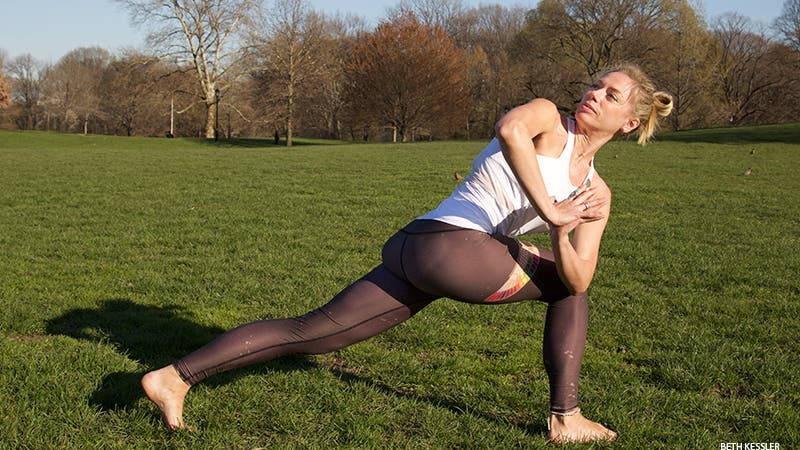
From Downward Dog, step your right foot forward with arms overhead and inhale into High Crescent Lunge. Exhale and bring your palms to Namaste, with your hands at your heart. Take a deep breath in, then exhale and hook the left elbow outside of the right knee. (Optional: Bring the left palm down and right hand straight up.) Pull the sternum forward and take a deep breath in. Then exhale both hands down, step back to the top of a pushup and lower. Return to Downward Dog and repeat on the left side.
ADVERTISEMENT
Dolphin Pose with Hand Clasp
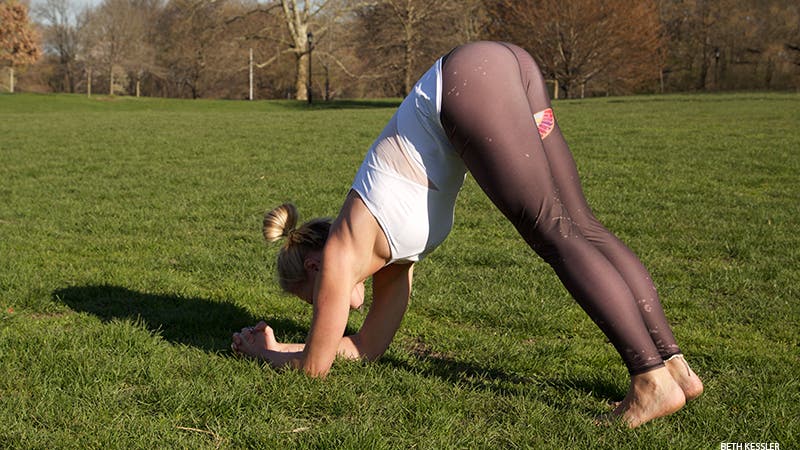
From Downward Dog, lower to your knees and forearms, then interlace your fingers. Straighten through your legs to come to a Dolphin Pose variation, and begin to walk your feet in. Push down into your forearms and keep stretching your chest back. Breathe deeply, then lower back to your knees.
Locust Pose
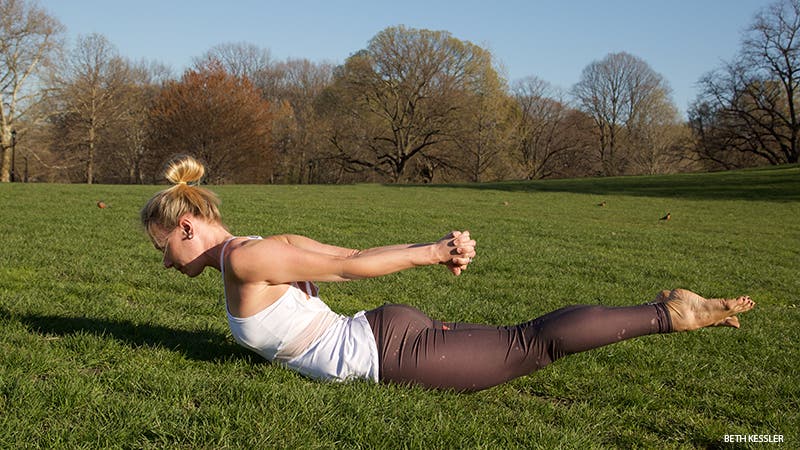
Lower all the way to your belly and interlace your fingers behind you. Inhale to lift your chest and legs in Locust Pose. Send the knuckles toward the buttocks. Breathe deeply as you stretch back and open up the chest. Release and turn your chin to one side.
Repeat up to 3 times.
ADVERTISEMENT
Camel Pose
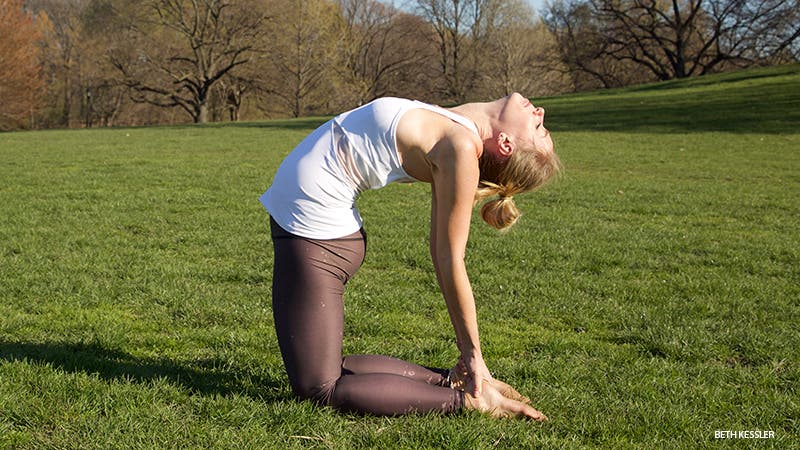
Come back to Tabletop and inhale to your shins and separate the knees. Curl your toes under if you’re tight in your lower back. Support your low back with your hands and inhale to lift your chest, then exhale and drop your hands back to your heels in Camel Pose. Gently release your head and neck back if it’s comfortable for you. Allow your heart to open wide and lift your sternum high.
When you’re ready, lower your hips to your heels and close your eyes.
ADVERTISEMENT
Repeat up to 3 times.
Upward Bow Pose
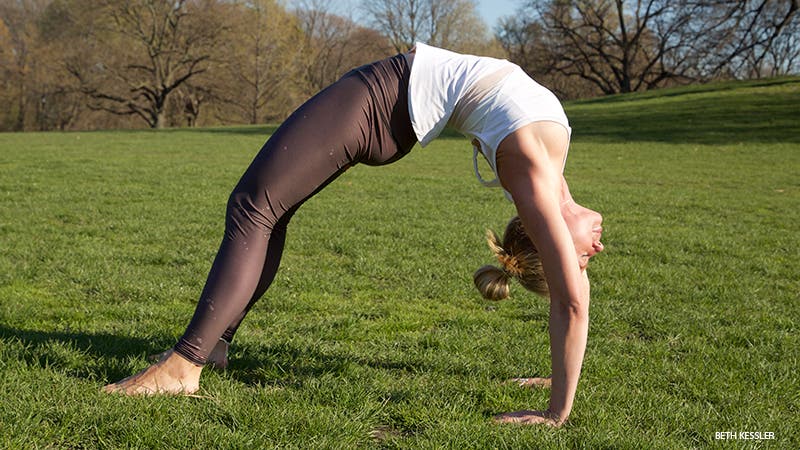
Come to lie on your back. Bend your knees and place the soles of your feet on the floor. Bring your hands behind you, fingertips pointing toward the shoulders. Inhale to the top of your head, then exhale to straighten through your heels in Upward-Facing Bow, or Wheel, Pose.
Repeat up to 3 times.
When you’re ready, hug your knees into your chest and take a deep breath in, exhale through your mouth.
Release the spine by following with a gentle supine spinal twist on each side, letting the knees drop to the left first, then the right.
ADVERTISEMENT
Double Pigeon Pose
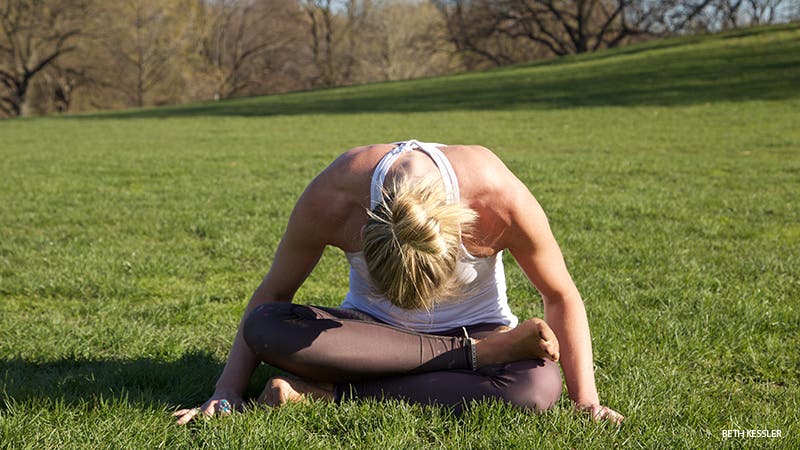
Roll up to a seated position and pull the flesh back from your sitting bones. Cross the legs by bringing the left shin down and placing the right shin on top. Take a deep breath in, then exhale and fold forward. Observe the sensations that arise, as well as your thought process. Allow yourself to get as quiet and still as you can.
Relax deeper into the shape and close your eyes. Breathe into any tension. Hold this pose for a few minutes before switching sides, then finish with a long seated meditation.
ADVERTISEMENT
“Take a moment to sit and bear witness to the aspect of your consciousness that is illuminated and the aspect of your humanity that tries to deny that connection with source,” Corn says. Think about what it means to align your body with cosmic consciousness—awareness, imagination, ideas and intuition—and move into direct dialogue with your inner wisdom.
This article has been updated. Originally published in 2016.