Updated July 3, 2025 09:53AM
If you buy through our links, we may earn an affiliate commission. This supports our mission to get more people active and outside.Learn about Outside Online's affiliate link policy
Child's Pose
Take a break. Balasana is a restful pose that can be sequenced between more challenging asanas.
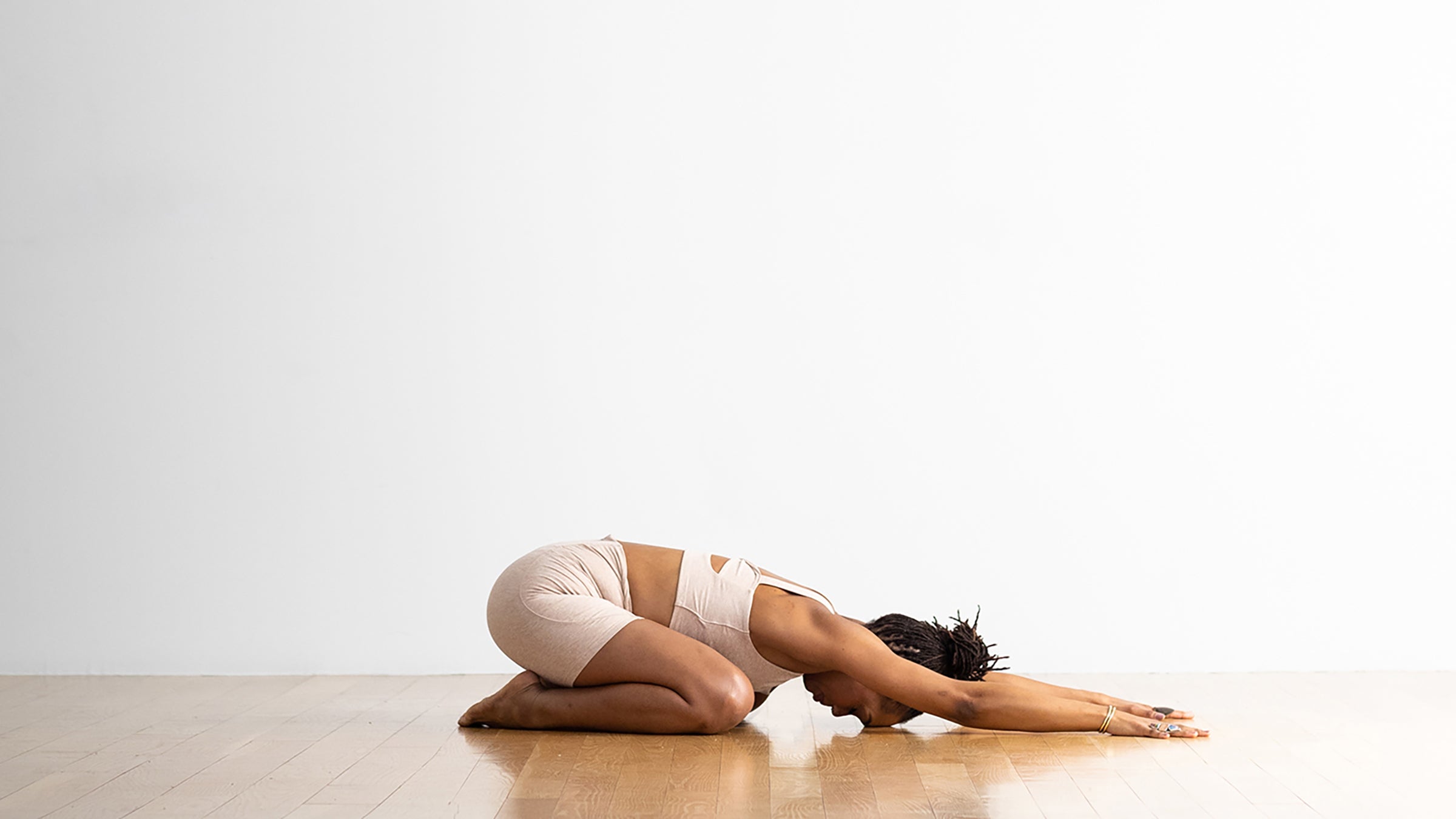
(Photo: Andrew Clark; Clothing: Calia)
Child’s Pose (Balasana) centers on creating a moment of rest where the body can be still. It is a foundational yoga posture that reminds us that inaction can be as valuable as action.
Child’s Pose isn’t entirely inactive if you take the version with your arms outstretched in front of you, which engages and stretches your back muscles as well as your shoulders and arms. Because Balasana involves compressing the body on the mat or floor, it can be challenging—physically and emotionally. There are multiple variations that can help different bodies relax into the pose.
Learning to surrender into the pose is an important part of the practice. “It is a very simple pose to begin with physically, yet it requires patience and the ability to surrender to gravity and a state of non-doing,” Peter Sterios, a yoga teacher and author of Gravity & Grace. “While it may not be a physically challenging posture, Balasana will help you cultivate the attitude necessary for deeper practice.”
Sanskrit
Balasana (bah-LAHS-anna)
bala = child
ADVERTISEMENT
How to do Child’s Pose (Balasana)
- Kneel on the floor. Touch your big toes together and sit on your heels, then separate your knees about as wide as your hips. (For more of a massage along the front of the body, keep your knees closer together.)
- Exhale and fold forward; lay your torso down between your thighs. Narrow your hip points toward the navel, so that they nestle down onto the inner thighs. Broaden across the back of your pelvis at the sacrum and lengthen your tailbone away from the back. Tuck your chin slightly to lift the base of your skull away from the back of your neck.
- Walk your hands out toward the front of your mat for Extended Child’s pose. Or reach back toward your feet and rest the arms on the floor alongside your torso, palms up, releasing the fronts of your shoulders toward the floor. Allow the weight of the shoulders to pull the shoulder blades wide across your back.
- Balasana is a resting pose. Stay anywhere from 30 seconds to a few minutes.
- To come up, first lengthen the front torso, and then with an inhalation lift from the tailbone as it presses down and into the pelvis.
Variations
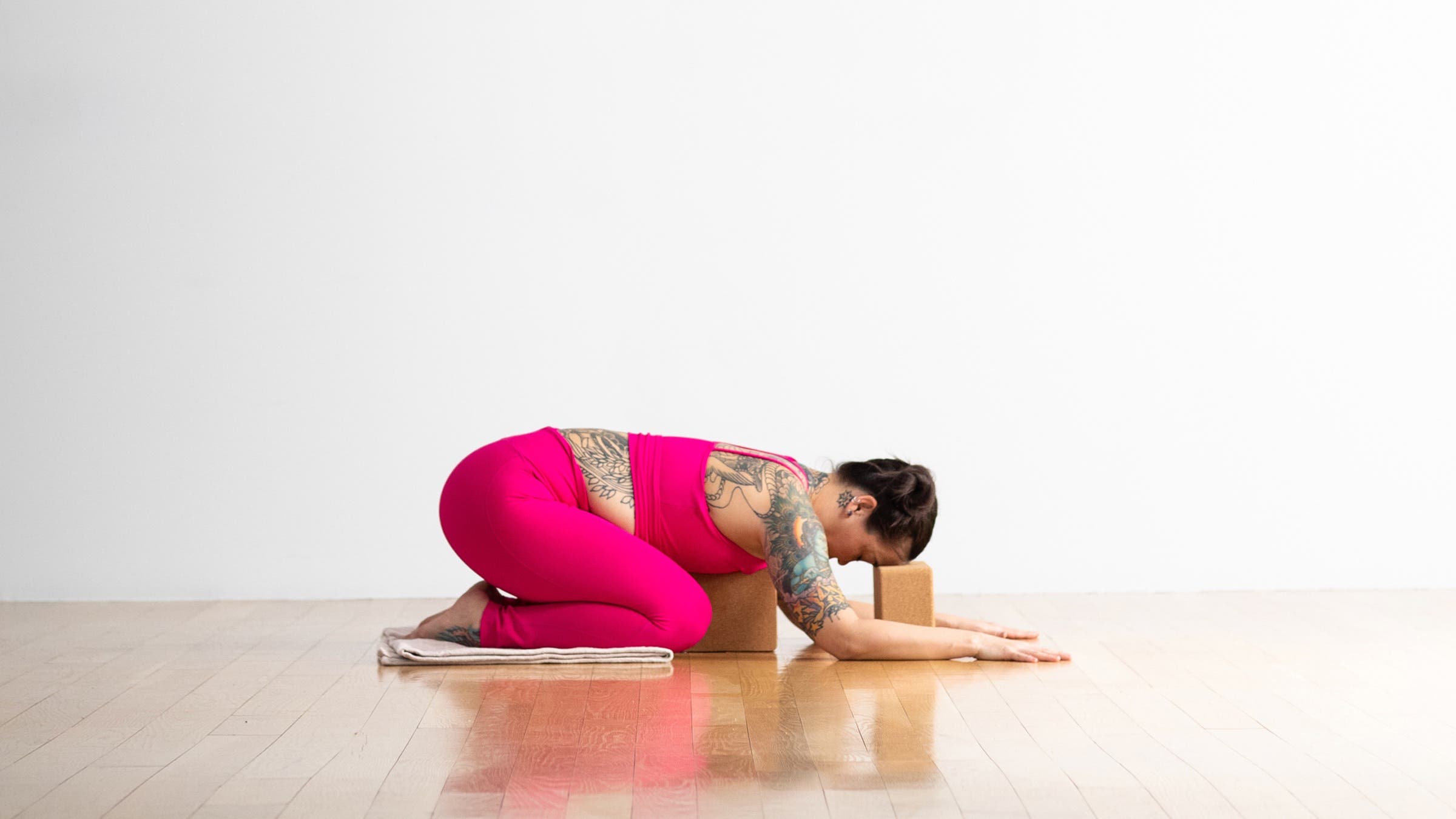
Child’s Pose with a bolster
Begin on your hands and knees. Place a bolster vertically between your inner thighs and slowly release down onto it. A rolled blanket or pillow placed between the backside of your thighs and calves may provide further support.
Bring your forehead or cheek to the bolster. If you rest a cheek on the bolster, be sure to flip to the opposite cheek after a few breaths to maintain an even stretch across both sides of your neck. If you have a longer torso, you may need to place block under your forehead or cheek to keep your neck in line with your spine.
ADVERTISEMENT
Take at least 8–10 deep breaths, or remain in the pose as long as you like.
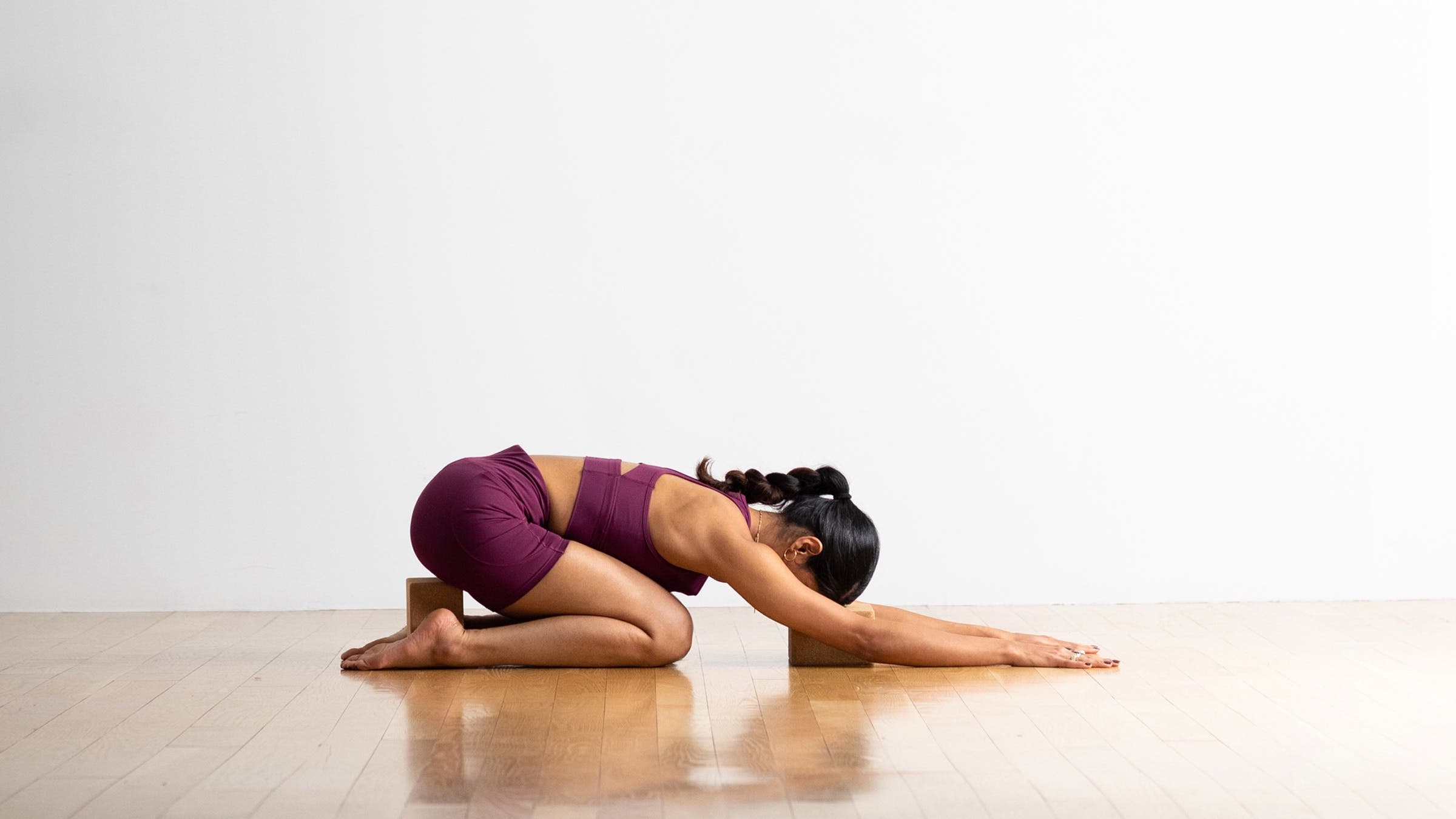
Child’s Pose with a block
Begin on your forearms and knees. Rest your forehead on a block or bolster for support. Your toes can be tucked under or released down to the floor. Take at least 8–10 deep breaths, or remain in the pose as long as you like.
Child’s Pose (Balasana) Basics
Pose type: Forward Fold
Target area: Full Body
Benefits: Child’s Pose can be calming and relaxing, helping to manage stress. This pose activates the relaxation response (parasympathetic nervous system) and deactivates the stress response (sympathetic nervous system). This may help lower or regulate blood pressure.
Other Child’s Pose perks:
- Stretches your back muscles, buttocks/gluteal muscles, front of your thighs/quadriceps, shins, and ankles.
- For some, this pose may ease symptoms of headaches, migraines, and PMS.
ADVERTISEMENT
Beginner tips
- Don’t be afraid to play with different iterations! You can spread your knees slightly wider or bring your arms alongside your legs, palms up. See what these modifications bring up for you and which version of the pose feels most connected to your body.
- If you wish, instead of extending your arms on the floor, reach them back alongside your feet, palms facing up.
- Don’t shy away from using blocks, blankets, or bolsters. Child’s Pose is meant to be restful and soothing. Whatever your best experience of the pose is, you should strive to create and lean into that posture.
Be mindful!
- If your head cannot reach the floor, rest it on a folded blanket instead to take the tension out of your neck.
- If you have a knee injury, place a folded blanket in the crease of your knees and then move your seat toward your heels. Let the back of your thighs rest on the blanket, which will lessen the compression in your knees.
Why we love Child’s Pose
“I didn’t understand Child’s Pose for the longest time. That is, I understood the mechanics of the pose, but I misunderstood its intent,” says Renee Marie Schettler, Yoga Journal‘s senior editor. “In my early years of practicing yoga, Child’s Pose was something the teacher told us to do when we were exhausted. I took it to be something that was an alternative option, something ‘less than’ the more challenging poses. While in Child’s Pose, I remained tensed and ready to pounce on the pose that followed. Only in recent years, after practicing more Yin, have I started to comprehend the innate and exquisite value in quiet and stillness and surrender, as well as the release and strength that proceeds from that.”
Teacher tips
These tips will help protect your students from injury and help them have the best experience of the pose:
- Give breathing cues to your students. Suggest that they try to sink a bit deeper into the pose as they exhale. Bring awareness to your body through gently rolling your forehead back and forth on the mat, or coming up on tented fingertips to deepen the stretch of Extended Child’s Pose.
- Remember that for some, Balasana is not a comfortable resting pose. Suggest using blocks, bolsters, or blankets to bring the floor up to their forehead and body. Taking a wide-legged posture can better accommodate the belly or breasts. Remind the class they can find a suitable alternative—perhaps curled up on one side or even on the back—that works for their body and makes them feel comforted.
- Offer a moment for students to set an intention or call a mantra to mind. Balasana is meant to be a period of intentional rest and quiet, and this is an ideal time to remind students to steady their focus or cultivate their gratitude practice.
Preparatory and counter poses
Balasana can appear at the beginning of class or near the end. The pose doesn’t necessarily require warm-up, although it can help you to settle into relaxation when you first stretch your hips and shoulders.
ADVERTISEMENT
Because it’s a neutral pose in terms of lengthening the back, it can be sequenced at almost any time. Child’s Pose is often used in sequences not just as a resting pose but as a counter pose to backbends.
Anatomy
Balasana is a resting pose that gently relaxes the muscles on the front of the body while passively stretching the muscles of the back. You may feel the stretch in certain muscles and joints, yet overall it should be a passive and not active or forced stretch.
In the drawings below, the pink muscles are stretching.
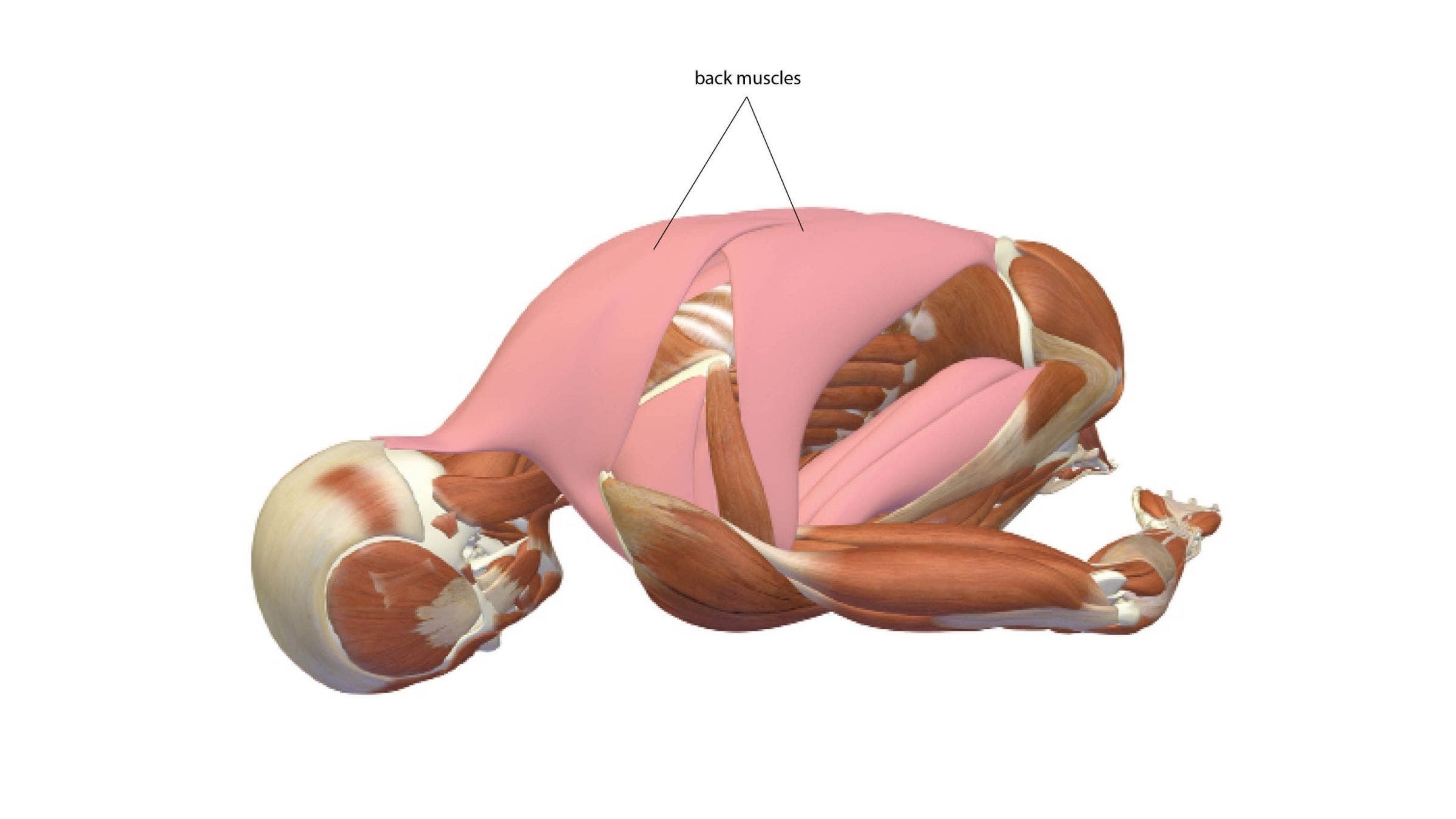
In this pose, ease is brought into all muscles in the body. On the upper back, this includes the rhomboids, connecting the spine and the shoulder blades, as well as the middle trapezius, which spans the back, and the posterior deltoids (at the back of the shoulders).
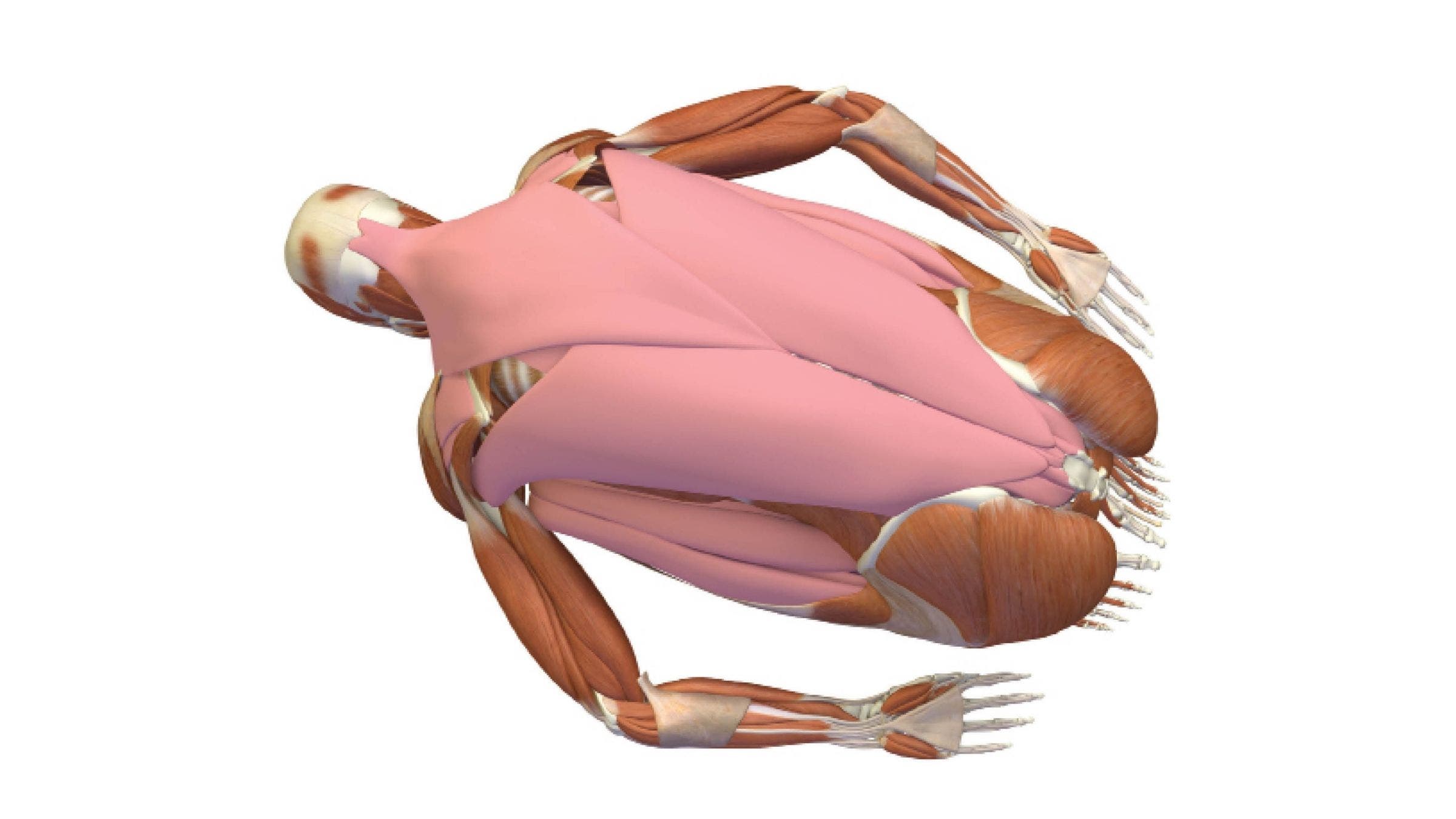
You may also feel a slight stretch in your quadriceps and hips.
Excerpted with permission from The Key Poses of Yoga by Ray Long.
RELATED: My Ideal Yoga Class is 60 Minutes of This Pose
Put Child’s Pose into practice
- Head Off A Migraine Before It Starts With These Yoga Poses
- These Are the 9 Yoga Poses We Turn To When We’re Stressed Out and Anxious
- 5 Calming Yoga Poses You Can Do In 5 Minutes
- Why Is Child’s Pose So Insanely Calming?
About our contributors
Teacher and model Natasha Rizopoulos is a senior teacher at Down Under Yoga in Boston, where she offers classes and leads 200- and 300-hour teacher trainings. A dedicated Ashtanga practitioner for many years, she became equally as captivated by the precision of the Iyengar system. These two traditions inform her teaching and her dynamic, anatomy-based vinyasa system Align Your Flow. For more information, visit natasharizopoulos.com.
Ray Long is an orthopedic surgeon and the founder of Bandha Yoga, a popular series of yoga anatomy books, and the Daily Bandha, which provides tips and techniques for teaching and practicing safe alignment. Ray graduated from the University of Michigan Medical School and pursued post-graduate training at Cornell University, McGill University, the University of Montreal, and the Florida Orthopedic Institute. He has studied hatha yoga for over 20 years, training extensively with B.K.S. Iyengar and other leading yoga masters, and teaches anatomy workshops at yoga studios around the country.
