Updated February 25, 2025 12:50PM
If you buy through our links, we may earn an affiliate commission. This supports our mission to get more people active and outside.Learn about Outside Online's affiliate link policy
Half Moon Pose
Say hello to leg and ankle strength as you seek stability and extend into this balancing pose, Half Moon Pose.
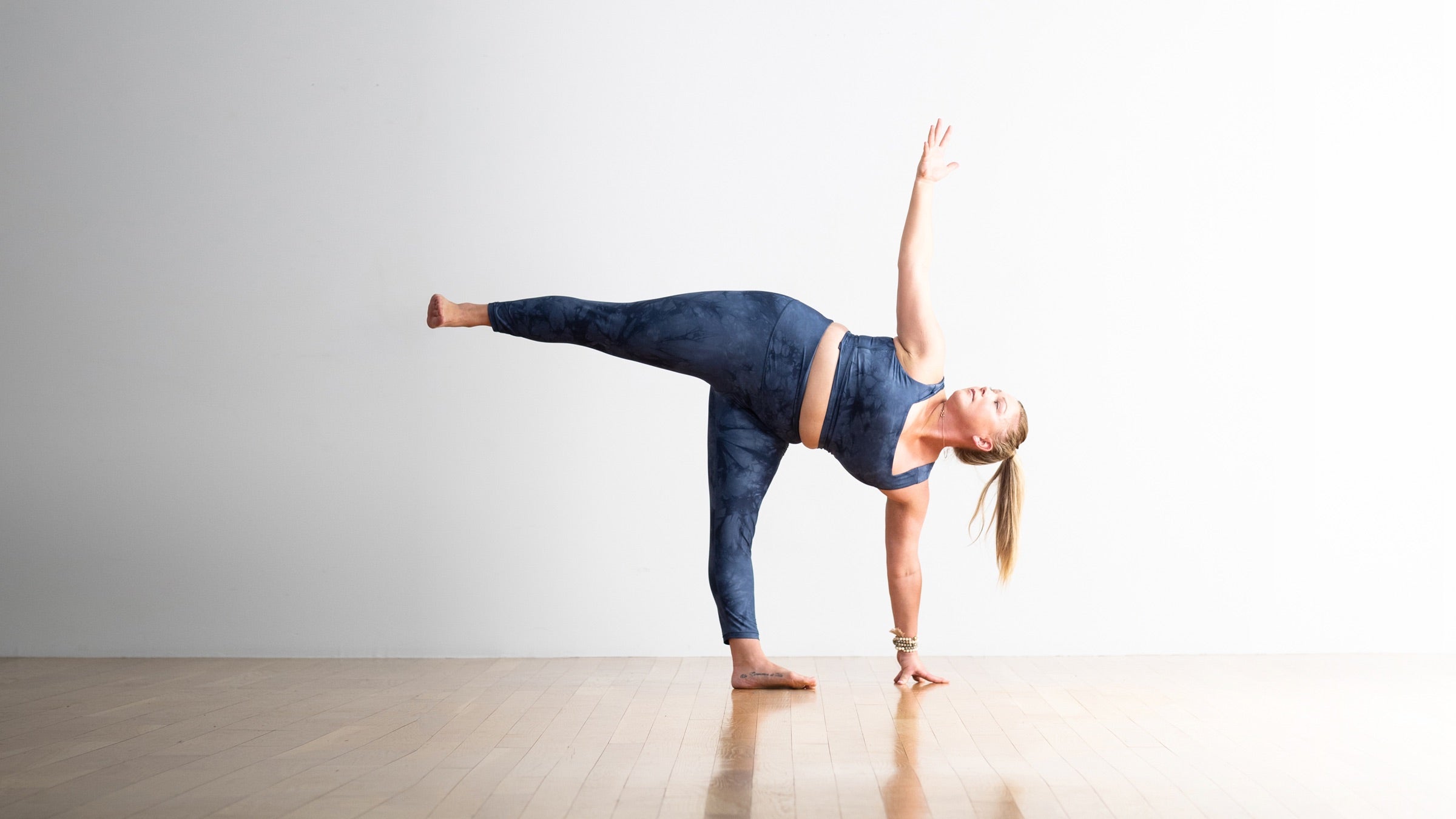
(Photo: Andrew Clark; Clothing: Calia)
Ardha Chandrasana (Half Moon Pose) is a challenging posture that will test your balance. You bring in energies from both the moon (calm, cooling) and the sun (fiery, intense), as you root down with your standing leg and stabilizing arm while lifting and extending your raised leg and opposite arm.
Practice Half Moon Pose on both sides to work on postural imbalances. If you have a tight chest or hips (say, from sitting at a computer all day), do some hip opening stretches before moving into this pose, so that you can more easily rotate your torso and lengthen your ribcage.
If you lose your balance and fall in Half Moon Pose, simply refocus and reconnect with your breath. It’s the same way in daily life: When you get distracted, come back to your breath and to the present moment.
Sanskrit
Ardha Chandrasana (are-dah chan-DRAHS-anna)
ardha = half
chandra = glittering, shining, having the brilliancy or hue of light (said of the gods); usually translated as “moon”
ADVERTISEMENT
How to do Half Moon Pose
- Start in Utthita Trikonasana (Extended Triangle) with your left foot forward.
- Bring your right hand to your hip and turn your head to look at the floor.
- Bend your front leg and shift your weight into your front foot.
- Reach your front hand a little forward and place it on the mat or a block directly beneath your front shoulder. Press down through your fingers to steady yourself.
- Lift your back leg until your thigh is parallel to the floor. Slowly turn your chest to face the right, twisting your torso and hips. Reach your top hand to the ceiling.
- Either keep your gaze on the floor or slowly bring it to your top hand. Keep a slight bend in your standing leg so you don’t hyperextend your knee.
- Exit the pose the same way you came into it and return to Extended Triangle.
Half Moon Pose variations
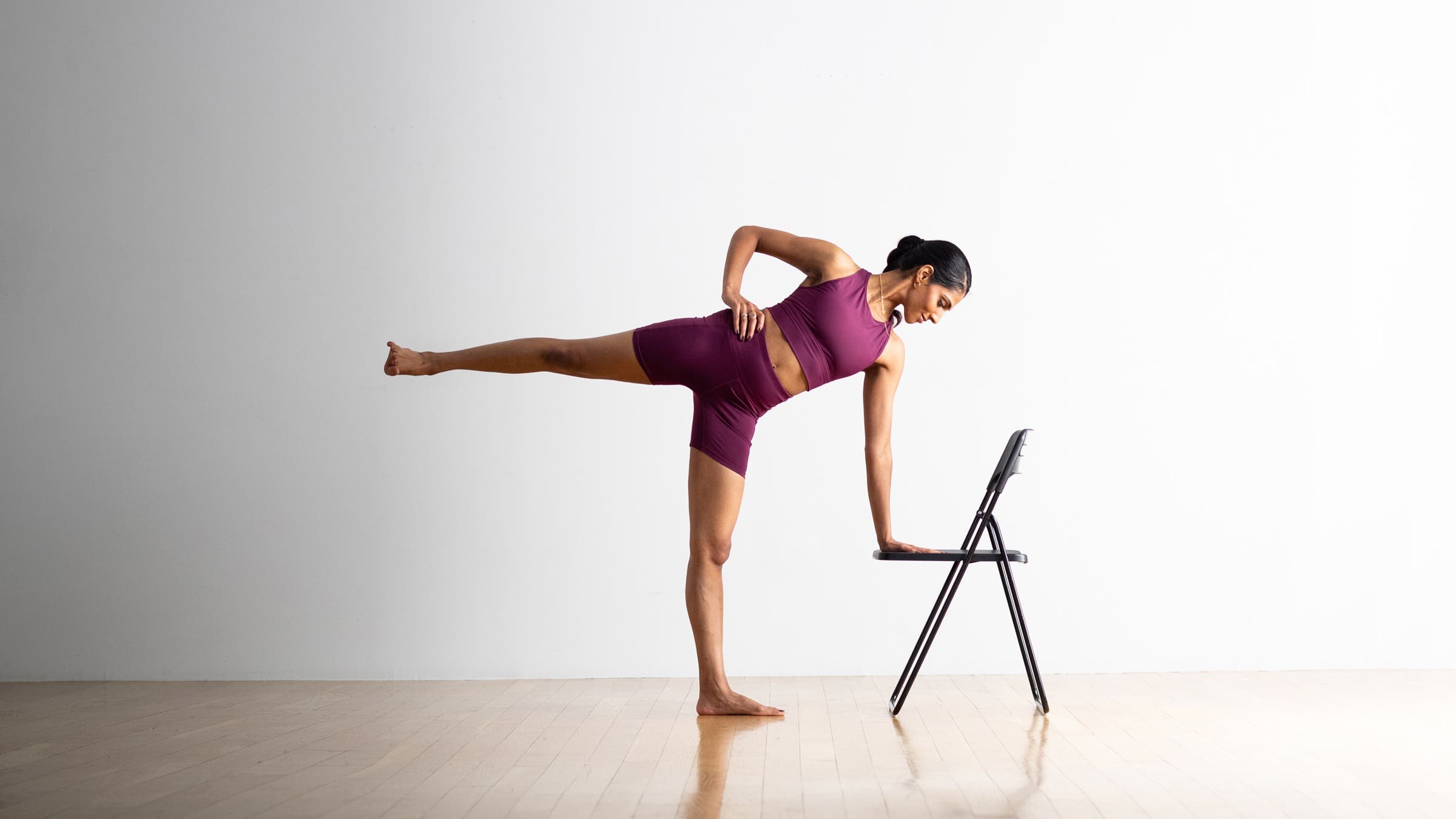
Half Moon Pose on a chair
To make the pose easier on your lower back, try it with your hand or forearm on the seat of a chair. Lift your leg up as high as you can without forcing. You can reach your top hand straight to the ceiling or keep it on your hip. Look down, straight ahead, or up.
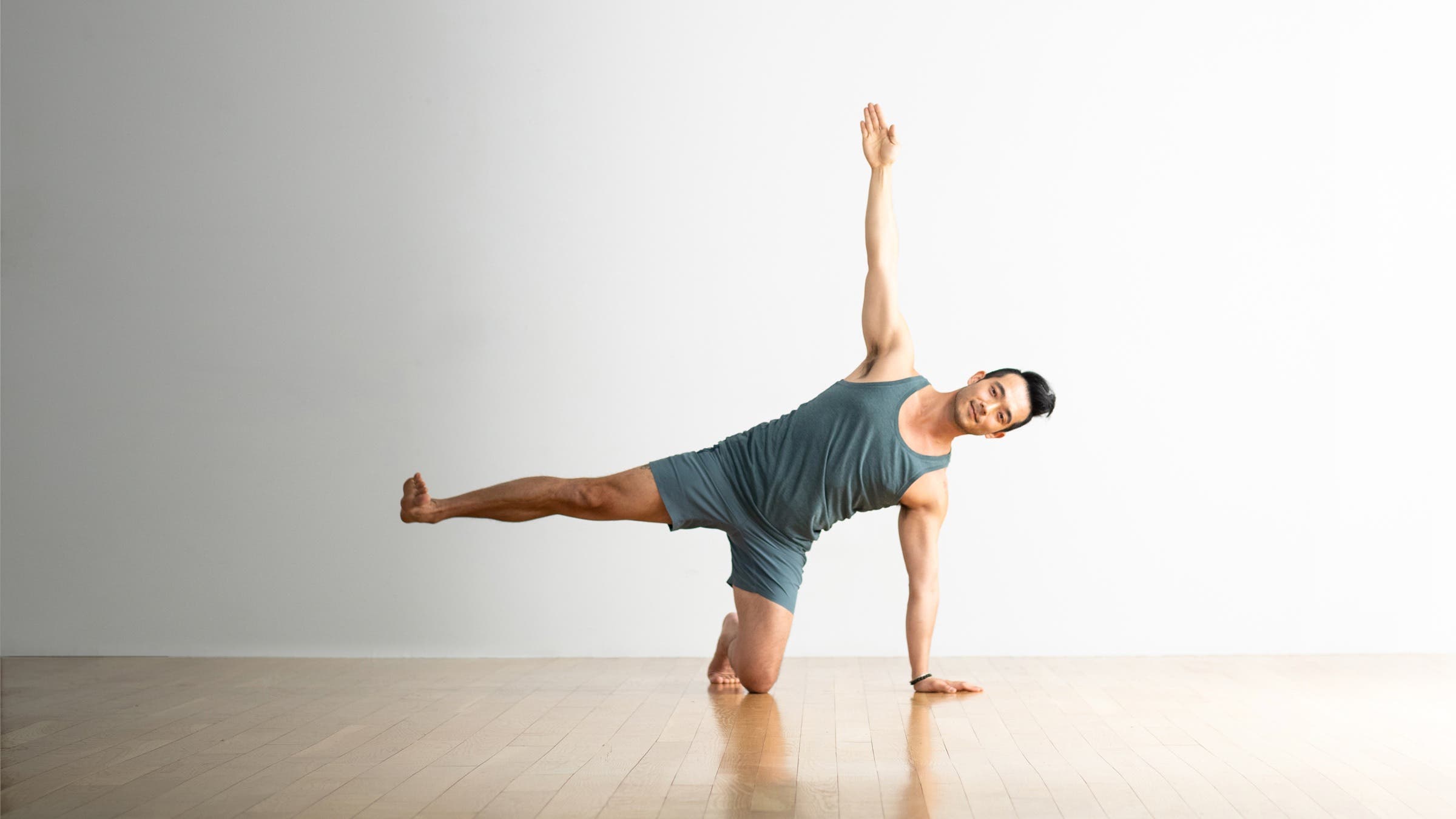
Half Moon Pose with the knee down
To focus on strengthening more than balance, try the pose on the floor with one knee down and the bottom shin extending straight behind you like a kickstand.
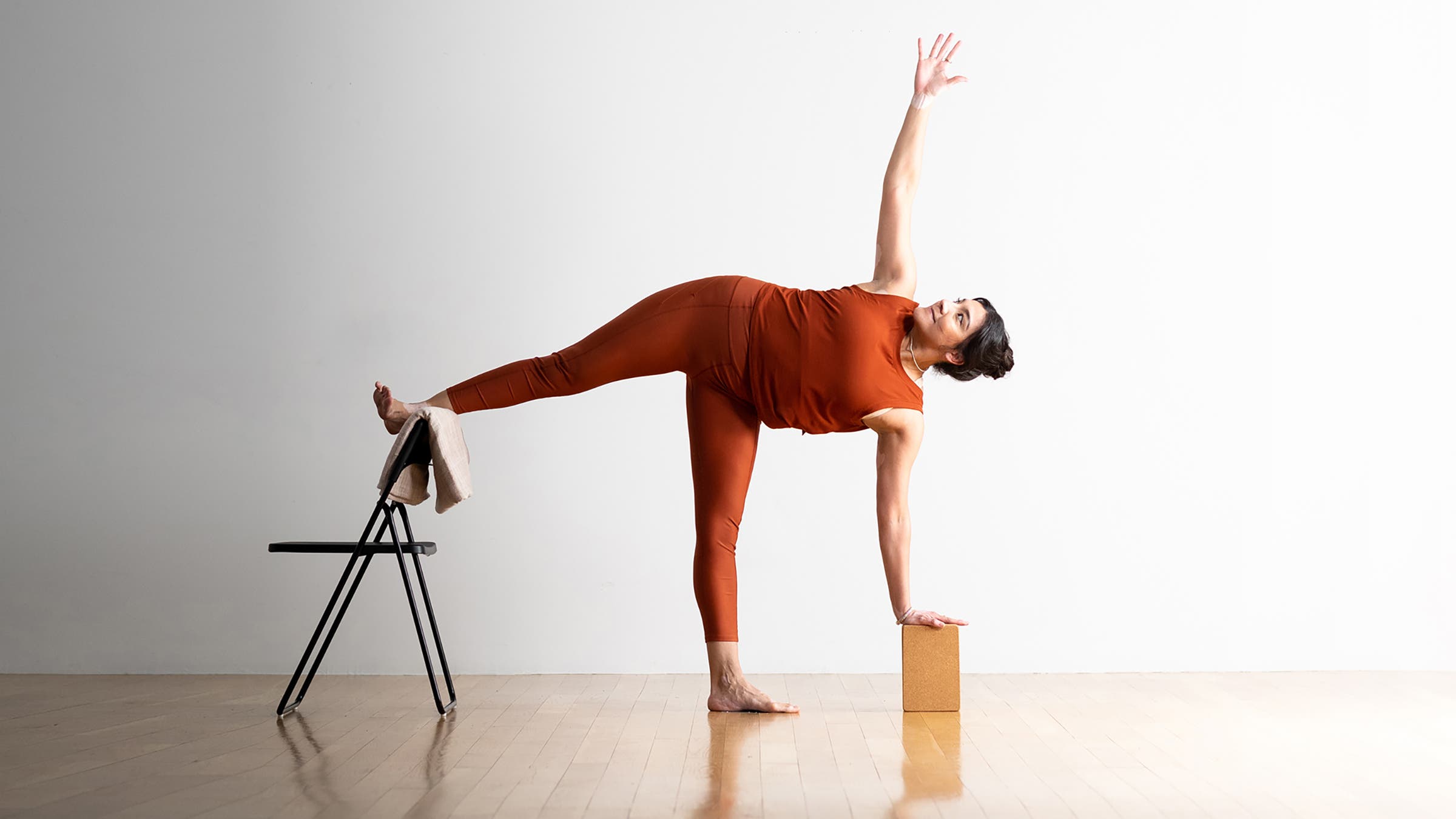
Half Moon Pose with a chair and a block
Another way to use a chair is to allow it to support your lifted leg. Rest your lifted leg on the back of the chair, using a blanket for cushioning. Bring a bottom hand to a block directly beneath your shoulder.
ADVERTISEMENT
Half Moon Pose basics
Pose type: Standing Balance
Targets: Full Body
Benefits: Half Moon Pose improves balance and counteracts the effects of sitting.
Other Half Moon perks:
- Strengthens your core muscles
- On your standing thigh: strengthens your thighs and ankles. It also stretches the back of your thigh (hamstrings) and your buttocks (glutes)
- On the lifted thigh, it stretches your groin and front of your hip (hip flexors), including your psoas. It also strengthens your thighs (especially your outer thighs/abductors) and your buttocks (glutes).
ADVERTISEMENT
Beginner tips
If you have difficulty touching the floor with your lower hand, support your hand on a block. Start with the block at its highest height and, if your balance is steady and comfortable, lower it down first to its middle height, then finally if possible to its lowest height.
Explore the pose
Half Moon Pose is usually sequenced somewhere in the middle of a standing pose series, often after Triangle Pose.
ADVERTISEMENT
For an added challenge and quad stretch, bend your top leg and reach for your top foot to come into Chapasana, or Sugar Cane Pose—a variation of Half Moon Pose that is more of a backend.
Be mindful!
- If you’re having trouble balancing, keep your gaze straight ahead.
- If you are side-bending too much to reach the floor, place a block under you bottom hand.
What we love about this pose
“Half Moon is the pose that brought me out of “block snobbery,’ ” says Tamara Jeffries, Yoga Journal‘s senior editor. “I have to use a block for support in this pose. Dianne Bondy had some great modifications for this using the wall. If you put yourself in a corner, you can support the extended/lifted leg, as well as your back body. That way, I can feel completely supported while I focus on my alignment.”
Preparatory and counter poses
Prepare for Ardha Chandrasana by stretching the hamstrings. Also, practice poses that challenge your balance. Additionally, in other poses in which your hands are on the mat, such as Uttanasana (Standing Forward Bend), practice pressing down with your fingers into the mat, as this action will help with steadiness when you are balancing.
Preparatory poses
Utthita Trikonasana (Extended Triangle Pose)
ADVERTISEMENT
Counter poses
Uttanasana (Standing Forward Bend)
Prasarita Padottanasana (Wide-Legged Standing Forward Bend)
Anatomy
In Ardha Chandrasana, your body weight is on one leg, with one hand extended and touching the floor. The other leg is extended parallel to the floor and acts as an active counterbalance. Freely interpreted, the pose carves a full moon as it hangs quietly in the sky.
ADVERTISEMENT
All your limbs need to remain in the same plane because tipping your leg or upper arm backward can cause you to come out of balance. If this happens, you can regain stability by bending your standing knee. For additional stability, lower your lifted leg slightly. Both of these actions lower your center of gravity and make it easier to balance. Throughout the pose, focus on your breathing to maintain balance.
In the drawings below, pink muscles are stretching and blue muscles are contracting. The shade of the color represents the force of the stretch and the force of contraction. Darker = stronger.
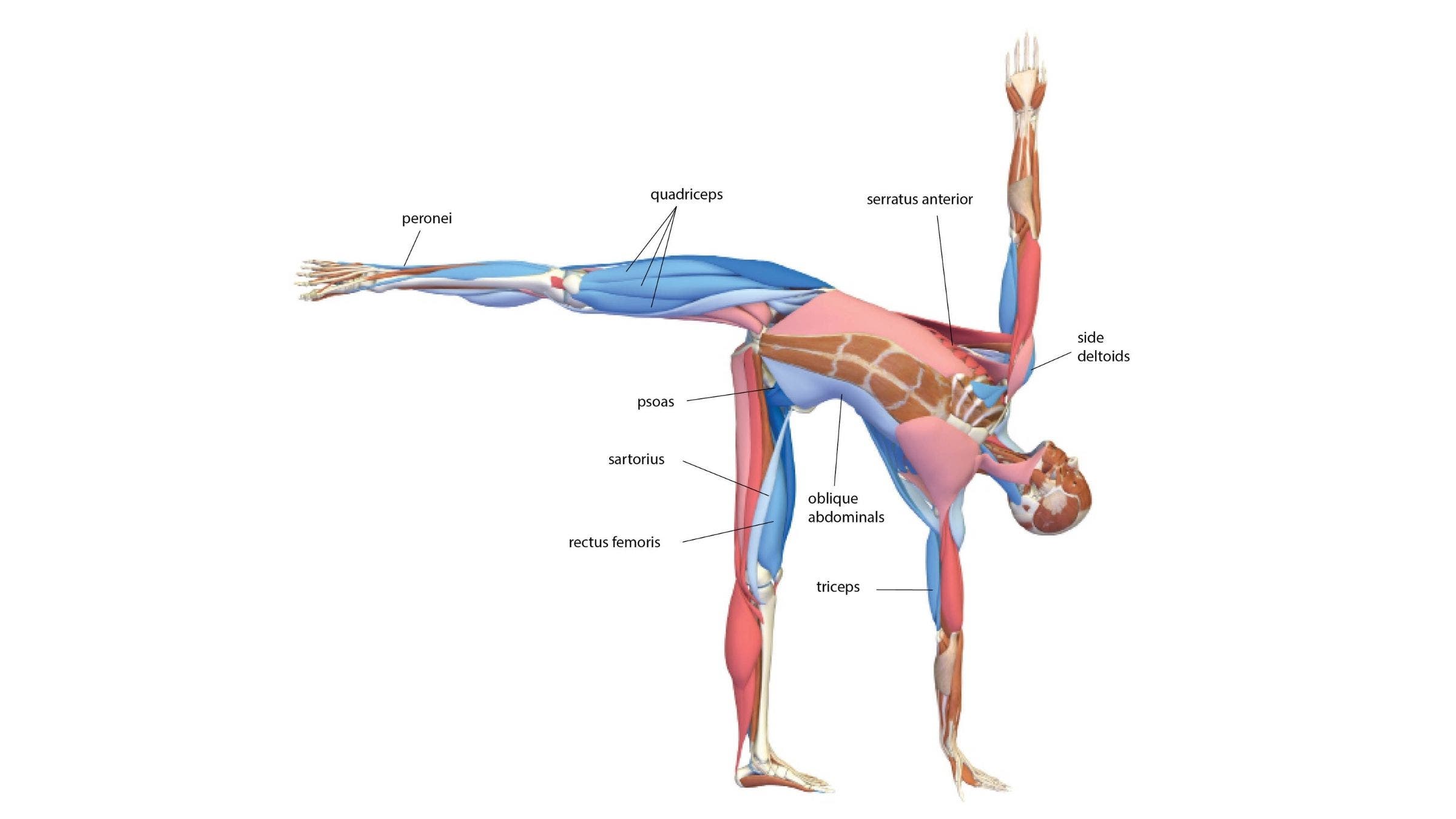
Lift your back leg by using your hip abductors—the gluteus medius, gluteus minimus, and tensor fascia lata. Activate the quadriceps to straighten the knee and lift the pelvis and trunk forward.
Laterally flex the trunk by engaging the oblique abdominals, the deep back muscles, and the hip flexors. The rectus femoris and sartorius muscles cross the pelvis and hip, making them synergistic hip flexors. Engage the rectus femoris by lifting your kneecap toward your pelvis.
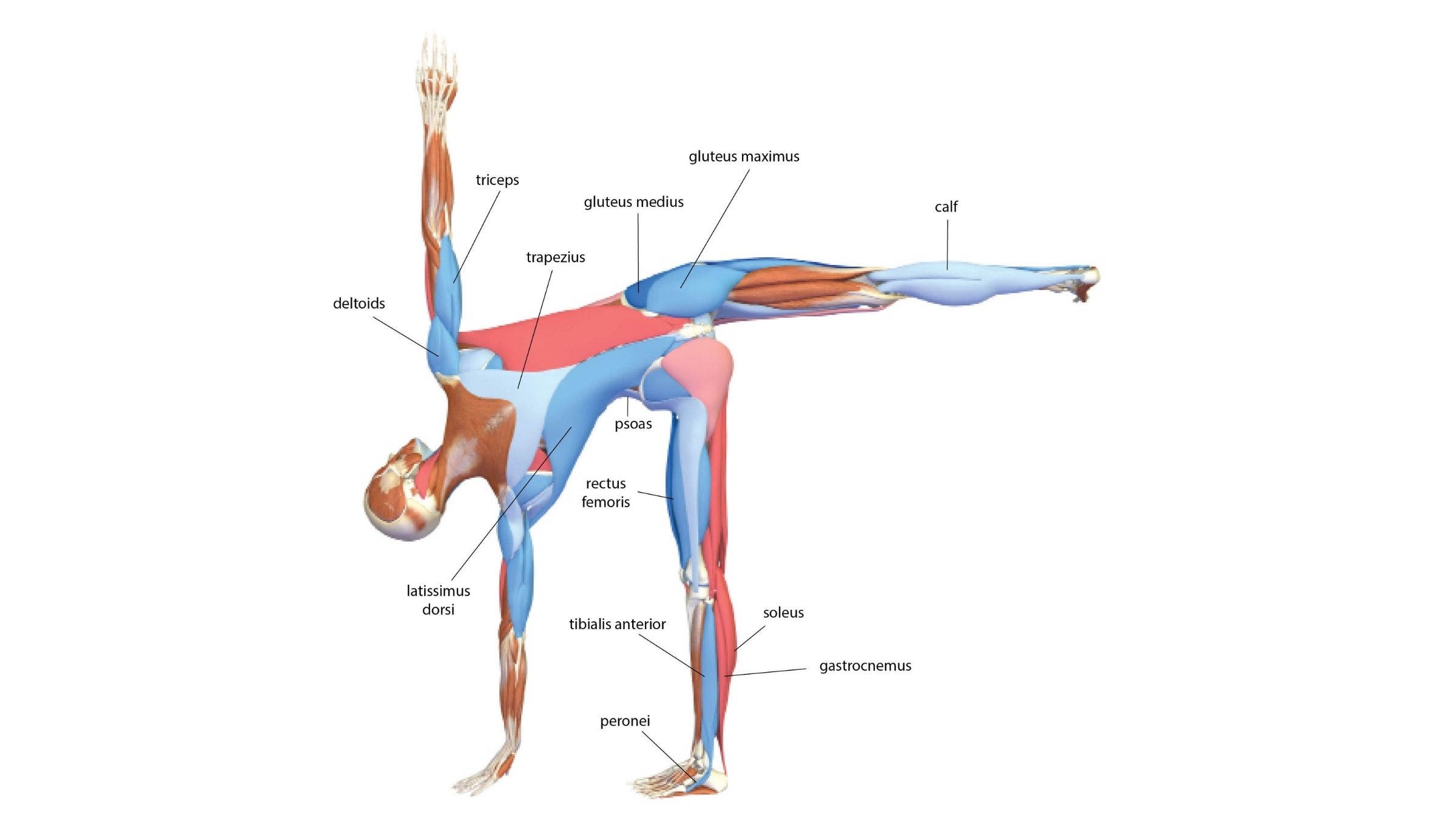
Use the muscles on the side of your standing leg to assist in balancing. The gluteus medius, minimus, and tensor fascia lata flex the hip and stabilize the pelvis.
Contract the upper rhomboids to draw your shoulder blades toward the midline of the back, opening the chest and turning it slightly upward. Reach toward the floor with the lower arm by activating the serratus anterior, drawing the scapula away from the spine.
Excerpted with permission from The Key Poses of Yoga and Anatomy for Vinyasa Flow and Standing Poses by Ray Long.
Put Half Moon Pose into practice
Think You Can’t Come Into Compass Pose? This 45-Minute Practice Will Get You There
10 Energy-Boosting Poses to Banish Sluggishness
Invigorate Your Body and Mind with This Warming Sequence
About our contributors
Teacher and model Natasha Rizopoulos is a senior teacher at Down Under Yoga in Boston, where she offers classes and leads 200- and 300-hour teacher trainings. A dedicated Ashtanga practitioner for many years, she became equally as captivated by the precision of the Iyengar system. These two traditions inform her teaching and her dynamic, anatomy-based vinyasa system Align Your Flow. For more information, visit natasharizopoulos.com.
Ray Long is an orthopedic surgeon and the founder of Bandha Yoga, a popular series of yoga anatomy books, and the Daily Bandha, which provides tips and techniques for teaching and practicing safe alignment. Ray graduated from the University of Michigan Medical School and pursued post-graduate training at Cornell University, McGill University, the University of Montreal, and the Florida Orthopedic Institute. He has studied hatha yoga for over 20 years, training extensively with B.K.S. Iyengar and other leading yoga masters, and teaches anatomy workshops at yoga studios around the country.
