Updated February 25, 2025 01:09PM
If you buy through our links, we may earn an affiliate commission. This supports our mission to get more people active and outside.Learn about Outside Online's affiliate link policy
Wide-Legged Standing Forward Bend
Open wide into Prasarita Padottanasana to increase flexibility by leaps and bounds.

(Photo: Andrew Clark)
Build Prasarita Padottanasana (Wide-Legged Standing Forward Bend) on a steady foundation. Think of your feet as having four corners: your inner and outer heels, big toe mounds, and pinkie toe mounds. Press into all four corners while lift your inner and outer arches. This lift will travel upward, firming the entire length of your legs and grounding your feet into the earth. If you have tight hamstrings or hips, bend your knees slightly to ease the stretch so that you can keep your low back long and fold forward from your hip joints.
Because your head is brought lower than your heart, Wide-Legged Standing Forward Bend pose can serve as a substitute for Sirsasana (Headstand) for those with neck issues, says yoga teacher Richard Rosen, “Many benefits of inversions—especially bathing the poor old tired brain with freshly oxygenated blood to perk it up—accrue to Prasarita without any weight-bearing stress on the neck.”
Sanskrit
Prasarita Padottanasana (pra-sa-REE-tah pah-doh-tahn-AHS-anna)
prasarita = stretched out, expanded, spread
pada = foot
ut = intense
tan = to stretch or extend
ADVERTISEMENT
How to
- Begin facing the long side of your mat in Mountain Pose (Tadasana).
- Step your feet 3 to 4 feet apart, with your hands on your hips.
- Lift tall through your whole torso and fold slowly over your legs. Bend from your hip joints instead of rounding your lower back. If your back starts to round, stop folding forward.
- Place your hands flat on the floor, shoulder-width apart; begin to stretch your torso forward.
- Fold deeper, bringing your head toward the floor. Anchor your feet, firm your leg muscles and activate your inner thigh muscles. Lengthen your entire spine from your sitting bones to the crown of your head.
- After several breaths, ground into your feet, straighten your arms, and lengthen your spine forward.
- Inhale as you slowly lift up to standing. Step your feet together, come into Mountain Pose at the front of the mat, and pause.
Variations
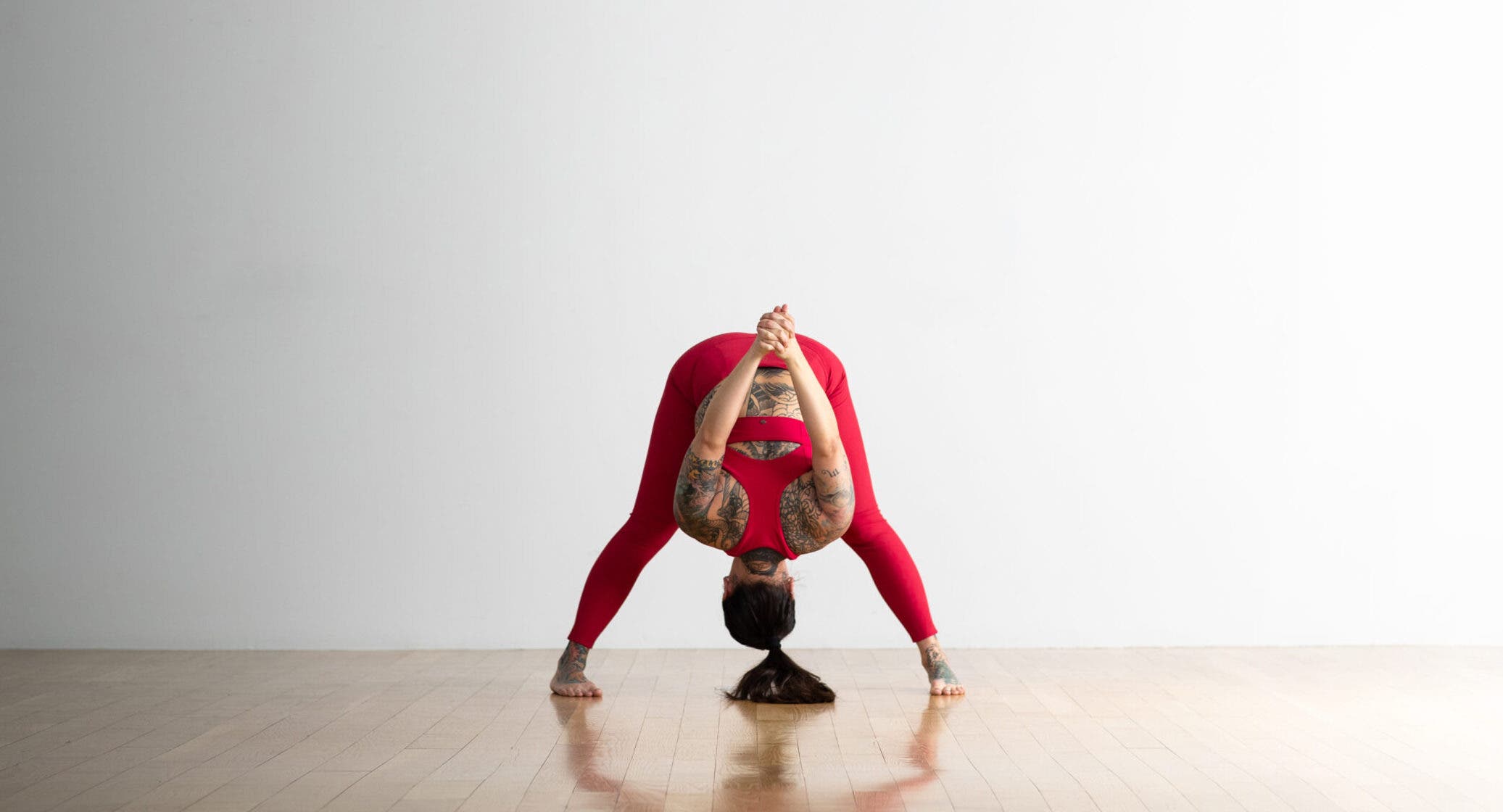
Wide-Legged Forward Bend with arm variations
You can take several different hand positions in Wide-Legged Forward Bend. Reach out and grasp your toes or the outside edges of your feet. Intertwine your fingers or clasp your hands behind your back and lift them away from your body to create more of a shoulder opener.
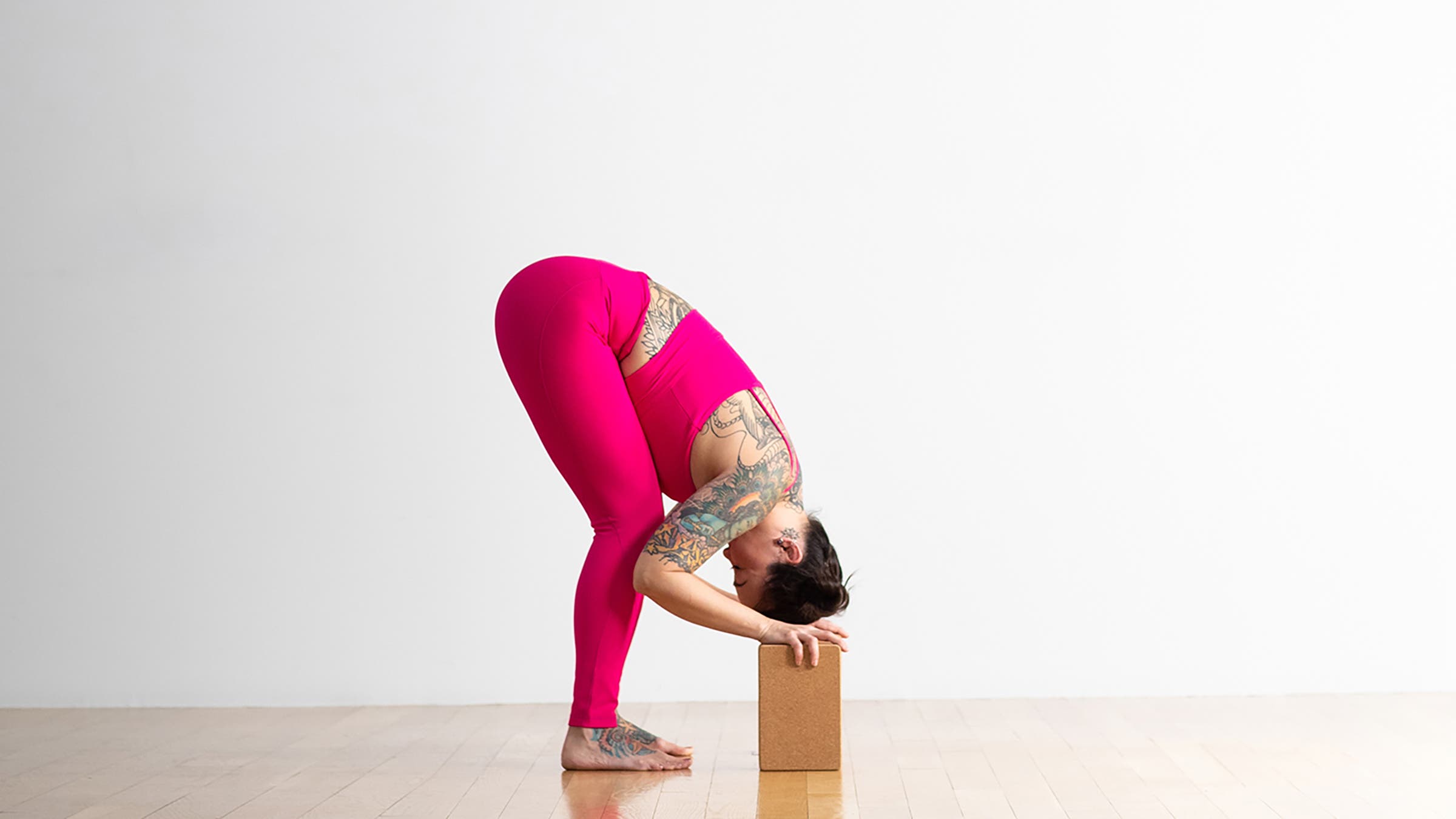
Wide-Legged Forward Bend with hands on blocks
If your hamstrings are tight, place blocks in front of you to effectively lift the floor to you. Keep your legs active. Remember that yoga is about making skillful choices that allow you to maintain the alignment of the pose. It’s not about getting into the deepest possible iteration of the stretch.
ADVERTISEMENT
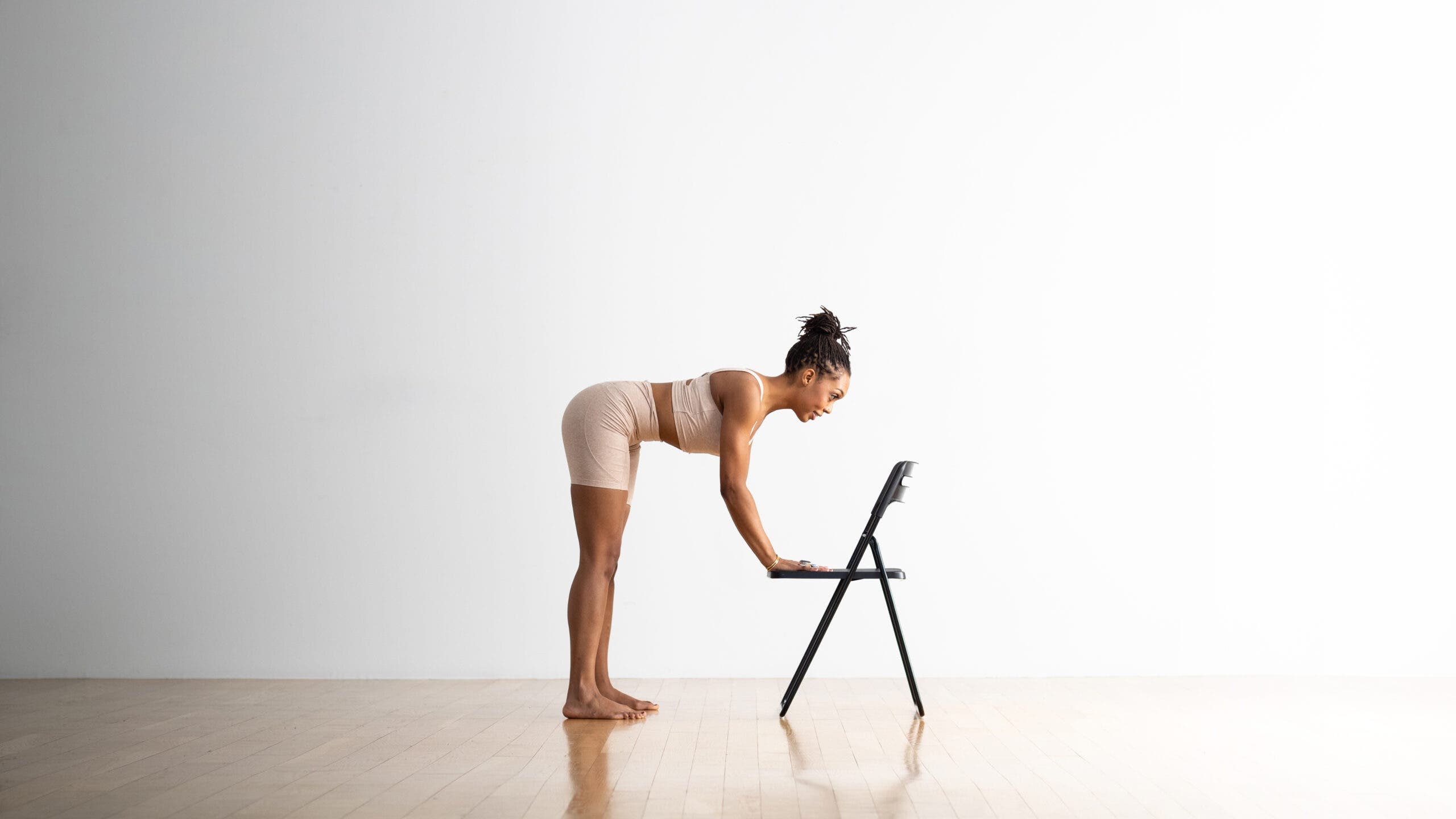
Wide-Legged Forward Bend on a chair
If you find it challenging to fold forward with your hands to the mat or blocks, rest your hands or forearms on the seat of a chair. You can raise the height of the support to you by adding folded blankets or towels beneath your forearms.
Wide-Legged Standing Forward Bend basics
Pose type: Forward bend
Targets: Lower body
Benefits: This pose is good for stretching your hamstrings, calves, and hips; strengthening your feet, ankles, and legs; and building awareness of protecting your lower back.
ADVERTISEMENT
Other Wide-Legged Standing Forward Bend perks:
- Counteracts the effects of prolonged sitting
- Calms and relaxes the mind to relieve anxious thoughts and feelings
- May ease symptoms of tension headaches and premenstrual syndrome (PMS)
Beginner tips
- The wider your stance, the easier it is to bend forward. But if it’s too wide, you may feel unstable and start to tip forward.
- If you feel tightness in your low back or the back of your legs, bend your knees as much as needed to find comfort.
If your hands don’t reach the mat, you can bring them to blocks.
Explore the pose
There are four varied arm positions you can take within the pose, classically distinguished by letters of the alphabet:
- Prasaritta Padotanasana A
Place your hands on the mat beneath your shoulders with your fingertips in line with your toes. Bend your elbows and draw them toward one another as if you were in Chaturanga Dandasana. Let your neck relax and the top of your head release toward the mat. - Prasaritta Padotanasana B
Keep your hands on your hips. Draw your elbows up. - Prasaritta Padotanasana C
Interlace your fingers behind your back in a bind and lift your knuckles toward the ceiling or reach your arms overhead and lift your knuckles toward the wall in front of you. - Prasaritta Padotanasana D
Use the first two fingers on each hand to wrap around your big toes as you would for Padangusthasana (Big Toe Pose). Bend your elbows and draw them toward one another as if you were in Chaturanga Dandasana. Let your neck relax and the top of your head release toward the mat.
Be mindful!
- Exit this pose slowly, especially if you are prone to dizziness or have low blood pressure. Make sure to take several breaths to come up slowly out of the pose.
- Breathe deeply in this pose and focus on folding forward with integrity and presence. Awareness and attention in even simple-seeming poses is a key to reaping the benefits of the practice of yoga. Bring that attention to your knees; if they have a tendency to hyperextend, practice with a slight bend in your knees to keep your hamstrings engaged.
- Avoid or modify the pose to be more gentle if you have a hamstring or groin tear
Why we love this pose
“I’ve always relished the feeling of slowly (and I mean slowly) releasing down into this deep forward fold to let gravity do its thing,” says Erin Skarda, Yoga Journal digital director. “The resulting stretch through your legs, especially your hamstrings and calves—and your adductors and groin if you shift from side-to-side—feels oh-so-sweet. Prasarita is one of my go-to poses between Zoom meetings. I can breathe here, hands to opposite elbows, and literally feel the space opening in my body and mind. It’s the perfect reset before slowly (slowly!) rising to tackle the rest of my to-do list.”
Teacher tips
These cues will help protect your students from injury and help them have the best experience of the pose:
- Never force yourself into a forward bend; rounding your torso forward from your belly to get your hands on the floor is counterproductive.
- Find the most appropriate stance for you, which will depend on the length of your legs; shorter people won’t have as wide a stance as taller folks will have.
ADVERTISEMENT
Preparatory and counter poses
Prep with hamstring openers, such as Uttanasana (Standing Forward Bend). Use this pose to open your shoulders and heart to prepare for any deep heart openers or arm balances.
Preparatory poses
Uttanasana (Standing Forward Bend)
Adho Mukha Svanasana (Downward-Facing Dog)
ADVERTISEMENT
Counter poses
Baddha Konasana (Bound Angle Pose)
ADVERTISEMENT
Anatomy
Prasarita Padottanasana is a forward fold that is also an inversion, explains Ray Long, MD, a board-certified orthopedic surgeon and yoga teacher, as it places the head below the heart. The focus of the stretch is the hamstrings and gastrocnemius and soleus complex extending into the erector spinae and quadratus lumborum muscles of the back.
When you flex forward, you draw the ischial tuberosities (the original of the hamstrings) upwards. Contract the quadriceps to help your hamstrings release. Squeeze the abdominals to activate the rectus abdominus. Contracting these muscles creates reciprocal inhibition of the gluteus maximus, quadratus lumborum, and erector spinae muscles, allowing them to relax into the stretch.
ADVERTISEMENT
In the drawings below, pink muscles are stretching and blue muscles are contracting. The shade of the color represents the force of the stretch and the force of contraction. Darker = stronger.
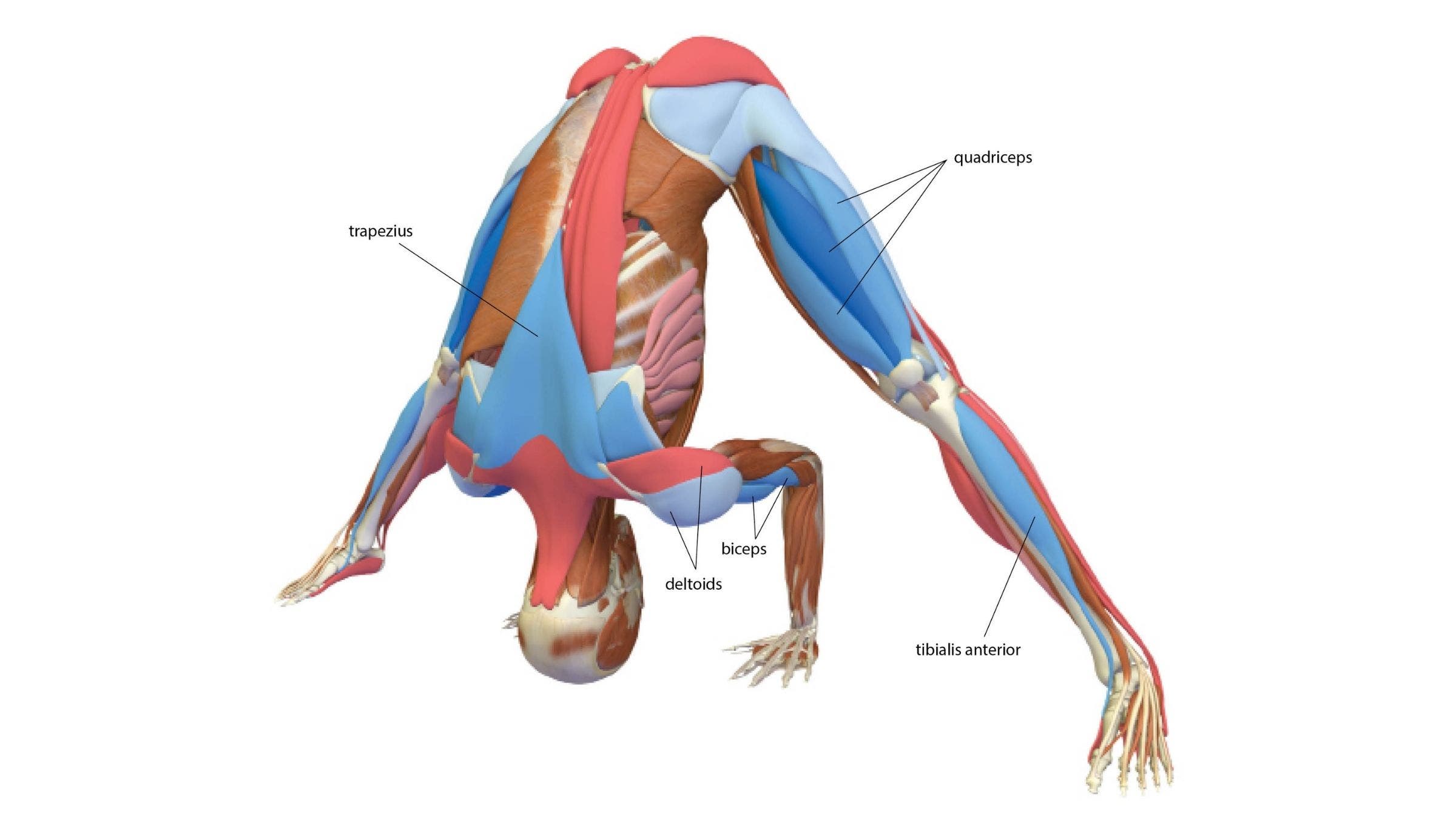
This pose stretches the entire back body, including the hamstrings, the gastrocnemius and soleus complex, adductor magnus, gluteus maximus, quadratus lumborum, and erector spinae muscles. Lift the arches of your feet by activating the tibialis anterior and posterior. Balance inversion of the ankles with a slight eversion force by pressing the balls of your feet into the mat. This engage the peroneus longus and brevis muscles at the outside of the lower legs to stabilize your ankles.
In Prasarita Padottanasana D (as in the illustration above), press the palms into the mat and rotate them externally. This activates the infraspinatus and teres minor muscles of the rotator cuff. Draw your shoulders away from your ears using the lower third of the trapezius. Note how these two actions open your chest and deepen the flexion of your trunk.
Excerpted with permission from The Key Poses of Yoga and Anatomy for Vinyasa and Standing Poses by Ray Long.
Put Wide-Legged Standing Forward Bend into practice
Ready to put this forward bend into practice? Here are a few flows to try:
10 Grounding Poses to Balance Your Vata Dosha This Fall
A Calming Yoga Sequence to Help You Slow Down
6 Yoga Poses for People Who Sit All Day
ADVERTISEMENT
About our contributors
Teacher and model Natasha Rizopoulos is a senior teacher at Down Under Yoga in Boston, where she offers classes and leads 200- and 300-hour teacher trainings. A dedicated Ashtanga practitioner for many years, she became equally as captivated by the precision of the Iyengar system. These two traditions inform her teaching and her dynamic, anatomy-based vinyasa system Align Your Flow. For more information, visit natasharizopoulos.com.
Ray Long is an orthopedic surgeon and the founder of Bandha Yoga, a popular series of yoga anatomy books, and the Daily Bandha, which provides tips and techniques for teaching and practicing safe alignment. Ray graduated from the University of Michigan Medical School and pursued post-graduate training at Cornell University, McGill University, the University of Montreal, and the Florida Orthopedic Institute. He has studied hatha yoga for over 20 years, training extensively with B.K.S. Iyengar and other leading yoga masters, and teaches anatomy workshops at yoga studios around the country.
